Book Recommendations
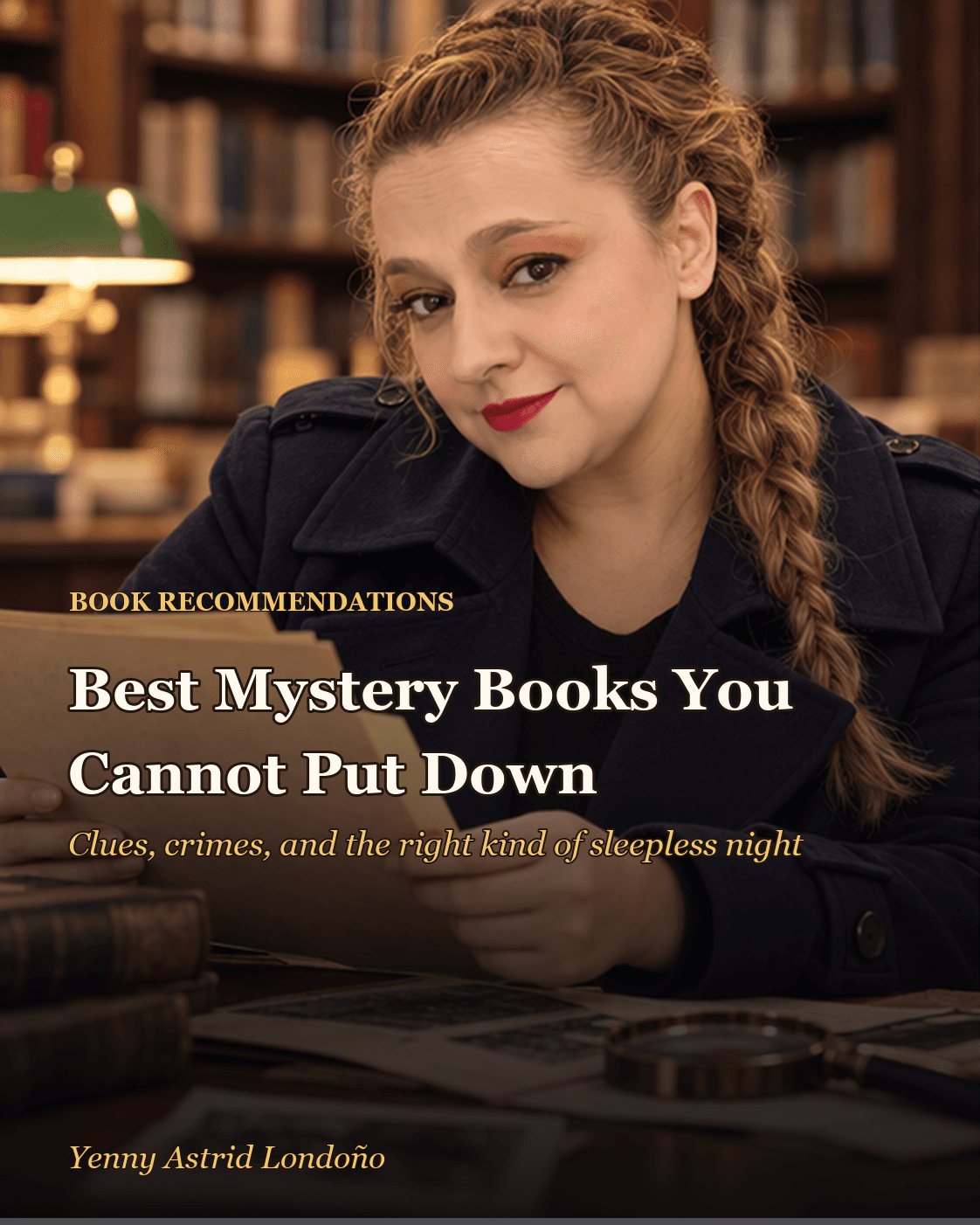
Best Mystery Books You Cannot Put Down: Eight Cases Worth Reading Suspiciously
A gripping mystery does not have to scream “unexpected twist” every two pages. It needs a question that matters, clues you can see differently afterward, and characters you would not trust with your house keys.
By Yenny Astrid Londoño · October 25, 2026 · 9 min read
Share
The short answer
For a fast mystery, try The Girl on the Train or The Fourth Monkey. If you want a room full of suspects, look at The Silent Patient or The Gypsy Bride. For something more classical or literary, The Name of the Rose and The Murder of Roger Ackroyd reward a different kind of patience. The best choice depends on what you want to solve: a crime, an identity, a family secret, or why somebody left a cup at the scene as though that were not extremely suspicious.
What this guide covers
- What makes a mystery gripping
- Books to read quickly while distrusting everyone
- Stories where every character looks guilty
- Mysteries for people who enjoy clues and details
- Investigation with social criticism
- How to choose without swallowing a spoiler
- A quick recommendation table
- Frequently asked questions
What makes a mystery gripping?
A mystery works when the book does not hand you the answer before you have had time to form the question. That does not mean hiding information through cheap tricks. It means distributing it: a scene that looks insignificant, a version of events that changes, a character who knows too much, or somebody who remembers with suspiciously convenient precision. The reader participates, yes, but should not need to work a second shift as a forensic detective to enjoy the novel.
It also helps when the investigation matters emotionally. If the only goal is discovering a name, the puzzle can feel like a crossword with corpses. Once we understand what the victim lost, what the suspect gains, or why a witness refuses to speak, every clue stops being decoration. That is when you say “one more chapter” and the clock says, “It is two in the morning and tomorrow still exists.”
This list mixes different styles because “mystery” is not one single experience. There is psychological suspense, police investigation, classic mystery, and historical fiction. They are not interchangeable, and it helps to know that before buying another cover with a dark house and a woman staring through a window.
To read quickly while distrusting everyone
The Girl on the Train, by Paula Hawkins, uses a narrator whose memory and alcohol use make her testimony difficult to trust. Rachel watches a couple she does not know from the train, invents a life for them, and then finds herself close to a disappearance. The attraction is not only asking what happened, but measuring how much of her account can stand. The first part takes its time; once the versions begin colliding, the book accelerates. In my review of *The Girl on the Train*, I explain why the mystery and the protagonist worked for me in very different ways.
The Fourth Monkey, by J. D. Barker, enters through a darker door. A serial killer leaves clues, and detective Sam Porter tries to read the pattern before the case claims another victim. The novel combines the investigation with fragments that widen the criminal's history. If you want something more graphic and tense than a drawing-room puzzle, this one has muscle. The trilogy requires checking the order if you plan to continue with Porter. I am not going to call it completely standalone so you can buy peacefully and then discover it left a door open the size of a garage.
A twist is not valuable because it shouts loudly. It is valuable because of the clues it leaves when you look back.
When every character deserves suspicion
The Silent Patient, by Alex Michaelides, begins with a woman who shoots her husband and then stops speaking. Theo Faber, a psychotherapist, wants to understand her silence and becomes involved in the case. The novel turns “Why did she do it?” into the engine of the story. If you like investigators with motives of their own, this narrative asks you to examine the patient and the person determined to interpret her.
The Gypsy Bride, by Carmen Mola, introduces Inspector Elena Blanco through a case that connects one brutal murder with an earlier crime. It is hard-boiled police fiction with an investigative team and a city that does not suddenly become kind because a badge entered the room. Check the English review archive for my full opinion and decide whether the tone suits you. The violence is explicit, and the recommendation comes with that information instead of an empty “You will love it.”
For readers who enjoy clues and details
The Murder of Roger Ackroyd, by Agatha Christie, is an excellent route into the construction of a classic mystery: small village, closed circle of suspects, carefully rationed information, and a narrator whose presence forms part of the mechanism. I am not saying more because the book depends on certain pieces arriving at the right moment. Its rhythm differs from contemporary thrillers. It works best if you accept that the novel will ask for your attention instead of chasing you through the house with an alarm.
The 7½ Deaths of Evelyn Hardcastle, by Stuart Turton, offers a more elaborate puzzle. Aiden Bishop wakes in a different body and must solve Evelyn's murder before the day resets. The structure can be tremendous fun if you enjoy narrative rules and connections. It can also be tiring if all you wanted was a simple bus-ride read. That is not criticism. It is a compatibility warning, which is more useful than selling everybody the same title.
Mystery with investigation and social criticism
The Name of the Rose, by Umberto Eco, is for readers who do not fear a medieval monastery, intellectual debates, and an investigation moving through a world crowded with ideas. William of Baskerville and Adso attempt to understand a series of deaths in an abbey. There is a mystery, but there is also history, religion, knowledge, and power. I would not hand it to somebody asking for “something short for tonight.” It may be perfect for anyone who wants the mystery to open more doors than the culprit's identity.
If you prefer contemporary police fiction with social context, The Gypsy Bride offers an investigation and its procedures, while The Fourth Monkey leans toward the serial killer and the pursuit. That is why labels matter: two books with bodies can leave radically different sensations. In my review of *The Fourth Monkey*, I explain its particular type of tension. For other cases, the English review archive works as a reading map.
How to choose without swallowing a spoiler
Read the premise and look for three signals: who investigates, what kind of crime appears, and which tone dominates. If the synopsis promises unreliable memory, contradictory versions, and intimate secrets, it probably leans toward psychological suspense. If it talks about clues, suspects, and an investigation, it will be closer to police fiction or classic mystery. If it promises a serial killer and graphic details, check the violence level before opening it. You do not need the final paragraph of somebody else's review. Some people label a post “spoiler free,” explain the twist, and place a shocked emoji beside it.
You can also decide how much work you want to do as a reader. A fast mystery moves you from scene to scene. A puzzle expects you to observe and remember. A literary mystery may allow the investigation to coexist with other questions. None is better because it has more pages or kills faster. They serve different moods.
Do not buy only a book with a twist. Ask what the story expects you to do while you wait for that twist.
Some mysteries make you run after the clue. Others make you sit still and notice who stopped talking.
Quick recommendation table
Book: The Girl on the Train
Type of mystery: Psychological
It may suit you if…: Memory, perception, and competing versions interest you
Keep in mind…: The beginning is deliberate
Book: The Fourth Monkey
Type of mystery: Serial killer
It may suit you if…: You want dark tension and an urgent investigation
Keep in mind…: It contains graphic violence and continues as a series
Book: The Silent Patient
Type of mystery: Psychological
It may suit you if…: A central question about silence and motive attracts you
Keep in mind…: Go in without searching for spoilers
Book: The Gypsy Bride
Type of mystery: Hard-boiled police fiction
It may suit you if…: You want an inspector, a team, and a brutal case
Keep in mind…: The violence is explicit
Book: The Murder of Roger Ackroyd
Type of mystery: Classic clue mystery
It may suit you if…: You enjoy observing suspects and narration
Keep in mind…: It asks for attention and patience
Book: The 7½ Deaths of Evelyn Hardcastle
Type of mystery: Narrative puzzle
It may suit you if…: You enjoy rules, repetition, and complex structure
Keep in mind…: It can feel demanding
Book: The Name of the Rose
Type of mystery: Historical and intellectual
It may suit you if…: You want ideas and history beside the mystery
Keep in mind…: It is denser than a fast thriller
Frequently asked questions
What is the best mystery book for a beginner?
If you want contemporary pace, try The Girl on the Train. If you prefer classic clue-solving, begin with Agatha Christie. The best entrance depends on whether you want to distrust a narrator, study a group of suspects, or follow a police investigation.
Which mystery novel has an unexpected twist?
The Silent Patient and The Girl on the Train are popular psychological-suspense choices. To avoid ruining them, do not search for ending explanations before finishing.
Which mystery book is a fast read?
Thrillers with short chapters, such as Red Queen or The Girl on the Train, usually move quickly, although every reader's pace differs. If you need something genuinely short, check the page count of your edition.
Which classic mystery do you recommend?
The Murder of Roger Ackroyd, by Agatha Christie, is famous for its construction of clues and narration. Enter without reading summaries of the ending.
Are there mysteries with police investigation and social criticism?
Yes. The Gypsy Bride combines Inspector Elena Blanco's investigation with a story involving violence, power, and inequality. It is a hard read, and its explicit content matters.
What is the difference between a mystery and a thriller?
A mystery usually centers the experience on discovering what happened and how the clues connect. A thriller prioritizes tension, danger, and urgency. Many novels mix both mechanisms.
How can I find a mystery novel without seeing spoilers?
Read the publisher's premise, check content notes, and look for reviews that clearly separate plot description from opinion. Avoid searches containing phrases such as “ending explained” until you finish.
A case that actually fits you
If you want speed, choose a thriller. If you want to sit and solve, find a clue mystery. If you want an investigation with characters and social context, try hard-boiled or noir fiction. The cover may be beautiful, but it does not have to decide for you. We already give far too much power to people we do not know.
And if a story does not hook you, that does not mean you are reading incorrectly. Maybe that day you did not want a medieval monastery, an unreliable witness, or a detective with more trauma than sleep. Try another route, visit Yenny's English review archive, and choose the case that makes you want to stay awake—although not necessarily until three.
Sources for book information
Frequently asked questions
What is the best mystery book for a beginner?
If you want contemporary pace, try The Girl on the Train. If you prefer classic clue-solving, begin with Agatha Christie. The best entrance depends on whether you want to distrust a narrator, study a group of suspects, or follow a police investigation.
Which mystery novel has an unexpected twist?
The Silent Patient and The Girl on the Train are popular psychological-suspense choices. To avoid ruining them, do not search for ending explanations before finishing.
Which mystery book is a fast read?
Thrillers with short chapters, such as Red Queen or The Girl on the Train, usually move quickly, although every reader's pace differs. If you need something genuinely short, check the page count of your edition.
Which classic mystery do you recommend?
The Murder of Roger Ackroyd, by Agatha Christie, is famous for its construction of clues and narration. Enter without reading summaries of the ending.
Are there mysteries with police investigation and social criticism?
Yes. The Gypsy Bride combines Inspector Elena Blanco's investigation with a story involving violence, power, and inequality. It is a hard read, and its explicit content matters.
What is the difference between a mystery and a thriller?
A mystery usually centers the experience on discovering what happened and how the clues connect. A thriller prioritizes tension, danger, and urgency. Many novels mix both mechanisms.
How can I find a mystery novel without seeing spoilers?
Read the publisher's premise, check content notes, and look for reviews that clearly separate plot description from opinion. Avoid searches containing phrases such as “ending explained” until you finish.
Share
Written by Yenny Astrid Londoño
Looking for the Spanish original? Read it in Spanish.
Keep reading