
Book review
The Girl on the Train:
Rachel rides past the same houses every day and invents a life for the couple she sees from the train. Then one of those lives breaks open, and her own memory becomes the least reliable witness in town.
By Yenny Astrid Londoño · October 7, 2026 · 8 min read
Share

The Book
The Girl on the Train
Psychological thriller
by Paula Hawkins
4 out of 5 stars
Rachel already had the blanks. He just showed up with a bloody pen.
Rachel takes the same train every day. From the window she watches a couple whose house stands near the tracks and imagines them as the kind of people she wishes she still were: attractive, stable, in love, living a life with no broken pieces visible from the carriage. The couple is not even the one she thinks it is. Then the woman disappears, and Rachel, who was near the scene and cannot remember everything she did, has information nobody wants to trust.
Paula Hawkins built this thriller around a brutal question: what happens when the person with a clue is also the person whose memory is easiest to dismiss? Rachel drinks heavily, has blackouts, and is still grieving the marriage she lost. The novel does not make her reliable just because she is the protagonist. It also does not make her useless just because she is messy. That distinction is the part I kept thinking about after I finished it.
Rachel’s train routine turns strangers into a private television show
Rachel’s daily route gives her a fixed view of the same houses, and she uses that repetition to create a story about the couple she calls Jess and Jason. She sees them for seconds at a time, then fills the missing parts with whatever she wants to believe. Their imagined relationship becomes a refuge from the life she has actually lost: her marriage to Tom, her home, and the future she thought she would have.
The detail matters because Rachel is not simply curious. She is building a fantasy with material she does not possess. I recognized the temptation to look at someone else’s life and assume it is better organized than ours. A smiling couple on a balcony, a pretty house, a person with their hair behaving: clearly the universe has given them a laminated instruction manual. Rachel’s view is incomplete, and the novel makes that incompleteness part of the danger.

Megan’s disappearance changes the meaning of every glimpse
When Megan Hipwell disappears, Rachel learns that the woman she watched is not a character in a comforting little romance. Megan has a history, desires, regrets, and secrets that do not fit Rachel’s version. The narrative lets the reader meet her through her own sections, which complicates the mystery instead of treating her as a body-shaped plot device.
Megan is not always admirable. She can be impulsive, evasive, and cruel. That does not make what happens to her less serious. One of the book’s better choices is allowing a woman to be complicated without suggesting that her flaws explain or excuse the violence around her. She is allowed to make bad decisions and still deserve safety. Imagine that: women are people, not morality lessons delivered with a soundtrack.
“Watching strangers through a train window is not evidence. It is a hobby with excellent potential for making things up.” — Yenny Astrid Londoño
Three women tell the story, and none has the full map
Rachel, Megan, and Anna give the book three different forms of limited knowledge. Rachel’s memories are damaged by alcohol and shame. Megan’s past arrives in fragments. Anna is living inside a marriage that Rachel still wants back and has her own reasons to distrust the woman at her door. Their accounts overlap, contradict, and shift the reader’s judgment.
That structure makes the book move quickly, but it also asks us to pay attention to timing. A detail that looks small in one section becomes important later; a confident explanation turns out to be a story someone needed to believe. I enjoyed that shifting perspective because it makes the reader do more than wait for the detective to announce the answer. We keep revising our private little theories—and discovering that some of them were assembled from the same scraps Rachel had.

The blackouts are a plot device, but they are also a vulnerability
Rachel knows she has lost time. She wakes with injuries, missing pieces, and the awful possibility that she has done something she cannot remember. The novel uses that uncertainty to make her a suspect in her own mind, which is a particularly cruel place to be. She cannot simply say, “I know what happened,” because she does not.
There were moments when the repeated blackout pattern tested my patience. It is a convenient suspense mechanism, and the plot leans on it more than once. But the vulnerability also has a purpose: Rachel’s drinking has made it easy for other people to dismiss her, including people who benefit from her confusion. The book’s central tension is not only whether Rachel can remember. It is whether anyone will take her seriously before she remembers everything.
Tom’s version of events is very comfortable for Tom
Tom appears in Rachel’s recollections as the stable husband she lost, then as the man who moved on with Anna. Rachel’s obsession with him can make her look like the obvious source of trouble. Anna has the marriage, the baby, and the house; Rachel has the train and a collection of memories she cannot fully trust. It is an arrangement designed to make one woman look unreasonable and another look secure.
The more the book reveals, the more I wanted to examine who had the power to define what happened in that marriage. Tom knows Rachel’s weaknesses and knows how other people see her. His calmness is not proof of innocence; sometimes it is just a useful costume. The novel understands that a person can exploit someone’s real flaws without needing to invent them. Rachel’s drinking is a problem. It is not a signed permission slip for everyone else to lie about her.
“The memory gap is bad enough. The man who benefits from it is worse.” — Yenny Astrid Londoño
What the suspense gets right, and where it gets repetitive
The rotating narrators, the suburban setting, and Rachel’s missing memories give the mystery a strong engine. Hawkins makes ordinary places feel exposed: the train, the street, a house you can see but never enter. The book is also good at turning envy into a source of bad information. Rachel wants the couple’s life to mean something, so she makes it mean something before she knows the people involved.
The same uncertainty can circle for a while, and the drinking-and-memory pattern gets repeated enough that I occasionally wanted the story to move on. Some character choices are frustrating in the very deliberate way thrillers enjoy: a person with a phone, a witness, and five minutes alone somehow still avoids the conversation that would save everyone time. But the underlying question stays sharp because the person with the strongest reason to speak is the person everyone has already decided not to believe.
Is The Girl on the Train still worth reading?
Yes, if you want a psychological thriller driven by unreliable memory, intimate relationships, and competing versions of the same event. It is not a police-procedural puzzle where the reader calmly sorts clues on a clipboard. It is a story about how grief, addiction, jealousy, and power shape the evidence people are willing to accept.
Rachel can be exasperating. She also has moments of courage and a stubborn instinct that survives even when her memory does not. Megan and Anna prevent the story from being only Rachel’s tunnel vision, while Tom’s role makes the domestic setting feel less safe than it looks. This is a fast, tense read with a few repeated turns, and it understands that “unreliable” is a description of how someone tells a story—not a reason to stop listening.
The book’s real discomfort is who gets believed
Rachel is flawed in ways that are visible, inconvenient, and easy to use against her. Tom’s version of events arrives with the advantages of composure and familiarity. Anna has a home and a new family; Megan is missing; Rachel is the woman with the drinking problem who keeps appearing where she should not. The novel turns that imbalance into suspense without pretending that Rachel’s behavior is harmless.
That nuance matters. Taking Rachel seriously does not require treating every memory as fact. It requires checking the evidence instead of deciding in advance that a person’s character makes her incapable of telling the truth. The book gives us a mystery, but it also gives us a small test of our own instincts: are we evaluating the account, or just choosing the person whose life looks easiest to believe?
“A narrator can be unreliable and still be the person everyone should have listened to.” — Yenny Astrid Londoño
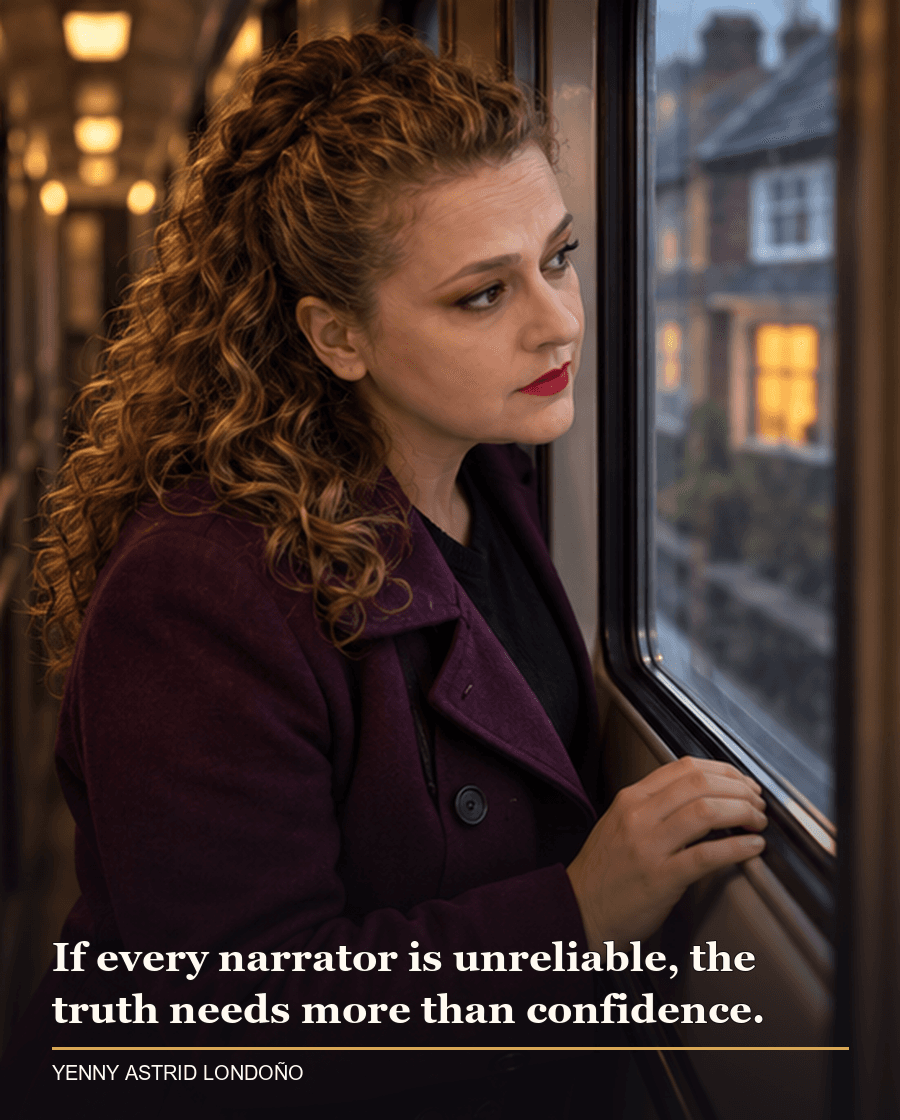
My verdict: a missing woman, a train window, and a memory someone else can use
The Girl on the Train succeeds because it puts the mystery inside the relationships. Rachel’s gaze through the window is incomplete, but so are the stories told by the people who live in those houses. The book asks us to watch how quickly we trust the composed person and doubt the visibly struggling one, especially when the composed person is the one controlling the explanation.
I liked the multiple perspectives, the way Megan’s story reworks Rachel’s assumptions, and the uncomfortable question of who gets believed. The repeated blackouts sometimes make the suspense work harder than it needs to, but the final picture has enough emotional bite to justify the journey. Rachel may not remember every minute. That does not mean the people who remember are telling the truth.
Frequently asked questions
What is The Girl on the Train about?
Rachel watches a couple from her daily train and becomes involved when Megan, the woman she has been watching, disappears. Rachel’s blackouts leave her unsure what she witnessed and what she may have done.
Is The Girl on the Train a psychological thriller?
Yes. Its suspense depends on unreliable memories, intimate relationships, shifting perspectives, and the question of which narrator has the most complete—and honest—version of events.
Who narrates The Girl on the Train?
The novel alternates among Rachel, Megan, and Anna. Their sections reveal different parts of the story and force the reader to revise earlier assumptions.
Is Rachel a reliable narrator?
No. Rachel struggles with alcohol and memory gaps, and she sometimes misunderstands what she sees. The book’s point is not that she should be trusted automatically, but that her flaws do not make every claim false.
Does The Girl on the Train contain spoilers in this review?
Yes. I discuss Megan’s disappearance, the three narrators, Rachel’s blackouts, and the truth about Tom.
What did Yenny think of The Girl on the Train?
I liked its shifting perspectives and its look at who gets believed in a marriage. The repeated blackout device occasionally slows the book down, but the central mystery and its uncomfortable social reading still work.
Is the first half of The Girl on the Train slow?
Yes, it drags on quite a bit. When the memories start coming back and the stories of Rachel, Megan and Anna finally come together, the book improves a lot. That's when I wanted to keep reading.
Is The Girl on the Train worth reading?
For me, yes, mostly because of Rachel. The first half drags and the train could have gone a little faster, but when the book really takes off, I couldn't put it down.
The Book
The Girl on the Train
by Paula Hawkins
Get the bookIf you buy through this link, Yenny earns a small commission and you pay the same price.
Keep reading
If you liked it, keep going

Javier Castillo
The Snow Girl
The Snow Girl: Kiera disappears and everyone moves on except her parents
Javier Castillo's The Snow Girl: Kiera vanishes at a New York parade and a tape reopens the case five years later. My honest review, 4 out of 5.
October 22, 2026

John Katzenbach
The Analyst
The Analyst: a birthday threat, fifteen days and a therapist who has lost control
John Katzenbach's The Analyst: a psychoanalyst gets fifteen days to find out who is threatening him. My honest review of this thriller.
October 22, 2026

Juan Gómez-Jurado
The Patient
The Patient: the President on the operating table and a daughter nobody can trade
Juan Gómez-Jurado's The Patient: a neurosurgeon, a President on the table and a kidnapped daughter in sixty-three hours. My honest review.
October 22, 2026
Want more like this? Join the Readers Club and get one of my books for free.
Share
My books
Books by Yenny Astrid Londoño



About the author
Yenny Astrid Londoño
Yenny Astrid Londoño is a Colombian author and entrepreneur, founder of Anchetas Medellín. She writes about real life with sarcasm, irony and smart humor, turning everyday situations, mistakes and imperfect relationships into stories that readers can laugh at and recognize themselves in.

A free book from me
Get a free book from me
Subscribe and get Sobreviviendo a mis muertos in full as a PDF.
After that, I'll only write when I have something worth telling you.
Also available: Read this review in Spanish →