
Book review
The Patient:
Juan Gómez-Jurado's The Patient: a neurosurgeon, a President on the table and a kidnapped daughter in sixty-three hours. My honest review.
By Yenny Astrid Londoño · October 22, 2026 · 7 min read
Share
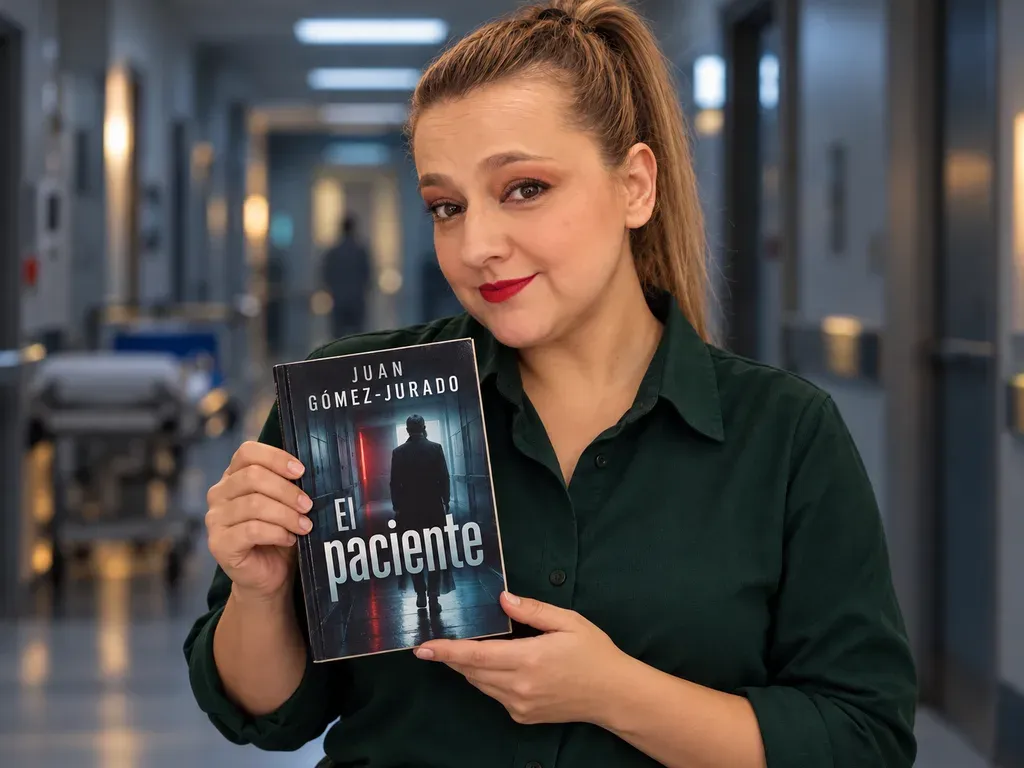
The Book
The Patient
Psychological thriller
by Juan Gómez-Jurado
More reviews by Juan Gómez-Jurado →
4 out of 5 stars
The dilemma is a kick in the stomach, and the countdown knows how to keep the pressure on.
David Evans is given the worst possible order
David is a neurosurgeon. His job is to open a skull and do everything he knows to help someone leave the operating room alive. Then a psychopath kidnaps Julia, David’s daughter, and changes the definition of success: if the next patient survives, the girl dies. David has to enter surgery with hands that have saved people and use them to do the opposite, or let the person he loves most be killed.
That premise is enough to ruin breakfast. But the patient is not a stranger; he is the President of the United States. The novel puts the life of a child and that of a head of state on a scale nobody should be allowed to build. The interesting question is not whether David is “good” or “bad.” It is who created a choice where every answer leaves blood behind.
Julia is not a number in the dilemma
When someone says “one little girl versus millions of people,” the arithmetic sounds simple from the couch. That is because the couch does not have a kidnapped daughter on it. Julia has a name, a face, habits, and a father who knows what her voice sounds like when she wakes up. The President is a person too, of course. But the antagonist uses the distance between them to make the decision almost unbearable.
It bothers me when thrillers reduce a threatened child to a photo that appears every twenty pages to remind the protagonist to hurry. Julia needs to matter as a person, not only as a red button in the plot. Otherwise the dilemma becomes an ethics exercise with family extras.
Sixty-three hours is barely enough time to regret things
The story unfolds over sixty-three hours. That clock works because every decision comes with incomplete information. David cannot ask for a week to weigh his options, sleep eight hours, and consult three experts on presidential kidnapping. He has to act while someone is watching him.
A short deadline gives suspense muscle, but it can also hand the author an excuse. If nobody checks something obvious because “there is no time,” I will notice. Urgency should complicate smart decisions, not replace them. I want to feel David doing the best he can under cruel limits, not leaving common sense in a drawer so the book can have more chapters.
Medicine has rules for exactly these days
A surgeon does not work alone. There is a team, protocols, records, and people watching what happens. That makes the blackmail more powerful and the story more demanding. David would have to alter a procedure under professional scrutiny, not shut a door and turn off the lights as if he were making a sandwich.
Medical ethics come up in hospital novels when they make a speech sound impressive. Here they should matter for real. David cannot separate his private life from his professional oath because someone has violently tied the two together. If he tries to save Julia by deliberately harming his patient, the consequences reach colleagues, institutions, and people who never got a say.
The President: person, symbol, and political problem
Making the patient the President raises the public stakes. His death could affect security decisions, markets, and international relations. But a job title does not automatically make someone more human than Julia, or make what happens to her less horrifying. I like that the novel makes both scales exist at the same time.
The reader will be tempted to say “I know exactly what I would do.” Sure. Some of us do not even know how we will react when we lose our wallet. Fiction lets us test our convictions without putting a real child in danger. The point is not to finish convinced we are heroic; it is to notice when we start negotiating principles that sounded unshakable yesterday.
The kidnapper has no right to call this a choice
Let me be clear: David is not freely choosing between two lives. He is being threatened. Moral debates sometimes erase the aggressor, leaving us to talk as if a father found a scale in his backyard. No. There is a psychopath who kidnapped a girl and intends to control an operation. The main blame has an address.
That does not erase the consequences of David’s actions, but it changes how I judge him. I get irritated when a story spends pages measuring a blackmail victim’s virtue and barely looks at the person who brought the gun. If we are going to discuss ethics, let us also talk about the power to manufacture impossible dilemmas for other people while watching from a safe distance.
Kate and help that does not come free
The publisher’s description introduces Kate, David’s sister-in-law and an FBI agent, whom he had not spoken to since his wife, her sister, died. David manages to reach her despite the surveillance. That relationship matters for more than her badge: help arrives tangled up with grief, family distance, and conversations nobody finished.
In a fast thriller, the federal agent can become a master key. She calls a contact, opens a database, and suddenly the problem improves. I hope not. Kate needs her own judgment; David should have to explain why he called now, and they should both carry the discomfort of needing each other. Families do not suspend old wounds just because an emergency starts. Sometimes the emergency puts them under a spotlight.
How lucky can a watched man get?
A desperate protagonist can be brilliant. He cannot succeed by decree. If David is watched and still manages to send messages, organize plans, and cross hallways exactly when cameras look away, the novel has to justify it. I love unlikely escapes when they are prepared. I get annoyed when the surveillance falls asleep because the next chapter needs it to.
A sixty-three-hour promise asks for precision about space and time. Who is with Julia? Who is watching David? What does the medical team know? I do not need a blueprint of the hospital, but I do need to feel that the world does not rearrange itself every time the protagonist needs a door. Tension works better when the rules still apply to the character we are rooting for.
What I did not like
The plan that forces David to kill or save the President depends on Julia’s kidnapping, surveillance of the doctor, and control over a presidential operation all lining up. The premise is powerful, but the antagonist’s logistics can feel almost too perfect. When blackmail organizes every piece with that much precision, I have trouble believing the freedom of movement the thriller needs.
Who should read it
Read it if you enjoy countdowns, blackmail, and moral dilemmas with no clean exit. If you want a realistic, slow medical novel, this one is aiming for high-voltage suspense. And if child kidnapping is a subject you would rather avoid, respect that limit. Life provides enough stress without paying for an extra dose.
I give it 4 out of 5 stars. David’s dilemma lands like a punch, and the countdown keeps the pressure on. I take one star off for the amount of control the kidnapper’s plan requires: even the best thriller has to remember that the hospital exists outside the villain’s head.
Frequently asked questions
What is the dilemma in The Patient?
David Evans has to operate on the President of the United States while a kidnapper threatens to kill his daughter, Julia, if the patient survives.
Who is the patient David Evans has to operate on?
The President of the United States. Julia's kidnapping turns that operation into the center of the blackmail that drives the novel.
How much time does the story cover?
The author sets the action against a countdown of sixty-three hours.
Who is Kate?
David's sister-in-law, an FBI agent, whom he manages to reach despite the surveillance.
Is The Patient a standalone novel?
Yes. Its central plot can be read on its own. The author lists it among the books connected to his narrative universe, but you don't need to start with Reina Roja.
Is it more a medical or a political thriller?
Both. The dilemma takes place during an operation, and the patient's identity gives it political consequences.
Does the review reveal what David decides?
No. It explains the public premise and analyzes its implications without revealing the resolution.
The Book
The Patient
by Juan Gómez-Jurado
Get the bookIf you buy through this link, Yenny earns a small commission and you pay the same price.
Keep reading
If you liked it, keep going

Javier Castillo
The Snow Girl
The Snow Girl: Kiera disappears and everyone moves on except her parents
Javier Castillo's The Snow Girl: Kiera vanishes at a New York parade and a tape reopens the case five years later. My honest review, 4 out of 5.
October 22, 2026
John Katzenbach
The Analyst
The Analyst: a birthday threat, fifteen days and a therapist who has lost control
John Katzenbach's The Analyst: a psychoanalyst gets fifteen days to find out who is threatening him. My honest review of this thriller.
October 22, 2026

Javier Castillo
The Soul Game
The Soul Game: a teenager is dead and someone still thinks it's a game
Javier Castillo's The Soul Game: a Polaroid of a bound girl, a 2011 murder and a suspense plot that sometimes crowds out the victims. Review, 3.5 out of 5.
October 21, 2026
Want more like this? Join the Readers Club and get one of my books for free.
Share
My books
Books by Yenny Astrid Londoño



About the author
Yenny Astrid Londoño
Yenny Astrid Londoño is a Colombian author and entrepreneur, founder of Anchetas Medellín. She writes about real life with sarcasm, irony and smart humor, turning everyday situations, mistakes and imperfect relationships into stories that readers can laugh at and recognize themselves in.

A free book from me
Get a free book from me
Subscribe and get Sobreviviendo a mis muertos in full as a PDF.
After that, I'll only write when I have something worth telling you.
Also available: Read this review in Spanish →