
Book review
The Soul Game:
Javier Castillo's The Soul Game: a Polaroid of a bound girl, a 2011 murder and a suspense plot that sometimes crowds out the victims. Review, 3.5 out of 5.
By Yenny Astrid Londoño · October 21, 2026 · 7 min read
Share
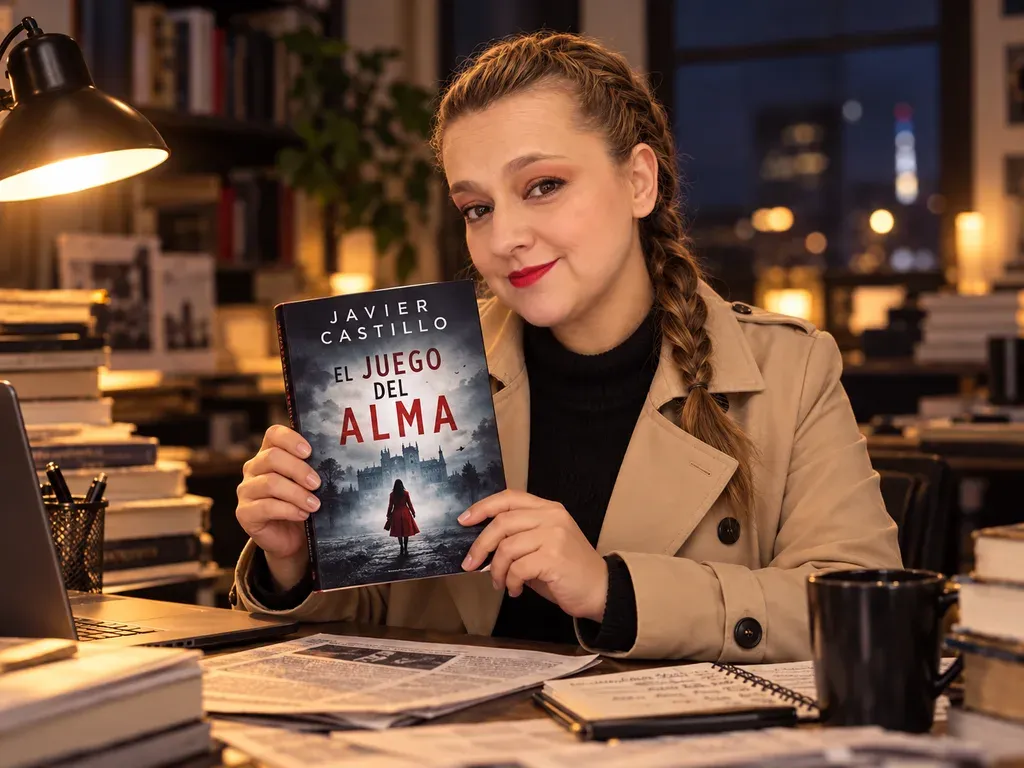
The Book
The Soul Game
Mystery
by Javier Castillo
More reviews by Javier Castillo →
3.5 out of 5 stars
Miren and the crossing of cases keep me inside; the violence against teenagers pushes me out each time it seems more interested in impressing than in understanding.
A brutal opening that demands attention
New York, 2011. A fifteen-year-old girl is found crucified in a suburb. It is an image designed to stop us in our tracks, and it does. My question is what the novel does next with the person who was behind that image. When a victim is a teenager and the violence is staged for maximum shock, a thriller walks a narrow line between exposing control and using horror to make the reader gasp and turn the page.
I am not interested in praising a scene merely because it is awful. I want to know who this girl was, not only how she was found. The mystery has to hold on to the person at its center even while it arranges clues around her. Otherwise the book becomes very good at staging a crime and not as good at caring about its victim.
The Polaroid and the name Gina Pebbles
As Miren investigates, she receives an envelope with a photograph of another teenager, gagged and bound, marked ‘Gina Pebbles, 2002.’ Nine years separate the photo from the 2011 murder. A picture turns a person into a message; the sender chooses what we can see, when we see it, and who receives it.
Miren gets a clue. Gina gets no voice in the moment the photo is used. That imbalance interests me more than treating the image as a puzzle piece. Who has the right to use another person’s suffering to move an investigation? The thriller can turn the photograph into a breadcrumb, or it can make us uncomfortable about who controls the frame.
Miren is no longer arriving as a beginner
After The Snow Girl, Miren Triggs is no longer a journalism student discovering what it costs to pursue a story. She is an investigative reporter with experience, scars, and an instinct that probably turns on even when she would like to sleep. That makes her more capable, but also more likely to believe every clue is calling her personally.
The envelope is addressed to her, which feeds the idea that the case has chosen Miren. It is useful for suspense, and it raises a question about how much she needs the investigation to connect to her own life. Sometimes a person tells herself she is saving someone and is also trying to save an earlier version of herself. Both motives can be true; they do not make the same decisions wise.
An investigation shared with Jim Schmoer
Miren follows the clues with Jim Schmoer, her former journalism professor. I like that the case is not solved by an omniscient heroine who has a factory-installed clue detector. A second investigator can bring disagreement, experience, and the possibility that Miren is wrong.
The old arrangement where a professor explains everything while the woman does the dangerous part would bore me. A useful partnership lets both people make mistakes and carry consequences. A line like ‘I know someone’ does not make a case believable by itself; the search becomes convincing when evidence takes time and witnesses do not answer like they have seen the script.

The religious institution: history or sinister wallpaper?
The trail reaches a religious institution with strange rituals. It is a potent setting, but the genre has opened this box often: dark hallways, symbols, someone warning us not to go inside. We know the building has secrets. I would also like the people inside it to have reasons that are more specific than ‘the atmosphere needed to get creepier.’
The institution becomes genuinely frightening when we ask who decides what stays hidden, whose reputation the rules protect, and what happens when an adult in authority defines a teenager’s body or obedience. A ritual can provide atmosphere. A structure that blocks someone from reporting abuse gives the story a deeper source of fear.
Two cases, nine years, and one uncomfortable question
The connection between the girl found in 2011 and Gina Pebbles in 2002 is the novel’s central promise. I will not spoil the answer. What matters to me is the structure of the question: if two cases years apart touch, somebody had time to build or maintain the silence between them.
Thrillers love a brilliant criminal organizing life like a chessboard. Sometimes the accomplices are less theatrical: an adult avoiding trouble, a superior protecting an institution, a neighbor deciding it is not their business. They do not appear on the dramatic photograph, but they can do a lot to help silence survive. The book asks us to look beyond the person who staged the scene.
What I did not like: suspense can crowd out the girls
The story brings together the crucifixion, Gina’s photograph, a religious institution, and several layers of mystery. The density keeps the questions coming, but it can leave too little room to process the girls as people. The device works for suspense; it frustrates me when the violence seems to exist mainly to prepare the next revelation.
I rate the novel 3.5 out of 5 stars. Miren’s investigation and the connection between the two cases kept me involved. The violence against teenagers pushed me away whenever it seemed more interested in shocking me than understanding what happened to them. A photograph can open a case; it should not close off Gina’s humanity.

Journalism and the temptation to make pain a spectacle
Miren has to decide not only what she can discover, but what to publish and when. A name might help locate someone or expose them again. A photograph can bring forward a witness, or turn suffering into clicks. Journalism’s ethics live in those decisions, not in a beautiful speech at the end.
Whoever sent the envelope knows a reporter has an audience and may be using that platform to steer attention. That is the kind of manipulation I want the book to take seriously. A source is not automatically a victim asking for help just because the information is dramatic. Sometimes the person handing you a story is also choosing what you are allowed to see.
Should you read The Snow Girl first?
I recommend starting with The Snow Girl. The Soul Game has its own case, but it is the second Miren Triggs novel, and the earlier book gives context for who she is and why some parts of this investigation reach her so deeply. Starting with book two is possible, like arriving at a family gathering two hours into an argument. You can follow along, but someone will have to explain the names.
Choose this if you like dark thrillers with parallel timelines, investigative journalism, and institutional secrets. If you want something light or prefer not to read about violence against teenagers, pick another book. No one earns a medal for forcing a story that is not right for them. The central question is compelling; the book works best when it lets that question coexist with the girls’ humanity.
Gina Pebbles is not just another clue
The Polaroid connects two cases and forces Miren into a story that started before she entered it. That is a solid engine for a thriller. My reservation is also the standard I bring to it: the more shocking the image, the more the novel owes the person in it. Suspense is not a permission slip to turn a victim into a prop.

Frequently asked questions
Journalist Miren Triggs investigates a teenager’s staged murder and a disturbing photograph of another girl, Gina Pebbles, that appears to connect the cases across nine years.
I recommend it. The Soul Game has a new case, but it is the second Miren Triggs novel, and the first book provides useful context for her character.
Miren is an investigative journalist who receives a photograph that draws her into a case involving two teenage girls and an institution with its own secrets.
It has a central investigation, but it continues Miren Triggs’s story from The Snow Girl and is best read in sequence.
Yes. It depicts violence against teenagers and includes a staged murder and a photograph of a bound girl. Readers who avoid those themes should take that into account.
I rate it 3.5 out of 5 stars. The investigative premise holds my attention, while the use of violence against teenagers sometimes feels more shocking than illuminating.
Frequently asked questions
What is The Soul Game about?
Miren Triggs investigates the murder of a teenager in New York in 2011 and receives a Polaroid pointing to Gina Pebbles, another young woman photographed in 2002.
Is it the sequel to The Snow Girl?
Yes. The publisher places it within Miren Triggs's series, after The Snow Girl.
Who is Jim Schmoer?
Miren's former journalism professor, who accompanies her in the investigation.
Does a religious institution appear?
Yes. The publisher's synopsis says the clues lead them to an institution with strange rituals.
Does the novel deal with violence against minors?
Yes, that is a central element of the premise. Check a sample if it's a sensitive topic for you.
Is The Soul Game a religious horror novel?
It is an investigative thriller: the religious institution and its secrets are part of the case, along with the crucifixion of a teenager and the photo of Gina Pebbles.
The Book
The Soul Game
by Javier Castillo
Get the bookIf you buy through this link, Yenny earns a small commission and you pay the same price.
Keep reading
If you liked it, keep going

Javier Castillo
The Snow Girl
The Snow Girl: Kiera disappears and everyone moves on except her parents
Javier Castillo's The Snow Girl: Kiera vanishes at a New York parade and a tape reopens the case five years later. My honest review, 4 out of 5.
October 22, 2026
John Katzenbach
The Analyst
The Analyst: a birthday threat, fifteen days and a therapist who has lost control
John Katzenbach's The Analyst: a psychoanalyst gets fifteen days to find out who is threatening him. My honest review of this thriller.
October 22, 2026
Juan Gómez-Jurado
The Patient
The Patient: the President on the operating table and a daughter nobody can trade
Juan Gómez-Jurado's The Patient: a neurosurgeon, a President on the table and a kidnapped daughter in sixty-three hours. My honest review.
October 22, 2026
Want more like this? Join the Readers Club and get one of my books for free.
Share
My books
Books by Yenny Astrid Londoño



About the author
Yenny Astrid Londoño
Yenny Astrid Londoño is a Colombian author and entrepreneur, founder of Anchetas Medellín. She writes about real life with sarcasm, irony and smart humor, turning everyday situations, mistakes and imperfect relationships into stories that readers can laugh at and recognize themselves in.

A free book from me
Get a free book from me
Subscribe and get Sobreviviendo a mis muertos in full as a PDF.
After that, I'll only write when I have something worth telling you.
Also available: Read this review in Spanish →