Books & Reading
Psychological Thrillers Starring Women You Are Not Sure You Can Trust
Ten psychological thrillers starring women who lie, forget, stay silent, or get dismissed—and why readers end up doubting each one.
By Yenny Astrid Londoño · October 30, 2026 · 10 min read
Share

What we’re getting into
- Lying and not being believed are not the same
- Why thrillers distrust women so often
- Five ways to make a female protagonist suspicious
- Ten books and ten different reasons to doubt
- When mental health becomes a cheap trick
- The reader’s complicity
- What to read for each kind of suspicion
- Frequently asked questions
In a psychological thriller, a woman says she saw something. She drinks. She takes medication. She has a history of anxiety, grief, or a relationship that has been sanding down her confidence for years. The police look at her with that professional patience reserved for people already classified as a problem. Her husband smiles, speaks slowly, and seems so reasonable that you almost want to apologize for suspecting him.
Then we learn the woman was not wrong about everything. Maybe she forgot, exaggerated, or lied. Maybe she interpreted one piece incorrectly. But somebody used the cracks in her story to install a more convenient version. And we, brilliant readers supposedly immune to manipulation, helped carry in the furniture.
The formula appears so often because it touches a real fear: memory can fail, and reputation can decide who deserves credibility. When handled well, the doubtful protagonist is not a gimmick. She becomes the place where the novel examines power, perception, and storytelling. When handled badly, the woman gets reduced to wine, pills, and a final reveal that tries to turn a diagnosis into a plot.
Lying and not being believed are not the same
An unreliable narrator may hide information, misinterpret events, lie to herself, or tell only the part that serves her. A discredited protagonist may be telling the truth and still fail to make anyone listen. Sometimes both conditions live inside the same person, because life does not arrange its categories with the courtesy of a spreadsheet.
Rachel in The Girl on the Train has real gaps in her memory. Anna in The Woman in the Window mixes substances with obsessive observation. That changes what they can reconstruct. But the question does not end there. We also need to ask who exploits those weaknesses, who provides the alternative explanation, and why the calm man’s story usually receives better treatment than the woman’s disordered experience.
At the other end are Amy, Nina, and Amber: women who do not merely survive suspicion. They manage it. They understand the value of a staged scene, a coherent story, and an audience ready to believe the correct role. They are not passive victims of the narrative. They are executive producers.
Nobody believes a confused woman. Let her lie calmly, though, and people will hand her the microphone.

Why thrillers distrust women so often
Because credibility is narrative power. Whoever defines what happened controls the investigation, the marriage, the family, and the way the reader distributes blame. Psychological thrillers take that authority and make it unstable.
The genre also works with familiar social fears: the “hysterical” woman, the greedy wife, the obsessive mistress, the monstrous mother, the imperfect victim. Those labels are dangerously efficient because they allow everyone to stop listening. A strong novel exposes the mechanism. A weak one simply recycles it and hopes the twist looks like depth.
There is another, less elegant reason: a broken woman sells mystery. Alcohol, medication, trauma, and isolation have become common decorations. There is nothing wrong with writing those experiences. The problem begins when they exist only so the reader will dismiss the protagonist until the final chapter announces that she “was not that crazy.” Mental health should not work as a curtain the author closes whenever a clue needs hiding.
Five ways to make a female protagonist suspicious
- Type of doubt: Fragmented memory · What it creates: The reader reconstructs events from incomplete pieces · The narrative risk: Using amnesia as a convenient eraser
- Type of doubt: Altered perception · What it creates: We do not know whether the event happened that way · The narrative risk: Turning medication or diagnosis into a scare device
- Type of doubt: Silence · What it creates: Other people speak for the woman and project onto her · The narrative risk: Mistaking a missing voice for a missing will
- Type of doubt: Deliberate deception · What it creates: The protagonist controls the version · The narrative risk: Cheating by hiding thoughts she could not logically hide
- Type of doubt: Performed identity · What it creates: She plays the role other people expect · The narrative risk: Making the twist more important than the character
None of these tools is automatically good or bad. What matters is whether the novel leaves clues, develops consequences, and understands why this woman cannot—or will not—tell the complete truth.
Ten books and ten different reasons to doubt
1. The Girl on the Train: Rachel cannot remember, but somebody knows how to use that
Rachel watches a couple from the train and turns fragments of their life into a complete story. When a woman disappears, Rachel’s missing hours may contain something important. Alcohol damages her memory, but the novel does more than say, “Do not trust her because she drinks.” It shows how someone else can take ownership of those gaps and fill them with a useful version.
Rachel is unreliable in the most literal sense: she cannot guarantee what she did or saw. Dismissing her entirely, however, is also a choice that benefits someone. Rachel already had the blank spaces. Somebody simply arrived with a goddamn pen. Read my review of *The Girl on the Train*.
2. The Woman in the Window: Anna sees, but watching is not the same as knowing
Anna lives in isolation, watches her neighbors, drinks, and mixes alcohol with medication. Then she says she witnessed a murder. Her credibility goes on trial before the investigation begins.
The book works when it holds two questions at once: did she see something real, and did she interpret it correctly? Anna can be vulnerable, perceptive, and mistaken without one quality canceling out the others. Read my review of *The Woman in the Window*.
3. The Silent Patient: Alicia says nothing, so everyone else explains her
Alicia shoots her husband five times and stops speaking. That absence of testimony creates an enormous space for doctors, family, the press, and readers. Theo Faber arrives convinced that he can discover the reason and restore her voice. It sounds noble until you notice how badly he needs to be the man who solves her.
Alicia’s silence does not make her empty. It exposes everybody else’s projections. She stopped talking, and all of us made the mistake of listening to Theo. Read my review of *The Silent Patient*.
4. Verity: a manuscript feels honest until you remember who wrote it
Lowen finds a text attributed to Verity Crawford. The voice is intimate, brutal, and so specific that treating it like a confession feels natural. But a manuscript is still a narrative. It has intention, audience, selection, and possibly a lie dressed as honesty.
Doubt spreads across the woman who wrote, the woman who reads, and the man who benefits from one version. Everyone lies. The problem is that we end up choosing our favorite liar. Read my review of *Verity*.
5. Gone Girl: Amy understands that the believable woman is a character
Amy does not wait for other people to interpret her story correctly. She designs it. She knows the gestures, expectations, and kind of woman the public wants to protect or punish. Nick has also constructed a version of himself. He simply did not realize he was competing with someone far more committed.
The novel asks more than whether Amy tells the truth. It asks why certain stories are so easy to consume. Marriage becomes an editing war in which both people believed they married a carefully revised version of the other. Read my review of *Gone Girl*.
6. The Housemaid: Nina does everything required to make us judge her quickly
Nina Winchester appears cruel, erratic, and chaotic. Andrew, meanwhile, arrives well dressed, kind, and reasonable. The roles come neatly packaged: she is the problem; he is the poor man trapped with her.
That is the mechanism. Nina understands how her behavior looks, Millie interprets what she sees, and Andrew enjoys the enormous credibility discount awarded to a man capable of speaking without raising his voice. Read my review of *The Housemaid*.
7. Behind Her Eyes: Adele never gives a version without calculating who will receive it
Louise knows David as a lover and Adele as a friend. Each relationship offers different information, and intimacy begins to look like privileged access to the truth. It is not. Learning a secret can bring you closer to someone—or turn you into the exact audience they needed.
Adele is unsettling because vulnerability and control remain tangled. The question is not only whether to believe her, but how much of what she shows was designed to lead Louise toward a particular conclusion. Read my review of *Behind Her Eyes*.
8. The Last Mrs. Parrish: Amber thinks she knows the marriage because she saw the photographs
Amber sees the house, jewelry, status, and the man who appears to pay for a perfect life. Daphne occupies the place she wants, so Amber builds a plan to replace her. The fine print of the marriage does not appear in the pictures.
Here, the deceptive perspective grows out of ambition. Amber is neither a neutral observer nor a confused victim. She sees exactly what she wants and calls anything that clears the path “truth.” Read my review of *The Last Mrs. Parrish*.
9. The Maidens: Mariana investigates a man she has already convicted
Mariana arrives at Cambridge convinced Professor Edward Fosca is connected to several murders. Her intuition may be valuable, but grief, personal ties, and the need to protect someone close to her all shape it.
The novel exposes a familiar problem: investigation is not only about collecting evidence. It is also about watching the story you have already decided to prove. To investigate Sebastian, Mariana first had to stop defending him. Read my review of *The Maidens*.
10. Rebecca: the second Mrs. de Winter lives inside someone else’s version
The narrator arrives at Manderley without even receiving a first name in the novel. Rebecca occupies the objects, memories, and devotion of everyone who knew her. The new wife does not doubt because she is manipulative. She doubts because everyone around her appears to possess a more authoritative version of the house, the marriage, and the dead woman.
Her insecurity makes perception fragile, but it also reveals how repetition can manufacture a presence. Rebecca does not need to speak to control the story. Read my review of *Rebecca*.
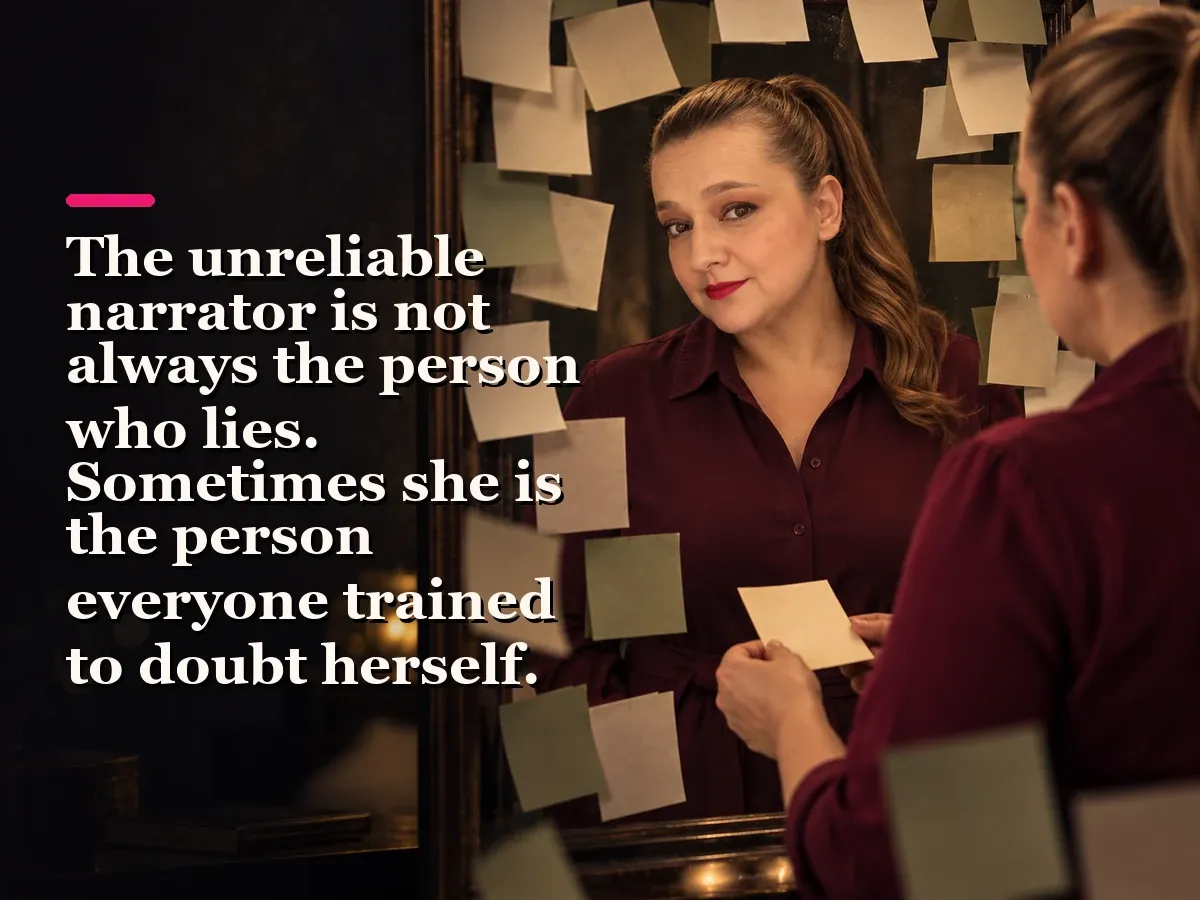
The unreliable narrator is not always the person who lies. Sometimes she is the person everyone trained to doubt herself.
When mental health becomes a cheap trick
Thrillers can explore trauma, addiction, anxiety, depression, grief, and isolation with depth. They can also use them as a smoke machine: the character takes medication, so every contradiction becomes possible; she has a diagnosis, so the novel feels authorized to hide whatever it wants.
The difference is consequence and humanity. A well-written psychological experience affects relationships, decisions, and perception in specific ways. It does not appear only to justify a twist. It does not turn the protagonist into a medical chart with legs.
Be suspicious when a book uses “she was crazy” as the entire explanation, treats medication as a synonym for danger, or includes a woman’s suffering only to make her look guilty. Uncertainty can be fascinating without using mental health as a Halloween costume.
The reader’s complicity
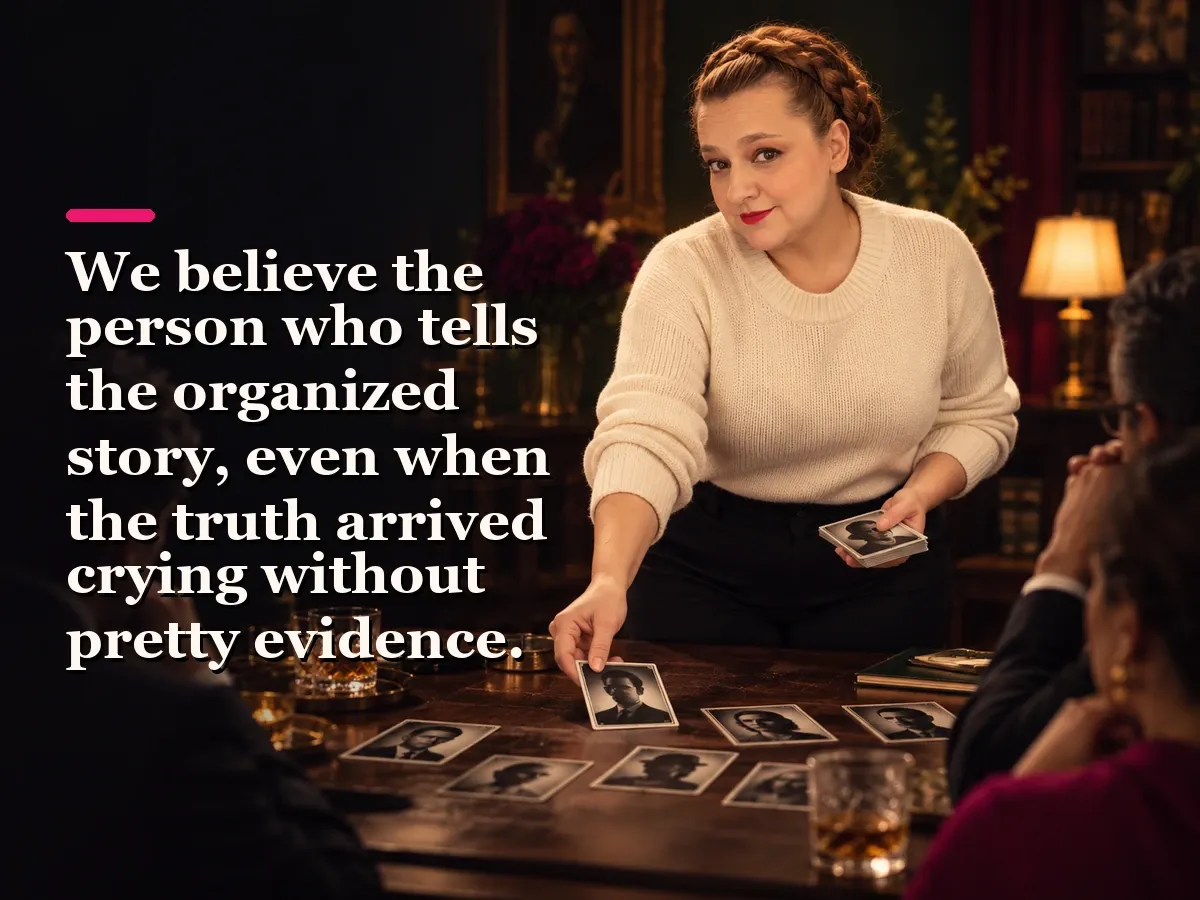
These novels are also about us. We believe people who tell organized stories. We doubt people who cry, contradict themselves, or cannot remember. We confuse composure with truth and chaos with guilt.
Good thrillers use those habits and then make us examine them. Saying “the author fooled me” is not always enough. Sometimes the clues were there, and we selected the more comfortable version. The husband was charming. The wife was difficult. The therapist used technical language. The patient said nothing. We distributed credibility as if we were not making moral decisions.
That makes the twist more interesting. It changes more than who committed the crime. It changes why we believed a particular person was capable of committing it.
What to read for each kind of suspicion
For fragmented memory: The Girl on the Train or The Woman in the Window.
For silence and projection: The Silent Patient or Rebecca.
For a woman actively controlling the narrative: Gone Girl, Verity, or Behind Her Eyes.
For domestic manipulation and appearances: The Housemaid or The Last Mrs. Parrish.
For an investigation shaped by grief and bias: The Maidens.
Do not choose only for the twist. Choose the kind of doubt you want to inhabit. There is a vast difference between forgetting, staying silent, not being heard, and lying with a perfectly organized filing system.
Belief has consequences too
The doubtful female protagonist will remain popular because she is a powerful tool. She forces us to read actively and turns truth into something built rather than received in a sealed package. But the device works best when the novel understands that credibility is not a neutral game.
Who gets to speak, who appears reasonable, who carries a diagnosis, and who receives the benefit of the doubt are decisions with history behind them. The strongest thriller does not use a broken woman as a curtain. It asks who broke her, who used the cracks, and why everyone else found it so comfortable to look away.
In the end, the question is not only “Do I believe her?” It is also: what would a woman have to do before I was willing to listen without waiting for perfect evidence?
Frequently Asked Questions
What is an unreliable narrator?
It is a voice whose version cannot be accepted without examination. The narrator may lie, forget, misinterpret, hide facts, or deceive herself. It does not mean everything she says is false.
What is a good psychological thriller with a female protagonist for beginners?
The Girl on the Train works if you like fragmented memory. The Silent Patient offers one clear central mystery. Gone Girl is ideal if you want a protagonist who understands and manipulates public expectations.
Why do so many female thriller protagonists drink or take medication?
The genre uses those conditions to destabilize perception and reduce a character’s social credibility. That can produce complex novels, but it has also become a repetitive and sometimes irresponsible shortcut.
Does an unreliable protagonist always lie?
No. She may tell an incomplete truth, remember incorrectly, or misunderstand what she saw. She may also be telling the truth while other people deliberately discredit her.
What should I read after The Girl on the Train?
Try The Woman in the Window for another discredited witness, Rebecca for insecurity and atmosphere, or Gone Girl if you want to move from a woman who doubts her memory to one who controls the story.
Do these books handle mental health responsibly?
Not all of them with the same care. Watch whether diagnosis and medication develop the character or merely excuse hidden information and manufacture fear.
Which of these thrillers has the most manipulative protagonist?
Amy in Gone Girl is the obvious reference because of her control over the public narrative. Adele in Behind Her Eyes, Verity through the manuscript, and Amber in The Last Mrs. Parrish also turn other people’s perception into strategy.
Share
Written by Yenny Astrid Londoño
Looking for the Spanish original? Read it in Spanish.