
Book review
Rebecca:
My review of Daphne du Maurier's Rebecca: Manderley, Mrs Danvers, Maxim and the cost of entering a marriage where the dead wife still owns the room.
By Yenny Astrid Londoño · October 9, 2026 · 10 min read
Share

The Book
Rebecca
Gothic and psychological suspense
by Daphne du Maurier
5 out of 5 stars
I give Rebecca 5 out of 5 for the narrator's voice, the force of Manderley and the way an absent woman can dominate a present life.
The narrator enters a life that already had a heroine
A young woman marries Maxim de Winter and comes to Manderley, where the memory of his first wife remains intensely present. We do not learn the new wife's given name. That contrast is no decorative trick: Rebecca owns the title, while the person speaking to us must struggle to claim a place in the story.
Marriage gives her a social name, Mrs de Winter, without guaranteeing an identity she can inhabit comfortably. She reads gestures as judgments and compares herself even before somebody says she should. Her insecurity does not arise in a vacuum. She is young and inexperienced, entering a household whose habits already carry authority. The environment can make her feel inadequate with remarkably little effort. Leave somebody alone with a standard she cannot see, and she may begin administering the exam to herself.
The narrator arrives young, uncertain and painfully aware of class. That makes comparison with Rebecca feel less like ordinary jealousy and more like an atmosphere she has to breathe. Nobody needs to stand over her and say she is inadequate; a remark about how the former mistress arranged a room will do the work. I was frustrated by her hesitations, then caught myself wanting her to show confidence in a household designed to punish precisely that.
Manderley is a system for sorting people, not just a big house
The mansion distributes memory, hierarchy and belonging through rooms, objects and routines. It is not merely a place where a secret might be hidden. It keeps telling the newcomer who lived here before and who knows how things are done. The architecture remembers a life without needing to say its name.
I like that much more than pages of expensive furniture offered as proof that a family is important. Manderley makes the narrator suspect herself whenever she is uncomfortable. She has been given a spectacular home; surely she should be grateful. What an inconvenient complaint to have in such a photogenic setting. Wealth can make unhappiness harder to name without making it less real. A huge room can still leave a woman very little space to move without being corrected.
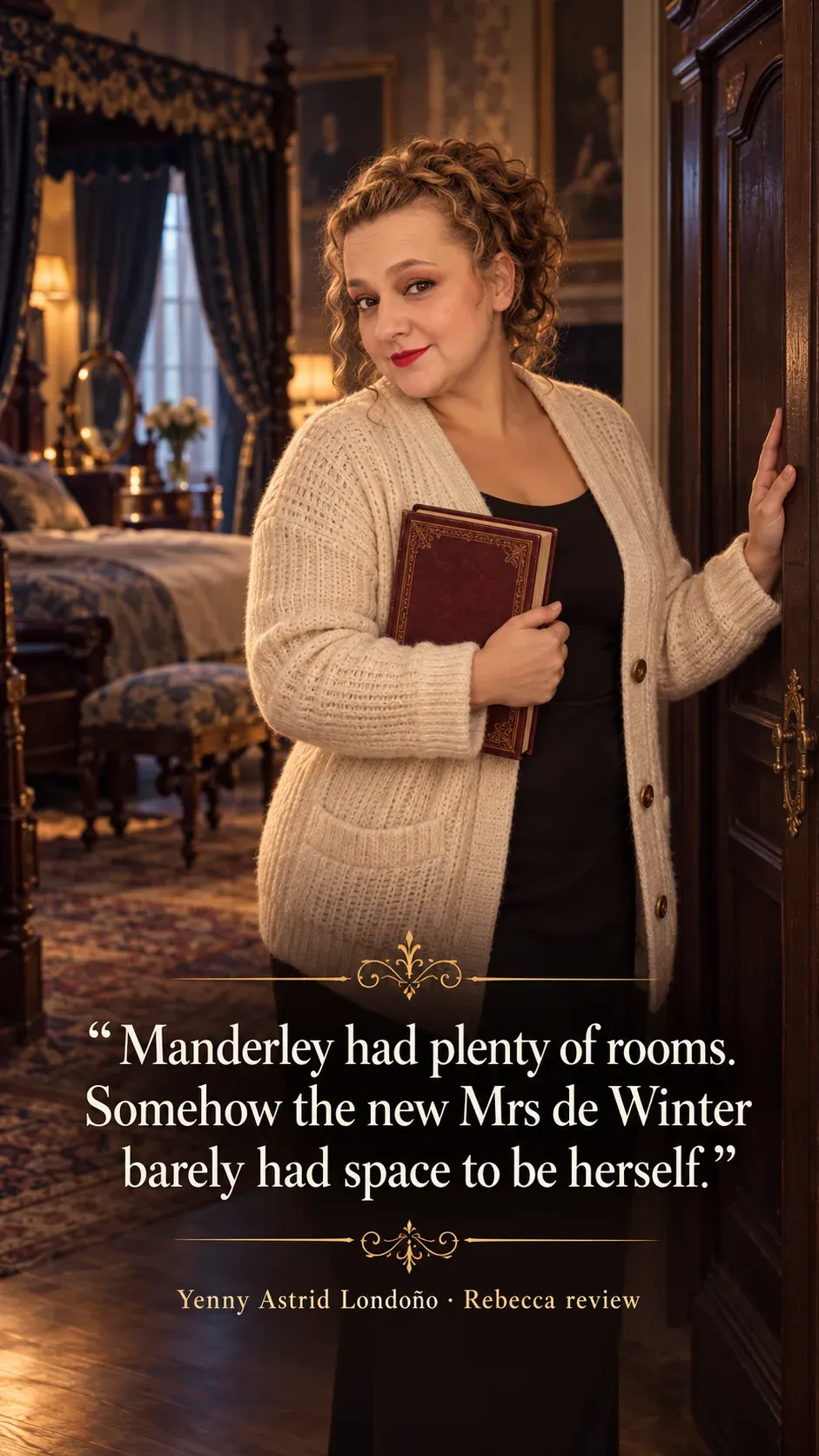
Manderley has rules about space, clothes, servants and who may occupy the center of a conversation. The house does not merely remember Rebecca; it teaches the new wife that she entered somebody else's finished picture. I understand why a grand estate can seduce a reader. I also want to ask who can afford to be comfortable in it and who must spend every meal trying to guess the correct performance. Beautiful rooms can be very efficient prisons when everyone calls them a privilege.

Mrs Danvers guards a memory that gives her power
Danvers is not simply an unpleasant housekeeper assigned to make the bride's life difficult. Her loyalty to Rebecca and her command of Manderley give her authority the newcomer does not possess. She knows the rules, and she can decide how to teach them. A domestic detail becomes a test when the teacher wants the student to fail.
Preserving a dead woman's memory is not inherently cruel. Using that preservation to keep another woman permanently below standard is a different choice. Danvers knows how to wrap control in fidelity. I would watch the small humiliations as closely as the dramatic scenes. You do not need a public confrontation every day to make somebody obedient. A well-timed reminder that Rebecca did things better can do the job before breakfast.
Mrs Danvers is unsettling because her loyalty to Rebecca gives her a kind of authority the new wife does not have. The narrator holds the title, but Danvers knows the routines and the history; she can make absence feel more present than a living person. I do not need to excuse her cruelty to see that she is defending a place in the household too. The struggle over memory is also a struggle over who gets to decide what this marriage means.
Maxim has a past; pain does not settle every question about him
The widower can seem like a wounded man whom his new wife ought to understand. I am willing to acknowledge grief. I am less willing to let it answer every question about his conduct. If he withdraws, people may explain his pain; if she asks what is wrong, people may diagnose her insecurity. That is an extremely generous distribution of understanding for the person who already owns the house.
The narrator tries to read Maxim through affection and limited information. Loving somebody can make you complete their silences in the way least threatening to your own hope. I will not expose his secrets here. I will say that a difficult history does not remove the responsibility to communicate with a person you have just brought into it. She should not have to solve the emotional terms of her marriage as if Manderley came with half its plans missing.
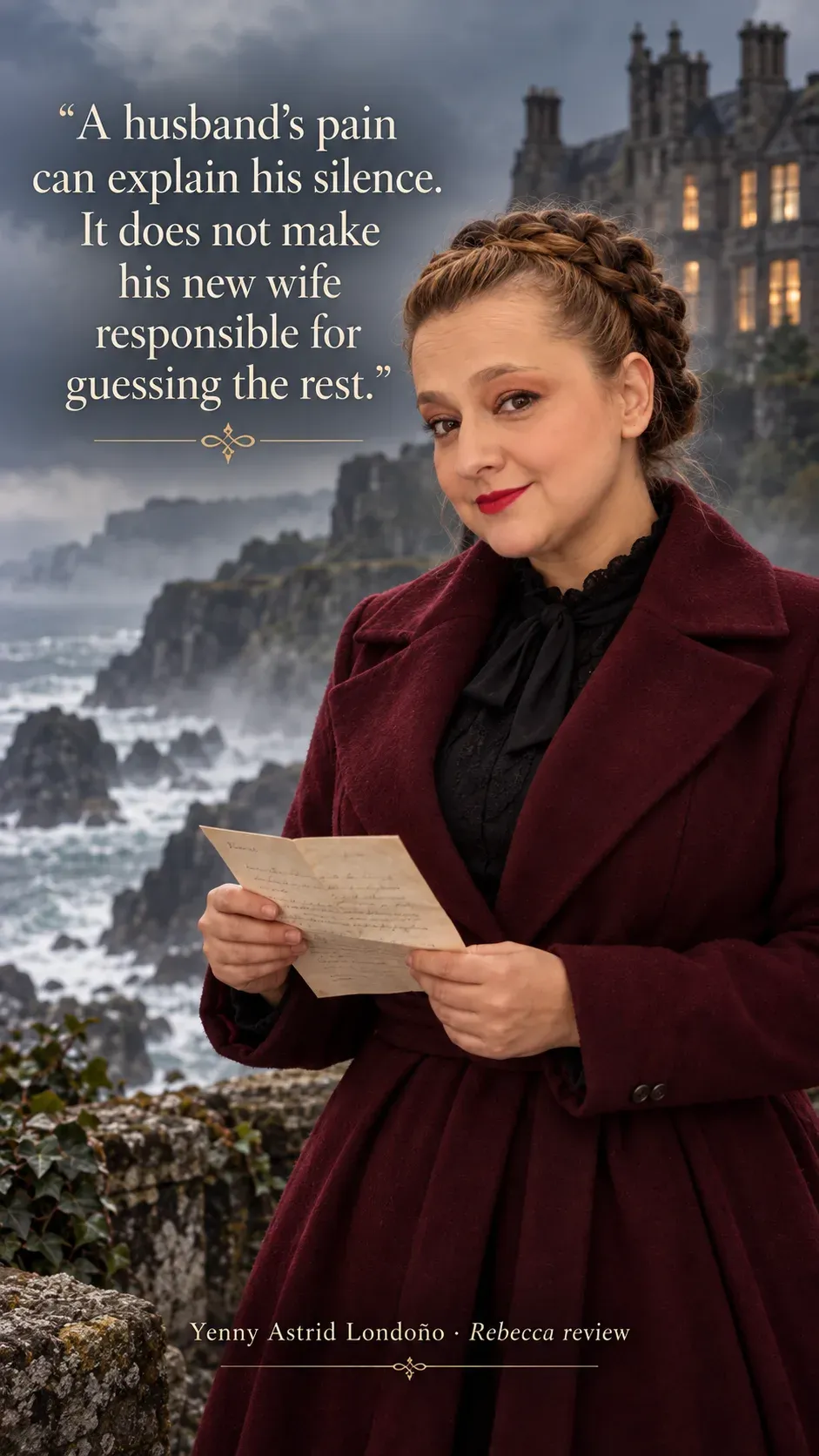
Maxim's reserve is often treated as a romantic wound the narrator should patiently heal. I cannot make that bargain so easily. Being troubled does not give a husband permission to leave his wife navigating an entire social world blindfolded. His silence shapes her fear and her self-doubt long before she can name what has been withheld. The book becomes more interesting when I stop asking only whether he loves her and start asking what his love requires her to swallow.
Rebecca exists in the versions other people need
The first wife is a memory, a comparison and a question. Because she is absent, others can describe her for their own purposes. Admiration can become intimidation; loyalty can become a means of control. The reader has to notice that a story about Rebecca always comes from somebody with a reason for telling it.
That is why the suspense exceeds the hunt for one hidden fact. A woman's public identity continues after she can no longer intervene in the conversation. I do not want to accept a perfect portrait as neutral evidence, and I do not want a later revelation to turn every complicated woman into a neat opposite label. The richer question is who gets to write Rebecca's story and what the narrator loses when the household makes that story the only one she is allowed to answer.
What did not work for me
The narrator's self-comparison requires patience. It has a purpose, and I understand why she keeps feeling out of place. I still had moments when I wanted to sit her down with coffee and tell her that she does not need to pass an examination in Rebecca before being allowed to eat breakfast in her own home. Repetition can make the pressure palpable; it can also make the reading slow.
I am also wary of how easily a reader may excuse Maxim because they want the romance to work. That trap is part of the book's value, but only if we notice ourselves stepping into it. And readers trained by contemporary thrillers to expect a revelation every few pages may find the atmosphere demanding. I would not call the slower rhythm an automatic flaw. I would say that my high rating does not mean every moment of the narrator's anxiety convinced me equally.
I did want the narrator to resist sooner, but that frustration is not a reason to declare the characterization weak. Du Maurier shows how steadily a person can be taught to distrust her own judgment. My sharper reservation is with moments when the story risks making a man's suffering feel like a complete answer to a woman's uncertainty. Explanation and absolution are separate jobs. A good gothic secret should open a moral question, not close it with a brooding profile.
Why it remains interesting without hiding behind the word classic
Rebecca does not need an assignment from a literature teacher to earn attention. Its central pressure still feels legible: entering a relationship where somebody else's identity seems to occupy every room and being taught to see yourself through the comparison. A classic can have faults and still keep asking a sharp question.
The novel also shows domestic power without needing visible violence in each scene. A silence, a custom and a carefully managed loyalty can decide who asks questions and who must adapt. Social rules have changed since the story's setting; that does not make the experience of being reduced by another person's narrative foreign. If you have seen a film adaptation, the book's access to the narrator's fears adds another layer. Manderley is frightening partly because of what she learns to expect inside it.
Who should read it, and how to enter Manderley
I recommend it to readers who enjoy Gothic suspense, patient atmosphere and relationships where power is rarely announced in a tidy speech. It is especially good for somebody who wants to discuss how a house and a marriage teach a woman to doubt her own place in them. Do not arrive expecting a linear police investigation or a heroine who answers every insult with confidence from page one.
I would also resist selling it as simply a romantic story about a widower and his young bride. That packaging leaves too much pressure out. Avoid explanations of Rebecca's past and Maxim's decisions before reading. For a book club, ask who defines a good wife, what authority Danvers gains by guarding memory and how much silence you would excuse from Maxim if the house belonged to somebody else.
My rating: 5 out of 5 for a woman who deserves her own room
I give Rebecca 5 out of 5 for the narrator's voice, the force of Manderley and the way an absent woman can dominate a present life. My reservations about repeated insecurity and easy excuses for Maxim remain. A high score is not a command to stop questioning the marriage.
The image that stays with me is a woman losing a comparison she never agreed to enter. She does not need to meet Rebecca to feel measured against her. Enough stories, rules and silences will do it. Manderley preserves one woman and examines another; Danvers manages the memory; Maxim carries secrets from a position of power. The new Mrs de Winter needs more than the answer to an old mystery. She needs a place where she is not required to live as the reply to a dead woman. What a workload for someone supposedly offered a wonderful new life.
The 4.7 is for a classic that still makes power feel domestic: a name spoken at dinner, a room preserved exactly, a servant who knows which comparison will wound. I would not recommend it merely because a syllabus says it is important. I recommend it because it lets me watch a woman trying to find a place in her own life while everyone else keeps handing her Rebecca's script. A house can have hundreds of rooms and still make its newest occupant ask permission to exist.
Frequently asked questions
Is Rebecca the name of the narrator?
No. Rebecca is Maxim de Winter's first wife. The new wife narrates, but her given name is never revealed.
Is Rebecca a romance or a suspense novel?
Marriage is central, but Gothic suspense and psychological pressure shape the book. Describing it only as romance misses much of the conflict.
Is Manderley merely the setting?
No. Its rooms, customs and stored memories help determine who belongs and who must adapt.
Does this review reveal Rebecca's secret?
No. I discuss her powerful absence and other people's versions without disclosing the decisive revelations or ending.
Will it feel slow if I usually read modern thrillers?
Possibly. Du Maurier spends time on atmosphere and the narrator's insecurity rather than delivering a twist every chapter.
Is it worth reading after seeing an adaptation?
Yes. The narrator's interior voice gives a different experience of the house and of the comparisons she fears.
Why do I rate Rebecca 5 out of 5?
The voice, Manderley and Rebecca's absent presence are remarkably effective. Repetition in the narrator's self-doubt and Maxim's treatment keep it short of five.
The Book
Rebecca
by Daphne du Maurier
Get the bookIf you buy through this link, Yenny earns a small commission and you pay the same price.
Keep reading
If you liked it, keep going

J. R. R. Tolkien
The Fellowship of the Ring
The Fellowship of the Ring by J. R. R. Tolkien: a dangerous mission and far too many people trusting a ring
An epic journey, friendship and a piece of jewelry that should come with a warning label. Here is my spoiler-light review of the first part of The Lord of the Rings. If you only know the films, the book takes longer to walk, talk, sing and tell you the history behind each place. Tolkien is not trying to get you to Mordor by taxi; first he wants you to understand why arriving matters.
October 27, 2026

J. R. R. Tolkien
The Hobbit
The Hobbit by J. R. R. Tolkien: a quiet home, a very rude wizard and one trip that should have come with a risk form
Bilbo Baggins likes comfort, good meals and not being disturbed before dinner. Then Gandalf and a company of dwarves arrive and decide he is exactly the person they need for a dangerous journey. This is my spoiler-light review of Tolkien’s The Hobbit, a classic adventure about courage, greed and the inconvenience of having a life-changing Tuesday.
October 26, 2026

Carlos Ruiz Zafón
The Shadow of the Wind
The Shadow of the Wind by Carlos Ruiz Zafón: you find a book, and the whole city tells you to forget it
Daniel Sempere enters the Cemetery of Forgotten Books and chooses a novel. I have made bad purchases, but none came with a stranger determined to destroy every copy.
October 23, 2026
Want more like this? Join the Readers Club and get one of my books for free.
Share
My books
Books by Yenny Astrid Londoño



About the author
Yenny Astrid Londoño
Yenny Astrid Londoño is a Colombian author and entrepreneur, founder of Anchetas Medellín. She writes about real life with sarcasm, irony and smart humor, turning everyday situations, mistakes and imperfect relationships into stories that readers can laugh at and recognize themselves in.

A free book from me
Get a free book from me
Subscribe and get Sobreviviendo a mis muertos in full as a PDF.
After that, I'll only write when I have something worth telling you.
Also available: Read this review in Spanish →