
Book review
The Silent Patient:
Alicia Berenson shoots her husband and never speaks again. Theo Faber becomes obsessed with getting her to talk. That is already a questionable professional boundary before the book starts hiding things from us.
By Yenny Astrid Londoño · October 6, 2026 · 8 min read
Share

The Book
The Silent Patient
Psychological thriller
by Alex Michaelides
More reviews by Alex Michaelides →
4.5 out of 5 stars
Alicia stopped talking, and all of us made the mistake of listening to Theo.
Alicia Berenson is a successful artist who shoots her husband Gabriel five times and then stops speaking. She is found guilty and sent to a secure psychiatric facility. Theo Faber, a psychotherapist, wants to treat her and discover why she has remained silent. He believes that getting Alicia to talk will be the key to understanding the crime.
Alex Michaelides gives us the shape of a classic puzzle: a woman who will not explain herself, a therapist who insists he can reach her, a diary that may expose the past, and a marriage whose public image is much cleaner than its private reality. The hook is strong. The question for me is not only what Alicia knows, but what Theo is doing with his certainty that he deserves access to it.
Alicia’s silence becomes the center of everyone else’s story
The crime is dramatic; Alicia’s refusal to explain it is what keeps the case open in the reader’s mind. She becomes a patient, an artist, a wife, a suspect, a symbol, and a mystery before she is allowed to be a person whose silence might belong to her. People interpret it as guilt, madness, manipulation, or a challenge they are entitled to solve.
I found that tension more interesting than the simple “what made her do it?” question. A person who cannot or will not speak is still surrounded by people eager to provide an explanation. Some want a diagnosis, some want a confession, and some want a satisfying ending. Theo wants to be the man who can finally make sense of her. That ambition may be professional, but it is also personal, and the book is better when we notice the difference.
Theo’s interest in Alicia does not stay professionally tidy
Theo pushes to work with Alicia and approaches the case with a determination that is not entirely clinical. He reads her art, follows clues from her life, and tries to build a path toward the moment she stopped speaking. His investment gives the novel momentum, but it also raises a reasonable question: is he trying to help Alicia, or trying to prove that he is the therapist who can solve her?
Therapy is not supposed to be a detective hobby with a vulnerable patient as the locked-room puzzle. The book knows Theo has his own emotional damage and history, but there are moments where his boundary-crossing is framed as dedication when it deserves more scrutiny. I wanted the story to take his professional behavior seriously instead of letting obsession wear a nice sweater and introduce itself as empathy.
“Silence can be a symptom, a choice, a shield, or all three. It is not an invitation for a man to write your story for you.” — Yenny Astrid Londoño
The diary offers a second version of Alicia
Alicia’s diary gives the reader access to her life before the shooting, especially her relationship with Gabriel and the events that shaped their marriage. That changes the novel’s structure: Theo’s investigation moves forward in the present while Alicia’s written account opens the past. The two timelines ask us to compare what is remembered, what is recorded, and what Theo believes he has figured out.
The diary is useful because Alicia stops being only the silent woman in the facility. Her own words bring back her voice, although they are still filtered through a written document and the assumptions of the people reading it. I liked that the book lets her perspective complicate the image of the perfect artist couple. Gabriel’s charm and their marriage’s public appearance do not answer what happened in private.
The marriage looks enviable from outside and strained from within
Gabriel and Alicia appear successful, attractive, and devoted. Their home and careers look like the kind of life people praise in public, which makes the violence seem impossible to explain. But a polished image is not a witness. The novel gradually lets us see tension, jealousy, and emotional pressure behind the couple’s visible success.
This is familiar territory for psychological thrillers, but it remains effective when the story treats appearances as evidence people choose to believe—not as proof that a relationship was healthy. A good portrait can tell you how someone wanted to be seen. It cannot tell you what happened after the guests left.
The Grove is a setting built to turn treatment into suspense
The secure psychiatric unit gives the story a contained environment full of rules, histories, and people who may not be able to tell their stories freely. Theo moves through the institution looking for access to Alicia, while other patients and staff hold fragments of information about her. The place is not just a backdrop; it changes what “help” and “control” look like.
Some of the facility’s atmosphere is heightened for thriller effect, and the novel sometimes treats access to a patient as a reward for Theo’s persistence. That made me pause. Alicia’s silence should not mean that everybody else gets to take turns deciding what she needs. The mystery benefits from her limited communication, but the story could have been more critical of the system that turns a patient’s privacy into an obstacle to be overcome.
“Theo says he wants to understand Alicia. He also wants a mystery that makes him the main character.” — Yenny Astrid Londoño
The twist reorders the clues, but it does not erase the questions
The book’s major reveal changes how the reader understands Theo’s narration and the timeline. Earlier details shift position, and scenes that seemed to belong to one person’s account take on a different meaning. The reveal is constructed to make readers reconsider what they were told and when they were told it.
I enjoyed the reorganization, though the twist is doing so much work that it invites a second look at the mechanics. A surprise can be clever and still depend on a narrator withholding information in a way that feels convenient. I also wanted more space for Alicia after the reveal. The puzzle’s answer is satisfying as a puzzle; Alicia’s life is more than the final mechanism that makes Theo’s story snap into place.
What works, and what made me raise an eyebrow
The premise is memorable, the dual structure makes the pages move, and the diary gives Alicia a presence beyond her silence. The novel is readable without being a complicated technical puzzle, and it knows how to plant small details that return with new weight. If you like narrators who make you rethink earlier chapters, this book has a strong final hand to play.
My reservations are about Theo’s professional boundaries, some of the facility’s treatment of patients, and the way the story sometimes uses Alicia’s silence chiefly to motivate a man’s investigation. The reveal also encourages us to admire the design before asking whether every character has been treated with enough psychological depth. I had fun reading it; I did not feel compelled to applaud every decision just because it came with a twist.
The patient is not a riddle just because the therapist wants an answer
The novel’s hook makes Alicia’s silence look like a locked door Theo must open. But treatment is not supposed to be an invasion with a sympathetic soundtrack. Alicia’s story is filtered through Theo’s project for much of the book, and the reader is invited to share his hunger for an explanation. That makes it even more important to notice the imbalance: he is the professional who controls access, while she is the patient whose actions have already been interpreted by everyone else.
I do not need the thriller to become a textbook, and the mystery can absolutely depend on withheld information. I do want the narrative to understand that a patient’s privacy is not a puzzle prize. The question “What happened?” matters. So does “Who gets to decide when her story is available?” The book raises that discomfort even when it does not always stay with it long enough.
“A twist can change the story. It cannot retroactively make every choice brilliant.” — Yenny Astrid Londoño
My verdict: a sharp twist and a patient who deserves more than to be solved
The Silent Patient is a compelling, fast psychological thriller with a premise that sticks: Alicia kills Gabriel and then refuses to explain herself; Theo makes understanding that silence his mission. The diary, the psychiatric setting, and the conflicting timelines create an effective trail of clues, and the final reveal makes earlier scenes look different.
I liked the pacing and the way the book rearranges its information. I was less convinced by Theo’s boundary-crossing and by how often Alicia becomes an object of interpretation instead of the center of her own story. The twist earns its surprise, but a clever ending does not make every ethical question disappear. I recommend it as a page-turner, with one note in the margin: wanting to understand someone is not the same as being entitled to them.
Frequently asked questions
What is The Silent Patient about?
Artist Alicia Berenson shoots her husband Gabriel and stops speaking. Psychotherapist Theo Faber becomes determined to treat her and discover what led to the crime.
Is The Silent Patient a psychological thriller?
Yes. It combines a violent mystery, an unreliable first-person account, a psychiatric setting, and a reveal that changes how earlier parts of the story are understood.
Why does Alicia stop speaking?
Her silence is central to the novel’s mystery. The story reveals the circumstances around it gradually through Theo’s investigation and Alicia’s diary, so the answer involves major spoilers.
Is Theo Faber a reliable narrator?
The reader should question his account. Theo has a personal investment in Alicia’s case, and the novel’s final revelation changes how his narration and timeline are interpreted.
Does Yenny’s review spoil the ending?
Yes. I discuss Alicia’s crime, Theo’s treatment of her, the diary, and the narrator reveal. Read it after finishing the novel if you want to avoid spoilers.
What did Yenny think of The Silent Patient?
I found it compelling and enjoyed the twist, but I wanted more scrutiny of Theo’s professional boundaries and more room for Alicia as a person beyond the mystery. It is a strong page-turner, not an excuse to stop asking ethical questions.
The Book
The Silent Patient
by Alex Michaelides
Get the bookIf you buy through this link, Yenny earns a small commission and you pay the same price.
Keep reading
If you liked it, keep going

Javier Castillo
The Snow Girl
The Snow Girl: Kiera disappears and everyone moves on except her parents
Javier Castillo's The Snow Girl: Kiera vanishes at a New York parade and a tape reopens the case five years later. My honest review, 4 out of 5.
October 22, 2026

John Katzenbach
The Analyst
The Analyst: a birthday threat, fifteen days and a therapist who has lost control
John Katzenbach's The Analyst: a psychoanalyst gets fifteen days to find out who is threatening him. My honest review of this thriller.
October 22, 2026
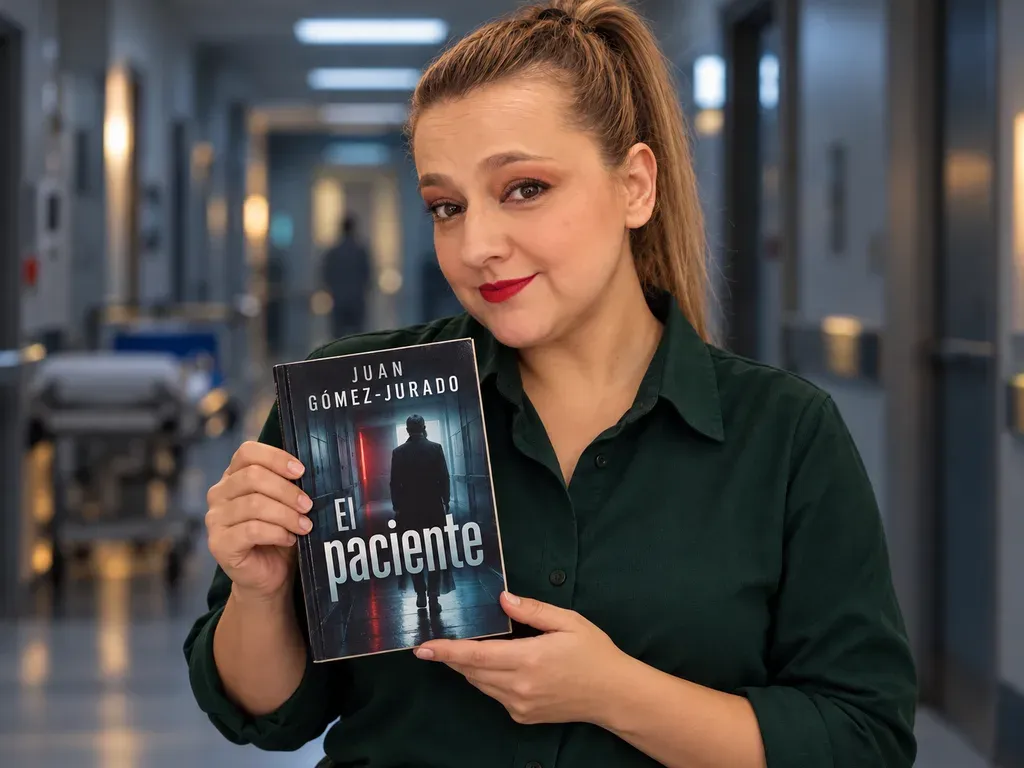
Juan Gómez-Jurado
The Patient
The Patient: the President on the operating table and a daughter nobody can trade
Juan Gómez-Jurado's The Patient: a neurosurgeon, a President on the table and a kidnapped daughter in sixty-three hours. My honest review.
October 22, 2026
Want more like this? Join the Readers Club and get one of my books for free.
Share
My books
Books by Yenny Astrid Londoño



About the author
Yenny Astrid Londoño
Yenny Astrid Londoño is a Colombian author and entrepreneur, founder of Anchetas Medellín. She writes about real life with sarcasm, irony and smart humor, turning everyday situations, mistakes and imperfect relationships into stories that readers can laugh at and recognize themselves in.

A free book from me
Get a free book from me
Subscribe and get Sobreviviendo a mis muertos in full as a PDF.
After that, I'll only write when I have something worth telling you.
Also available: Read this review in Spanish →