
Book review
Gardens of the Moon:
The Malazan Empire, meddling gods, assassins, mages, and absolutely no intention of introducing themselves politely. Getting in is hard. Getting out without wanting book two is harder.
By Yenny Astrid Londoño · November 12, 2026 · 10 min read
Share
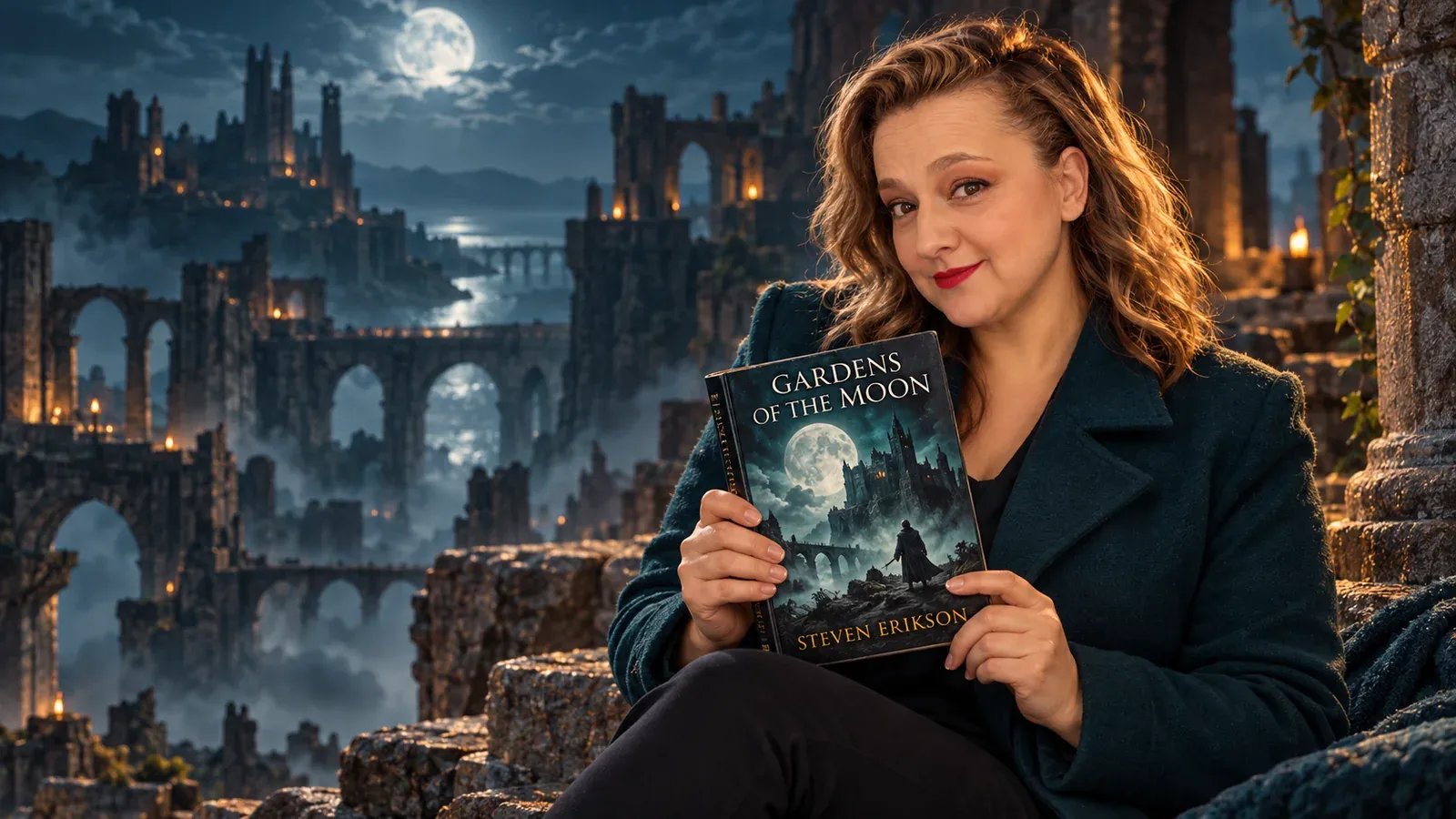
The Book
Gardens of the Moon
Epic and military fantasy
by Steven Erikson
4 out of 5 stars
An ambitious, humane, visually brutal entrance to Malaz. I am taking points off for emotional distance, abrupt viewpoint changes, and the book's habit of making you search for the door while it…
Some books meet you at the door, offer coffee, and introduce every character with a name, a job, and a brief inventory of their trauma. Gardens of the Moon kicks the door open, shoves you into a battle between mages, points at a floating fortress, and walks away as if you had been employed by the Malazan Empire for years.
For the first stretch, I felt like the guest who arrived late to a family meeting where everyone was already fighting over the inheritance. I caught pieces, suspected somebody had betrayed somebody else, and watched new names appear with the confidence of a novel that assumes you brought a notebook. The strange thing is that once the confusion begins to arrange itself, this world becomes difficult to leave. Not because Erikson suddenly develops a passion for hand-holding. He does not. It is because the noise starts revealing frightened soldiers, exhausted mages, petty gods, and ordinary people trying to survive plans designed by people who never set foot on the battlefield.
This is not a novel to read while checking your phone every three minutes. It is also not an intelligence test or a secret initiation for readers who enjoy bragging about literary suffering. It is demanding, uneven, wildly ambitious epic fantasy with flashes of unexpected tenderness. It asks for attention, yes. It does not require a tattooed genealogy of every Ascendant before you are allowed to have fun.
Pale is burning, and nobody has time for introductions
The story enters through the Siege of Pale, where the Malazan Empire has spent years trying to take a city protected by Anomander Rake and his flying fortress, Moon's Spawn. The name alone tells you subtlety missed the invitation. Here we meet Whiskeyjack's Bridgeburners, veteran soldiers who have survived too many campaigns and too many decisions made from distant offices. Tattersail and the imperial mages are there too, and within pages a magical battle leaves bodies, suspicion, and the reasonable impression that someone at the top is cleaning house with explosives.
Erikson does not present war as a parade of polished heroes. He presents a machine where glory belongs in speeches and the dirt stays with the people carrying bodies. Whiskeyjack and his soldiers follow orders, but they are not stupid. They know their reputation also makes them inconvenient to Empress Laseen. That tension — serving an empire that may be trying to erase you — gives the novel more political muscle than a simple campaign of conquest.
Darujhistan: a beautiful city with far too many people planning its ruin
After Pale, the target is Darujhistan, a blue-lit city built over natural gas, because apparently living on top of something flammable was not exciting enough without assassins, spies, and gods. The Bridgeburners arrive with orders to weaken it from within. Meanwhile, its own citizens move through separate conspiracies: the alchemist Baruk, the assassin Rallick Nom, the young thief Crokus, and Kruppe, a man who speaks as if every sentence needs three desserts before reaching the point.
The city works because it is not scenery waiting to be conquered. It has interests, classes, history, and residents capable of making bad decisions without asking the plot for permission. Crokus gets into trouble with the confidence of a teenager who has not yet received a serious invoice from life. Kruppe looks like a walking joke, but underneath the food and verbal fog is a mind that sees more than it shows. Darujhistan feels alive because everyone wants something different from it.
Sorry, Cotillion, and the girl whose fear became a tool
One of the most disturbing threads belongs to Sorry, the young woman who joins the Bridgeburners after being possessed by Cotillion, the god known as the Rope. The soldiers can tell something is wrong: the coldness, the talent for killing, the emptiness where a young person should be. The novel does not make possession look glamorous. A human being has been turned into a container by powers that consider people replaceable pieces.
When that control breaks and Apsalar returns, the book leaves behind a question it has only begun to explore: what remains of a person after someone else has occupied her body, made choices, and left memories that do not entirely belong to her? That is where Erikson proves his spectacle is not built only from magical explosions. Divine interference has a face, an age, and a stolen life. That carries more weight than another diagram explaining the warrens.
The gods play games, but the pawns bleed for real
Oponn tosses a coin into the story, Cotillion moves Sorry, Shadowthrone smiles from the dark, and other powers arrive with the ease of guests attending a party they helped set on fire. Divine intervention does not make the book holy. It makes it dangerous. These gods are not moral referees. They have alliances, grudges, and a very flexible relationship with human consent.
Paran is trapped between those forces as soon as he accepts command of the Bridgeburners. He is killed, returned, and transformed into a piece whose importance he does not understand. I liked that his privilege offers no shield against manipulation. He is noble, an officer, and central to one of the main threads, yet he is still a man trying to identify who is using him this week. In Malaz, having power often means larger players have finally found a reason to notice you.
Anomander Rake does not enter a scene; the scene reorganizes around him
Anomander Rake could easily have become too perfect: ancient, powerful, owner of a terrifying sword, commander of a floating mountain. He works because that power comes with responsibility and exhaustion. He does not exist so readers can applaud magical muscles. He feels like someone who has spent centuries carrying decisions that other people later polished into legend.
Dragnipur is not an elegant accessory either. The fate of the people killed by it gives power a physical and moral burden. Rake could destroy nearly anyone, but the novel is more interested in what it means to possess that kind of force than in a list of opponents he might defeat. That keeps him from becoming the author's favorite action figure and turns him into a presence that changes the temperature of the book whenever he appears.
Quick Ben and Kalam: workplace politics in an office where everyone carries knives
Quick Ben and Kalam are two reasons the Bridgeburners never feel like a generic military unit. Quick Ben manages secrets like investments and reveals only enough to keep anyone from calculating the true size of his power. Kalam combines lethal competence with a loyalty that does not need a speech. Both understand that following orders does not require surrendering your brain with the uniform.
Their bond with Whiskeyjack holds together much of the empire's human side. There is trust, but it comes from surviving together, not from instant friendship manufactured for an emotional scene. When they suspect their superiors plan to sacrifice them, they respond like professionals who are tired of an institution confusing loyalty with obedience. Honestly, in a novel full of ancient magic, the most recognizable conflict is still a company trying to eliminate the employees who know too much.
Raest, the Finnest, and an apocalypse with incomplete instructions
The release of the Jaghut Tyrant Raest pulls several threads together and turns up the volume on disaster. Lorn, the Adjunct to the Empress, awakens a force she believes can be used against Anomander Rake. As usual when someone digs up an ancient entity for strategic purposes, the plan relies far too heavily on the monster's cooperation. Raest has no interest in serving anyone, and his power threatens to erase the line between military operation and catastrophe.
The Finnest, the Azath, and the final confrontation can feel abrupt if you expected a clean explanation. The idea worked better for me than the clarity: even a seemingly invincible power can be trapped by mechanisms in the world far older than the current schemes. Erikson plants seeds that will make sense later. That is exciting if you trust the series and maddening if you wanted to close the book understanding every door it opened.
The difficulty is real, but its reputation has become a ridiculous competition
Yes, Gardens of the Moon is difficult at first. It changes viewpoints, uses terminology without pausing the scene, and expects you to infer political, magical, and historical relationships. I will not pretend it flows like water. I also stared at names thinking, “Has this bastard appeared before, or did the book just hire him?” The learning curve exists.
What annoys me is turning that difficulty into a medal. Missing something on its first appearance does not make you a bad reader, and understanding it does not grant honorary Malazan citizenship. The novel becomes more enjoyable once you accept that you do not need to master every detail immediately. Follow emotions, immediate goals, and alliances; much of the rest will settle into place. A reread helps, but it should not become a moral requirement for having an opinion.
What I did not like: Erikson mistakes mystery for bad manners more than once
My main problem is not that the book refuses to explain everything. It is that some passages hide basic information in a way that creates distance rather than mystery. Emotionally important scenes sometimes arrive before a character has received enough room to matter. Viewpoint changes also cut the momentum just as a thread begins to breathe. Ambition defeats patience, and the result can feel like five novels fighting over one chair.
Not every character receives the same depth. Some arrive with spectacular designs and clear functions but still feel like names walking around. The climax gathers so many forces that some tension dissolves. When gods, dragons, tyrants, magical houses, and legendary swords enter the same room, you start checking the ceiling to see what else is coming. I know the series develops these elements later, but this volume must also defend itself as a book, not only as a promise.
Why I kept reading when pretending not to care would have been easier
I kept reading because underneath the complexity is a steady concern with who pays for power. Soldiers are not decoration, cities are not prizes, and magic does not erase trauma. Tattersail, Paran, Whiskeyjack, Apsalar, and even characters who only brush against the plot carry consequences. Erikson may lose me inside a warren, but he finds me again when someone tries to protect a piece of dignity inside an enormous machine.
I also stayed because the world has texture. It feels old without forcing a character to recite five pages of history. Ruins, ancient peoples, fallen empires, and debts between gods appear as living layers. You understand that history began long before page one and that nobody has complete control. That sense of depth is hard to fake, and it supports even the most confusing sections.
My verdict: it is not a friendly door, but it opens into an enormous world
Gardens of the Moon is not the fantasy novel I would hand to someone who only wants to sample the genre. More welcoming entrances exist. But if you like stories that trust your attention, conflicts where nobody owns the full truth, and worlds too large for one plot, this is a powerful experience. The reward is not feeling smarter than other readers. It is discovering connections and tenderness where you first saw smoke.
I am giving it four stars because its imagination, soldiers, and sense of scale won me over, but I refuse to reward every stumble as if confusion were automatically a virtue. Erikson built an unforgettable entrance and left some furniture across the hallway. I crossed it anyway. And yes, after complaining the whole way through, I ended up looking at book two. That is how toxic relationships with epic fantasy begin.
Frequently asked questions about Gardens of the Moon
Is Gardens of the Moon hard to read?
The beginning is demanding because it introduces many characters, factions, and concepts without immediate explanations. It gets easier when you focus on each group's goals and accept that some answers arrive later.
Is Gardens of the Moon the first Malazan book?
Yes. It is the first volume of Malazan Book of the Fallen, although the world has an enormous history and several related series.
Do I need to read anything before Gardens of the Moon?
No. You can begin here. A map or character list may help, but you do not need a previous novel or a graduate degree in magical warrens.
Does Gardens of the Moon have too many characters?
It has a large cast and many viewpoints. Paran, Whiskeyjack and the Bridgeburners, Tattersail, Sorry, Lorn, and the Darujhistan group are the most useful anchors at the beginning.
Is there romance in Gardens of the Moon?
There are emotional bonds and attraction, but romance does not drive the novel. War, conspiracy, magic, gods, and the human cost of power remain central.
Is the Malazan series worth continuing?
If the world, the Bridgeburners, and the unanswered questions interested you, yes. Later books expand and reframe much of what appears here. If the narrative style made you miserable, the size of the series will not magically make it your thing.
Does Gardens of the Moon end on a cliffhanger?
It resolves the immediate conflict involving Darujhistan and Raest, but the wars, divine alliances, and several character arcs remain open. It closes a campaign while clearly beginning something much larger.
The Book
Would I recommend Gardens of the Moon? Here is my honest verdict.
Gardens of the Moon
by Steven Erikson
Find the book on AmazonIf you buy through this link, Yenny earns a small commission and you pay the same price.
Keep reading
If you liked it, keep going

Anthony Ryan
Blood Song
Blood Song: Vaelin entered the Sixth Order as a child and left as the legend everyone wanted to use
A father abandons his son to a military order, a king discovers the boy is useful for war, and a voice in his blood keeps him alive without explaining the bill.
November 23, 2026

Brian Staveley
The Emperor’s Blades
The Emperor’s Blades: three heirs, one corpse, and an empire that clearly skipped crisis planning
The emperor of Annur is dead, and his three children are scattered between a monastery, a military academy, and a capital full of smiling people with knives behind their backs.
November 22, 2026

John Gwynne
Malice
Malice: Corban wanted to be a warrior and inherited a badly managed war between gods
A prophecy promises a Bright Star and a Black Sun. While powerful men decide which title flatters them best, a boy, a giant wolf, and several families get stuck with the bill.
November 21, 2026
Want more like this? Join the Readers Club and get one of my books for free.
Share
My books
Books by Yenny Astrid Londoño







About the author
Yenny Astrid Londoño
Yenny Astrid Londoño is a Colombian author and entrepreneur, founder of Anchetas Medellín. She writes about real life with sarcasm, irony and smart humor, turning everyday situations, mistakes and imperfect relationships into stories that readers can laugh at and recognize themselves in.

A free book from me
Get a free book from me
Subscribe and get Sobreviviendo a mis muertos in full as a PDF.
After that, I'll only write when I have something worth telling you.
Also available: Read this review in Spanish →