
Book review
The Blade Itself:
A barbarian trying to improve, a torturer who believes in nothing, a nobleman impressed by his own existence, and a wizard who probably charges extra for manipulation. The First Law introduces the human wreckage before letting the war loose.
By Yenny Astrid Londoño · November 19, 2026 · 10 min read
Share
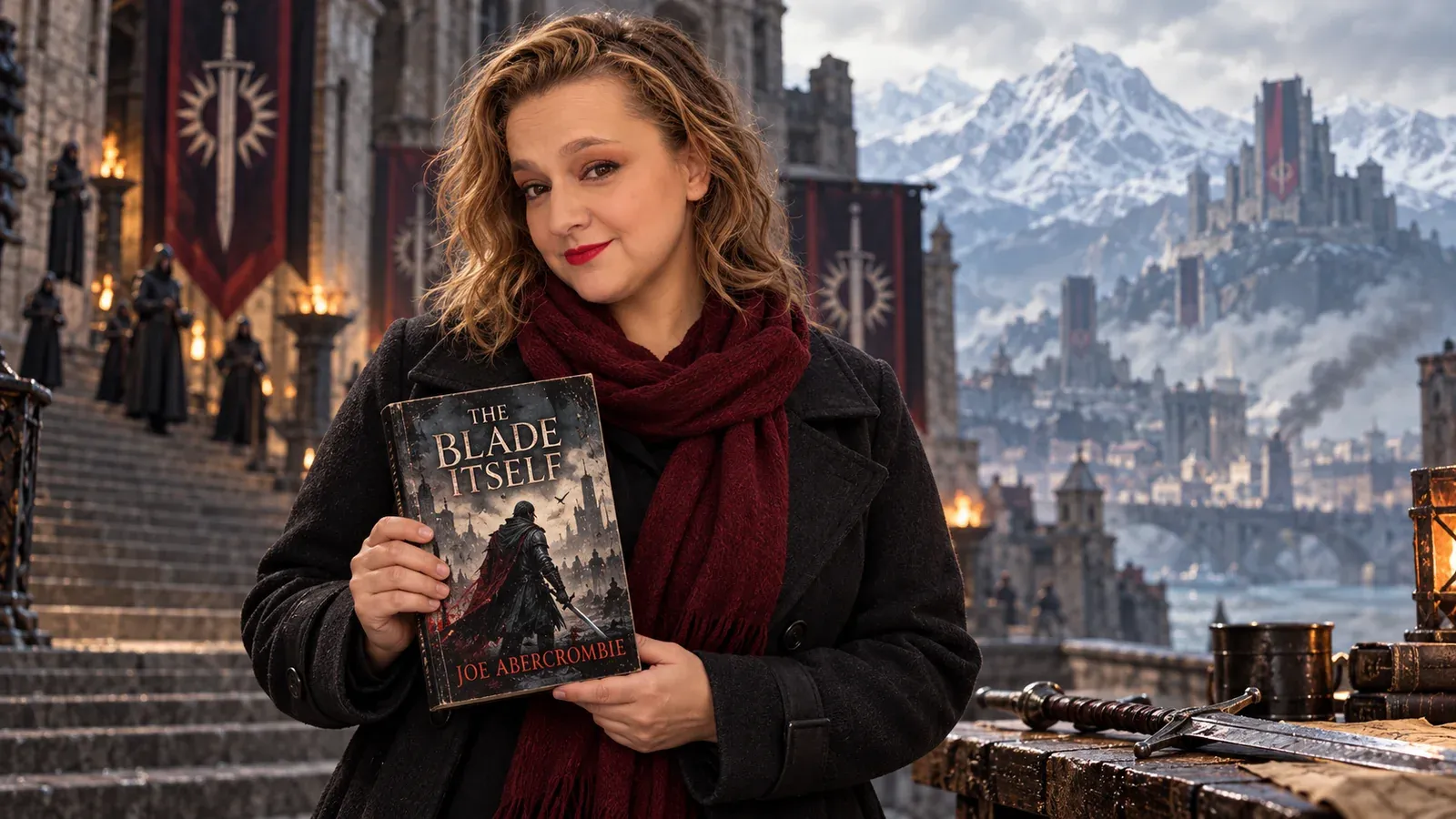
The Book
The Blade Itself
Grimdark and dark fantasy
by Joe Abercrombie
4.5 out of 5 stars
Unforgettable characters, exceptional narrative voices, and black humor; it loses half a star because it functions as extended setup and leaves nearly every major conflict open.
Some fantasy novels begin with a map, a prophecy, and a hero destined to save the world. The Blade Itself begins with Logen Ninefingers falling off a cliff and wondering, quite reasonably, why he is still alive. That tells you plenty about Joe Abercrombie's approach. Nobody moves forward because destiny selected them under flattering lighting. They move because death somehow missed its appointment.
The novel divides its attention among Logen, a Northman exhausted by the reputation he built himself; Sand dan Glokta, a former golden hero turned inquisitor after years of torture; and Jezal dan Luthar, a noble officer whose first great battle is against the possibility of effort. Around them stand Ferro Maljinn, Collem and Ardee West, and Bayaz, alleged First of the Magi and a bald old man with the social warmth of a controlled explosion.
The plot does not sprint. It walks, limps beside Glokta, stops to insult Jezal, and watches Logen attempt to become a better man without knowing what to do with the monster inside him. It worked for me because the book does not build suspense around who is good. Almost nobody is. The better question is what each person does when decency costs more than delivering a lovely speech about it.
Logen Ninefingers wants to change, but the Bloody-Nine already knows the way back
Logen enters the story separated from his old crew after a Shanka attack. Believing them dead, he follows Malacus Quai to Bayaz because staying put does not offer a particularly promising life. The journey lets him practice a less violent version of himself. He talks before striking, protects people when he can, and repeats that you have to be realistic as if a sentence might perform the work of therapy.
The trouble is that Logen was not merely a victim of Northern violence. He was one of its most talented employees. The Bloody-Nine, the state in which he loses control and turns combat into slaughter, is not a charming superpower. It is why even his allies remember him with fear. Abercrombie lets us like him without erasing the bill. Wanting to improve matters. Pretending the past was an administrative misunderstanding does not.
Glokta tortures people and stairs are still his most convincing enemy
Sand dan Glokta was a beautiful, rich, arrogant officer until the Gurkish captured and tortured him for two years. He returned with broken teeth, a ruined leg, and a body that charges interest on every movement. Now he works for the Inquisition, doing to other people what was done to him. He is a walking contradiction and, to the inconvenience of my moral peace, the most entertaining character in the book.
His investigation of the Mercers' Guild first looks like another political assignment from Arch Lector Sult. Then he finds impossible accounts, convenient suicides, and the name Valint & Balk. Glokta realizes he is touching a power the Inquisition would rather ignore. His appeal does not come from secret goodness. He has none to spare. It comes from seeing the system clearly, despising it, and continuing to serve because he no longer knows who he would be without the institution using him.
Jezal trains to win a Contest and may accidentally meet another human being
Jezal dan Luthar begins convinced that his surname, face, and uniform already form a complete personality. He trains for the Contest because victory looks good, not because fencing moves him. Major West demands discipline, and Jezal discovers, with the outrage of a man receiving offensive news, that talent requires work.
Ardee West is the first person who refuses to join his automatic admiration society. She needles him, makes him listen, and exposes his class prejudice. Jezal wants her but fears what the relationship would say among other nobles. His arc does not instantly make him a great man. It opens one window in a room where he has spent years breathing his own ego. For Jezal, that qualifies as emergency ventilation.
The Contest proves that merit can receive undeclared magical assistance
Jezal reaches the Contest better prepared because of West, but Gorst is plainly superior in the final. Bayaz quietly interferes with magic and turns likely defeat into public victory. Jezal collects applause for an achievement he does not understand, while Bayaz confirms that he never watches an event without asking how to use it.
The scene is funny and poisonous. The triumph that should complete the young man's growth is contaminated by manipulation. Jezal did work, but he also won because a powerful man needed him to become a presentable piece. Meritocracy always photographs beautifully when nobody checks who was moving the board underneath.
West tries to be the decent man in the story and fails where it hurts most
Collem West looks like the Union's functioning adult. He rose without an important name, works harder than the nobles, and worries about his sister Ardee. He also carries rage, class shame, and a need for control that erupts when he hits her during an argument. Abercrombie does not let the good-man label shield him from that act.
That collapse matters because comparison with worse men is not enough. West can be responsible in the army and cruel at home. He can love his sister and hurt her. The novel offers no quick absolution for services rendered. Sometimes the decent-looking man simply had not reached the place where he believed he was entitled to command.
Bayaz is a wizard; the reasonable doubt concerns whom the magic serves
When Bayaz arrives in Adua claiming to be the First of the Magi, the court treats him as a badly dressed fraud. He answers by opening the impossible House of the Maker, tied to Kanedias, and proving that the legend has a body, a memory, and a serious temper. Proving his identity does not prove his intentions.
Bayaz arranges people the way a banker arranges debts. He recruits Logen, Jezal, Ferro, Quai, and the navigator Longfoot to seek the Seed at the edge of the world. Each person thinks they have a private reason, but the design belongs to the Magus. Magic does not restore innocence here. It arrives with an agenda, ancient contacts, and the confidence of a man who has spent centuries renaming his will as necessity.

Ferro Maljinn does not need lessons in anger; she needs somewhere to put it
Ferro escaped Gurkish slavery and turned revenge into a compass. Yulwei brings her to Bayaz because her abilities may help find the Seed. She trusts nobody, and the book has given her enough evidence to treat trust as a condition suffered by protected people.
Her connection with Logen works because neither can pretend to be morally clean in front of the other. Ferro also widens the world beyond the Union and reminds us that the Gurkish Empire is not an abstract diplomatic threat. It is the system that marked her body and life. I wanted even more of her inner world, but her fury never feels like decoration added to make the novel look tougher.
The North does not miss Logen, but his old crew still carries the consequences
While Logen travels south, the Dogman, Rudd Threetrees, Black Dow, and the others survive and face Bethod's expansion. They reveal the political cost of the Bloody-Nine's fame. Logen helped Bethod unite the North through violence and then broke with him; everyone left behind still lives inside that history.
Bethod is not a villain disconnected from his enemies. His power grew through violence Logen performed. The coming war did not begin because a bad lord woke up wanting more map. It grew from alliances, ambition, and men celebrating brutality while it served them. Once it changed owners, they suddenly found it excessive.
Abercrombie builds the world through voices rather than lectures
The novel's greatest strength is point of view. Glokta thinks in sarcasm because his body gives him no rest. Jezal interprets everything through ego. Logen measures danger like a man who has survived too long. The same city changes depending on who walks through it, and exposition arrives mixed with prejudice, pain, and humor.
That keeps the cynicism from becoming a black filter pasted over conventional fantasy. The world feels cruel because we meet institutions through the people who suffer and maintain them. There is torture, war, and inequality, but also absurd conversation and humanity slipping in where it should not. Laughter does not soften the darkness. It prevents the book from becoming a five-hundred-page funeral led by a man in love with his own seriousness.
What did not work for me: the book ends when it finally seems ready to begin
The obvious criticism is accurate: The Blade Itself behaves like an extremely long prologue with excellent dialogue. We meet the characters, understand the political forces, and watch the expedition assemble, but most major plots remain open. The Northern war has barely raised its hand, Valint & Balk stays hidden, and the central journey begins at the end. If you need a novel with a complete conflict and a satisfying stop, this one plans to invoice you for the trilogy.
There are also fewer women with point of view and room to act than men. Ardee and Ferro have force, but much of their presence is mediated through desire, violence, or male plans. And although the character pace held me, some stretches felt like the novel was arranging knives with enormous style without yet choosing where to use them.
The ending resolves no disaster; it assigns destinations and opens the slaughterhouse
Glokta dismantles the Mercers' Guild, learns that financial powers he cannot touch stand behind it, and is sent to Dagoska, a city threatened by the Gurkish. The appointment resembles promotion only if you do not understand the administrative meaning of sending someone to a besieged outpost. Sult removes him and gives him another impossible problem at the same time.
Bayaz leaves with Logen, Ferro, Jezal, Quai, and Longfoot to find the Seed. Jezal thinks he is entering an adventure; we already know Bayaz does not gather people for fellowship. War with Bethod continues in the North. The book closes the introductions and opens the campaigns. There is no final victory, only the certainty that everyone accepted a job without reading the contract.
My verdict: four and a half stars for a collection of human disasters I need to keep watching
I give it 4.5 out of 5 stars. Not because the plot is complete—it absolutely is not—but because Abercrombie accomplishes something harder than moving armies. He makes cruel, ridiculous, contradictory people impossible to abandon. Glokta is brilliant, Logen carries genuine moral tension, and Jezal improves just enough to make me wonder whether the change can survive a full week.
I recommend it to readers who enjoy character-led fantasy, black humor, consequential violence, and heroes who could not pass an ethics audit even with a bribe. If you want clean nobility, comforting prophecy, and a first volume that closes all its doors, keep walking. The doors stay open here because a war is coming and nobody had time to tidy the room.
Frequently asked questions about The Blade Itself
What is The Blade Itself about?
It introduces Logen Ninefingers, Glokta, Jezal, Ferro, and Bayaz as the Union faces threats from the North and the Gurkish Empire. It sets up Glokta's investigation, the wars, and a magical expedition.
Does The Blade Itself have a closed ending?
No. The Contest and part of the Mercers' Guild investigation conclude, but Bayaz's expedition only begins and both major wars remain open.
Who is the Bloody-Nine?
The Bloody-Nine is Logen's violent, nearly uncontrollable battle state. It is not a clean heroic power; it reveals the part of Logen he fears and the damage his legend caused.
Is Glokta a hero or a villain?
He is an inquisitor and torturer who understands institutional cruelty because he was also its victim. His insight and humor make him compelling, but they do not make his actions innocent.
Is Bayaz really the First of the Magi?
Yes. The House of the Maker and his magic show that he is not simply an impostor. The unresolved issue is whether his plans serve anyone besides himself.
Is there romance in The Blade Itself?
There is desire and a developing relationship between Jezal and Ardee, plus tension between Logen and Ferro, but romance does not drive the novel.
Is The Blade Itself worth reading?
Yes, especially for readers who enjoy character-driven grimdark, sharp dialogue, and black humor. It may frustrate you if you need immediate action or a fully resolved first volume.
The Book
Would I recommend The Blade Itself? Here is my honest verdict.
The Blade Itself
by Joe Abercrombie
Find the book on AmazonIf you buy through this link, Yenny earns a small commission and you pay the same price.
Keep reading
If you liked it, keep going
Anthony Ryan
Blood Song
Blood Song: Vaelin entered the Sixth Order as a child and left as the legend everyone wanted to use
A father abandons his son to a military order, a king discovers the boy is useful for war, and a voice in his blood keeps him alive without explaining the bill.
November 23, 2026
Brian Staveley
The Emperor’s Blades
The Emperor’s Blades: three heirs, one corpse, and an empire that clearly skipped crisis planning
The emperor of Annur is dead, and his three children are scattered between a monastery, a military academy, and a capital full of smiling people with knives behind their backs.
November 22, 2026
John Gwynne
Malice
Malice: Corban wanted to be a warrior and inherited a badly managed war between gods
A prophecy promises a Bright Star and a Black Sun. While powerful men decide which title flatters them best, a boy, a giant wolf, and several families get stuck with the bill.
November 21, 2026
Want more like this? Join the Readers Club and get one of my books for free.
Share
My books
Books by Yenny Astrid Londoño







About the author
Yenny Astrid Londoño
Yenny Astrid Londoño is a Colombian author and entrepreneur, founder of Anchetas Medellín. She writes about real life with sarcasm, irony and smart humor, turning everyday situations, mistakes and imperfect relationships into stories that readers can laugh at and recognize themselves in.

A free book from me
Get a free book from me
Subscribe and get Sobreviviendo a mis muertos in full as a PDF.
After that, I'll only write when I have something worth telling you.
Also available: Read this review in Spanish →