
Book review
The Darkness That Comes Before:
A holy war, a sorcerer dreaming about the end of the world, a barbarian who recognizes the manipulator, and a man trained to turn every human emotion into a tool. Light reading this certainly is not.
By Yenny Astrid Londoño · November 20, 2026 · 9 min read
Share
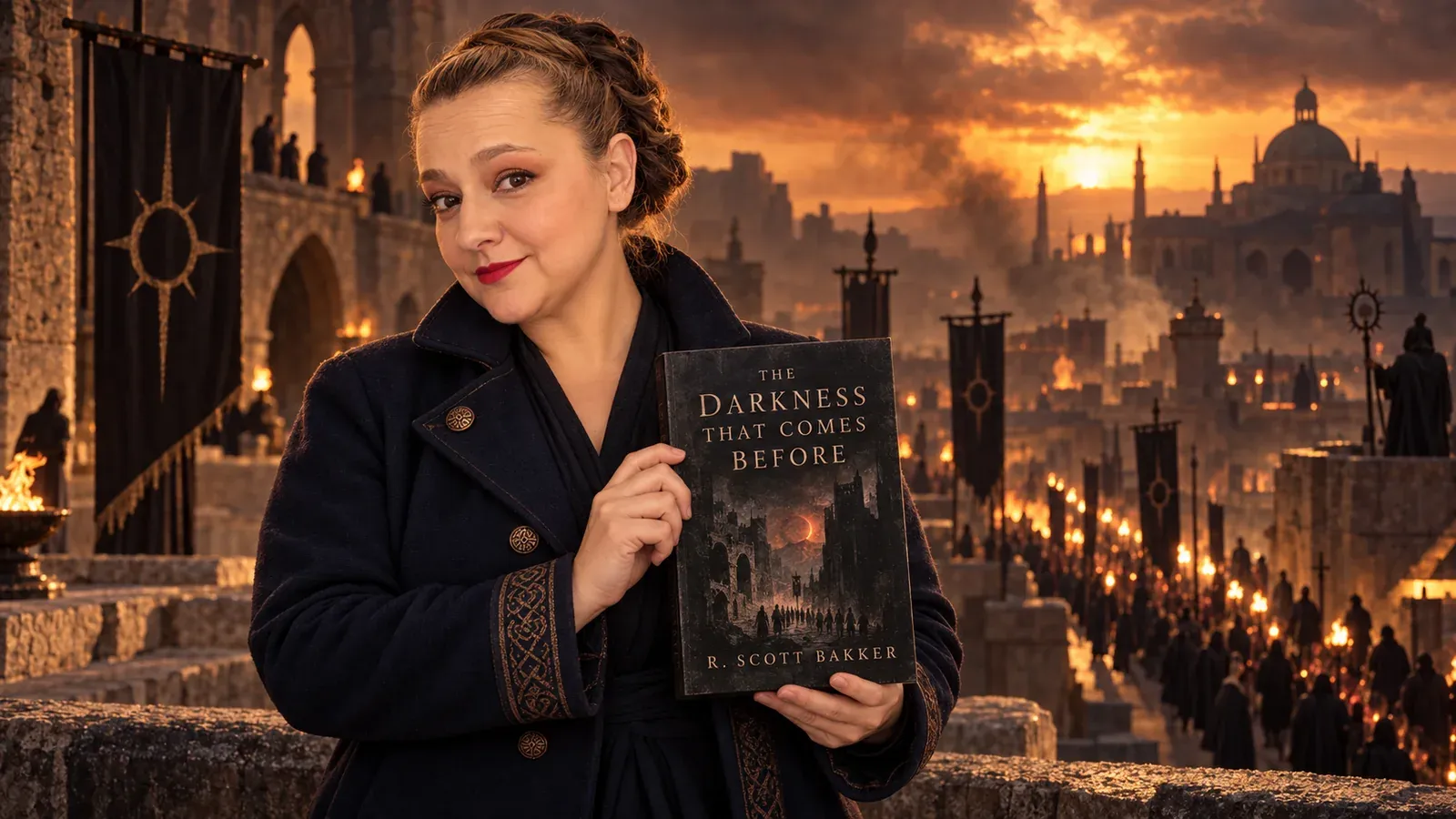
The Book
The Darkness That Comes Before
Dark philosophical epic fantasy
by R. Scott Bakker
3.5 out of 5 stars
Powerful philosophical ideas, excellent tension between Kellhus and Cnaiür, and a complex world; it loses points for setup-heavy pacing and its relentless use of violence and subordination…
Some books invite you inside. The Darkness That Comes Before watches from a fortress, requests three passwords in dead languages, and then asks whether you truly understand free will. R. Scott Bakker did not write fantasy for unwinding after a difficult day. He built a world where religion, politics, desire, and knowledge compete to decide who gets to control whom.
Anasûrimbor Kellhus was raised by the Dûnyain, an isolated sect that trains body and mind to read causes, emotions, and weaknesses with terrifying precision. He leaves Ishuäl to find his father Moënghus, who summons him from Shimeh. To get there, he needs Cnaiür urs Skiötha, a Scylvendi warrior who knew Moënghus decades earlier and understands exactly what these men do. He understands and still falls. That is the novel's darkest joke: recognizing manipulation does not always grant immunity. Sometimes it only lets you describe how you are being used.
Meanwhile, Drusas Achamian, a Mandate Schoolman, dreams every night of the First Apocalypse and searches for proof that the Consult has returned. The Holy War called by Shriah Maithanet against the Fanim gathers nobles, priests, and armies who believe they march for faith, while emperors calculate, sorcerers spy, and creatures wear stolen faces. The book does not lack ambition. Bakker does not lack ideas. What he sometimes lacks is mercy for the reader and, much more seriously, for his women.
Kellhus does not talk to people; he opens them, checks the parts, and chooses what he needs
The Dûnyain raised Kellhus to identify what precedes a decision. A gesture, a breath, or a word lets him infer fear, desire, and hierarchy. From his perspective, people are not moral mysteries. They are causal systems to be read and directed. The result is fascinating because he looks like a messiah and functions like social machinery.
Bakker does not ask us to admire him innocently. Kellhus rescues, seduces, comforts, and persuades, but every act has a purpose. He learns a person's emotional language and turns it into leverage. The more human he appears to everyone else, the more we remember that he is performing humanity with enough data. He is the perfect chosen one for anyone who mistakes feeling understood for being safe.
Cnaiür knows the poison because he survived the father, and he drinks it anyway
Cnaiür urs Skiötha knew Moënghus when he was young. Their relationship mixed desire, shame, betrayal, and manipulation until it destroyed his place among the Scylvendi. When he meets Kellhus, he recognizes the same methods. He guides him toward Shimeh because he needs answers and revenge, even as every mile returns him to the trauma he means to master.
Their relationship is the novel's tensest core. Cnaiür teaches Kellhus about the outside world; Kellhus studies his rage. The warrior knows he is being observed and tries to manufacture false reactions, but his need to prove he is not a victim becomes another rope Kellhus can pull. The most dangerous man on the steppe is readable precisely because of everything he must hide.
Achamian dreams the Apocalypse and everyone treats his nightmares like a public relations problem
Drusas Achamian belongs to the Mandate, the School that preserves Seswatha's memories. Every night he relives the First Apocalypse: falling cities, the Nonmen, the No-God, and destruction the rest of the world has reduced to uncomfortable legend. His mission is to watch the other Schools and search for signs of the Consult.
Achamian brings vulnerability to a book crowded with men determined to control the board. He doubts, loves, fails, and carries a truth nobody wants because accepting it would reorder politics, religion, and war. When skin-spies capable of imitating humans appear, his fear stops looking like professional paranoia. The end of the world is returning, and powerful men are still deciding who gets to sign the announcement.
Inrau tries to leave the war of the Schools, only to learn that the war knows his address
Inrau, Achamian's former student, abandoned sorcery to serve the faith in Sumna. Achamian recruits him to investigate Maithanet and the new Holy War. That decision pulls the young man into a network where the Consult already operates behind borrowed faces.
His death does more than fuel a mystery. It destroys a bond between teacher and student and confirms that the threat is real. It also shows the price of knowledge in this world. Discovering the truth does not guarantee you can tell it. Sometimes it merely guarantees that somebody else will have to interpret the ruins you leave.
Esmenet understands men better than men understand the world
Esmenet survives as a sex worker in Sumna and maintains an intermittent relationship with Achamian. She is intelligent, perceptive, and able to read desire without Dûnyain training because her survival has always depended on it. Inrau's death and Achamian's absence leave her exposed to a world that uses her body and then pretends she has no mind.
Whenever the novel lets her observe, Esmenet cuts through male grandeur with tremendous clarity. The problem is that the story too often traps her in sexual violence, abandonment, and emotional service to men. A powerful character is trying to emerge; the book seems determined to charge her a toll every time she moves.
The Holy War begins with faith and quickly fills with accountants of power
Shriah Maithanet calls the Inrithi to reclaim Shimeh from the Fanim. Religious promise moves thousands, but Emperor Ikurei Xerius wants to convert that energy into imperial reach. His nephew Conphas, a brilliant strategist with an ego large enough to demand territory, represents the military machine behind the fervor.
Bakker shows how a war can be sincere to the person marching and calculated to the person administering it. Nobles argue over precedence, the emperor designs obedience, and every faction attempts to claim the collective will. Faith moves armies; power decides where they go and who supplies the bodies. Shimeh becomes holy city, political target, and the place where Moënghus waits.

The skin-spies make paranoia look like a healthy response
The Consult does not return under a banner reading ancient evil. It infiltrates institutions through skin-spies, creatures capable of wearing human appearance and using desire as a weapon. Achamian realizes the Second Apocalypse may begin while everybody is watching the wrong war.
That presence raises the story beyond religious intrigue. Rulers think they manipulate the Holy War, Kellhus manipulates the people he meets, and behind them an older intelligence prepares conditions almost nobody sees. The title gains weight: every action comes from something before it, and the real horror is not knowing how many layers of will existed before yours.
Serwë proves that Kellhus can use compassion with surgical precision
Serwë enters marked by slavery and abuse. Kellhus rescues her, and she reads his attention as love and salvation. He understands that need immediately and uses it to secure control over her and Cnaiür. What means refuge to Serwë is strategy to Kellhus.
The cruelty is not simply that Kellhus lacks familiar emotion. It is that he can produce the exact feeling another person needs without granting equality. Serwë wants to believe because the alternative is admitting that someone has once again converted vulnerability into property. Her story prepares a powerful critique, although the novel still views her too often through the suffering she creates in men.
The philosophy supports the world and occasionally sits on top of the pacing
The central idea—that what comes before determines what comes after—appears in Dûnyain education, Mandate memory, empires, and trauma. Nobody reaches a decision clean. History, desire, and power prepare the ground. Kellhus stands apart because he sees some of those chains and learns to pull them.
When it works, the novel forces us to reconsider the charismatic hero. When it gets too excited, every conversation begins to sound like an oral philosophy exam. Names, Schools, peoples, creeds, and concepts arrive with little patience. I enjoy a book that trusts my intelligence. I also appreciate one that does not punish me for needing to remember who the hell finances which sorcerer.
What did not work for me: darkness does not need women as its receipt of authenticity
My largest problem is not density. It is the novel's insistence on concentrating sexual exploitation, humiliation, and lack of agency on Esmenet and Serwë. The world is patriarchal, yes, but depicting a system does not require repeating it from every angle without giving women comparable interiority and power. Brutality stops revealing the world when it begins to look like the author's automatic setting.
This is also a deeply preparatory first volume. The Holy War is only assembling, Kellhus is only beginning to build influence, and the Consult remains in shadow. There are brilliant scenes, but the terminology and relentless solemnity slow the movement more than necessary. The book wants you to think; sometimes it seems offended that you also wanted to breathe.
The ending assembles the Holy War and places Kellhus exactly where he can do the most damage
By the end, the major contingents of the Holy War are ready to march. Xerius and Conphas think they can still govern the movement; the Schools calculate their risks; Achamian knows the Consult is real. Cnaiür brings Kellhus into that world as strategist and guide, although he understands the danger better than almost anyone.
Kellhus begins influencing nobles, warriors, and believers while continuing his search for Moënghus. He does not conquer Shimeh or solve the threat. He gains something more unsettling: access. The novel stops before the main campaign, with the manipulator inside the perfect crowd to turn him into a prophet. Everyone believes they found a tool. Almost nobody sees the tool measuring them.
My verdict: three and a half stars for a monumental work that mistakes pain for depth more than once
I give it 3.5 out of 5 stars. Its intellectual construction is ambitious, Kellhus and Cnaiür form an extraordinary relationship, and Achamian makes the apocalyptic threat human. This world has history, religion, and politics that actively shape the present rather than sitting on the map as decorative notes.
But the treatment of women pulled me out far too often, and the first volume demands enormous investment before delivering comparable narrative movement. I recommend it to dark-fantasy readers who enjoy philosophy, religious intrigue, and morally disturbing protagonists. If you want hope, lightness, or a woman allowed to exist without paying violence by the page, this is not your pilgrimage.
Frequently asked questions about The Darkness That Comes Before
What is The Darkness That Comes Before about?
It follows Kellhus on his journey to find Moënghus, Achamian investigating the Consult's return, and the powers organizing a Holy War toward Shimeh.
Who is Kellhus?
He is a Dûnyain trained to read causes, emotions, and behavior. He manipulates people with such precision that he appears prophetic, though his immediate goal is finding his father.
What is the Holy War in the novel?
It is Maithanet's campaign to reclaim Shimeh from the Fanim. It also becomes a struggle among the Empire, the Schools, nobles, and competing manipulators.
What are Achamian's dreams?
They are inherited memories from Seswatha about the First Apocalypse. The Mandate preserves them as warning of the possible return of the Consult and the No-God.
Does The Darkness That Comes Before have a closed ending?
No. It ends with the Holy War ready to march and Kellhus entering its center of power. It is the first volume in The Prince of Nothing trilogy.
Why is The Darkness That Comes Before difficult to read?
It has dense terminology, many factions, philosophical arguments, religious politics, and a setup-heavy pace. It also contains sexual violence and a deliberately bleak worldview.
Is The Darkness That Comes Before worth reading?
Yes for readers who want dense, philosophical, morally uncomfortable fantasy. I would not recommend it to someone seeking a light adventure or balanced treatment of women.
The Book
Would I recommend The Darkness That Comes Before? Here is my honest verdict.
The Darkness That Comes Before
by R. Scott Bakker
Find the book on AmazonIf you buy through this link, Yenny earns a small commission and you pay the same price.
Keep reading
If you liked it, keep going

Anthony Ryan
Blood Song
Blood Song: Vaelin entered the Sixth Order as a child and left as the legend everyone wanted to use
A father abandons his son to a military order, a king discovers the boy is useful for war, and a voice in his blood keeps him alive without explaining the bill.
November 23, 2026
Brian Staveley
The Emperor’s Blades
The Emperor’s Blades: three heirs, one corpse, and an empire that clearly skipped crisis planning
The emperor of Annur is dead, and his three children are scattered between a monastery, a military academy, and a capital full of smiling people with knives behind their backs.
November 22, 2026
John Gwynne
Malice
Malice: Corban wanted to be a warrior and inherited a badly managed war between gods
A prophecy promises a Bright Star and a Black Sun. While powerful men decide which title flatters them best, a boy, a giant wolf, and several families get stuck with the bill.
November 21, 2026
Want more like this? Join the Readers Club and get one of my books for free.
Share
My books
Books by Yenny Astrid Londoño







About the author
Yenny Astrid Londoño
Yenny Astrid Londoño is a Colombian author and entrepreneur, founder of Anchetas Medellín. She writes about real life with sarcasm, irony and smart humor, turning everyday situations, mistakes and imperfect relationships into stories that readers can laugh at and recognize themselves in.

A free book from me
Get a free book from me
Subscribe and get Sobreviviendo a mis muertos in full as a PDF.
After that, I'll only write when I have something worth telling you.
Also available: Read this review in Spanish →