
Book review
Atomic Habits:
James Clear's Atomic Habits: useful tools for building routines, with a warning about tidy systems and unequal lives. My honest review, 4 out of 5.
By Yenny Astrid Londoño · October 21, 2026 · 7 min read
Share

The Book
Atomic Habits
Nonfiction
by James Clear
4 out of 5 stars
Borrow the tools, leave the guilt behind.
The goal looks lovely; the system has to meet your actual life
Atomic Habits is built around a simple promise: small repeated changes can compound into meaningful results. James Clear offers a practical framework for shaping habits through cues, cravings, responses, and rewards, and he keeps returning to the systems that make behavior easier to repeat. I see why the book has reached so many readers. It gives people something more usable than ‘just be disciplined,’ which is advice usually delivered by someone who has already made the difficult thing look easy.
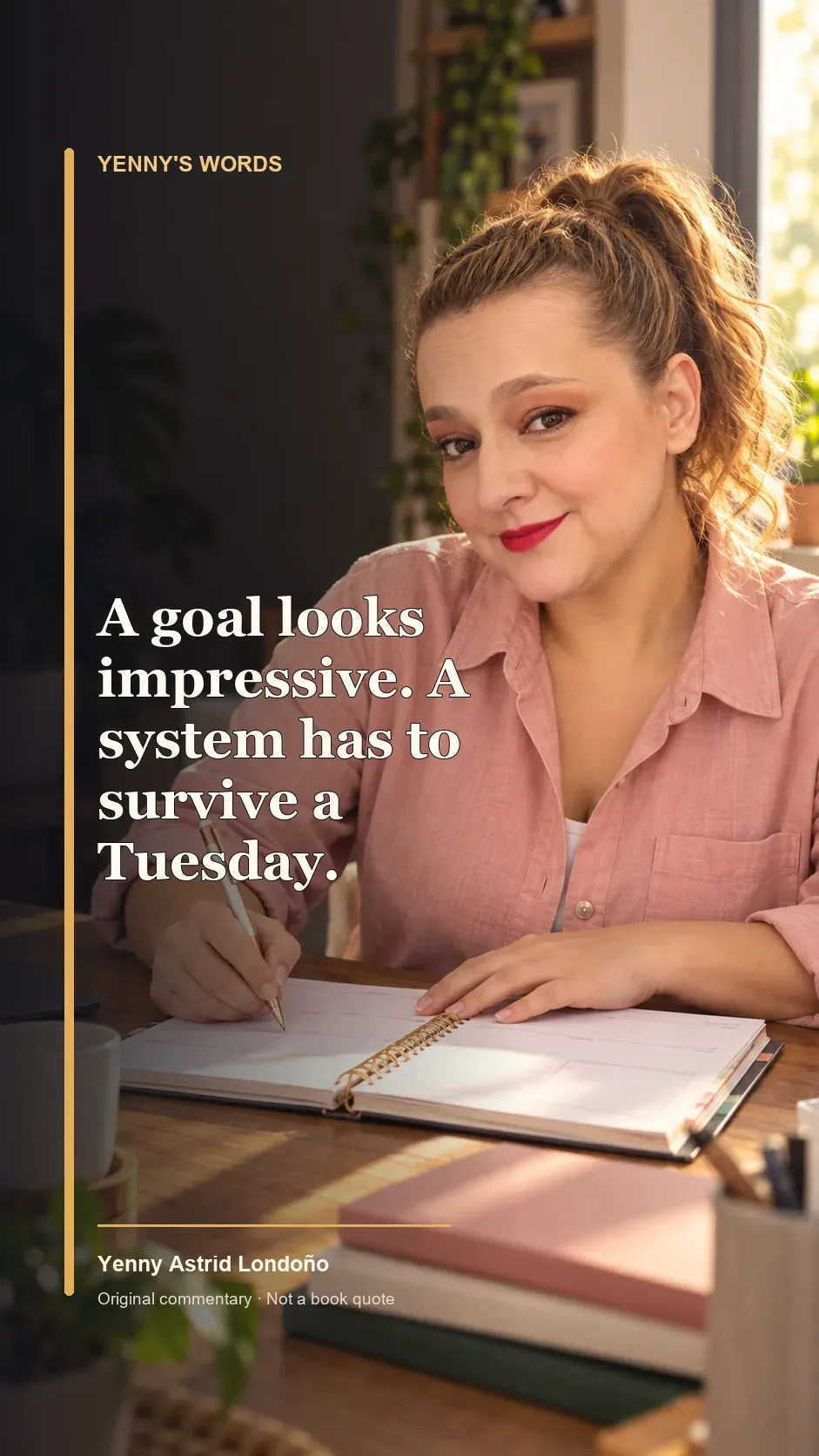
The most useful shift is from staring at the goal to examining the routine that might carry you there. A goal can look gorgeous on a page; the system has to survive work, family, a bad night, and the Tuesday when your motivation has gone out for groceries and never come back. I like the book when it helps a reader make a desired action easier to start and an unwanted one harder to repeat. I get less interested when the framework starts sounding like a tiny calculator for the entire human life.
Identity can support a habit—or turn it into another exam
Clear’s emphasis on identity asks readers to think about the kind of person their repeated actions help them become. That can be motivating. Reading a few pages, walking regularly, or practicing a skill can provide evidence that you are building a relationship with the activity rather than waiting for one grand transformation. The small action matters partly because it makes the next action feel more familiar.
But identity is not a courtroom where every missed habit gets presented as evidence that you are a failure. You did not exercise today; that does not mean you are a lazy person with a defective character. You missed a writing session; that does not erase every other page you have written. I want a habit framework that helps us return after a disruption, not one that quietly turns a routine into a moral scorecard. Rest, illness, caregiving, money, and circumstances are part of a life, not excuses that must be hidden from the productivity police.
The one-percent idea is useful as a metaphor, not a destiny calculator
The book’s small-improvement idea is memorable because it gives change a scale that feels possible. You do not have to reinvent yourself by Monday; a small adjustment can be easier to practice than a dramatic promise. That is a good way to lower the first step. It is also a metaphor, not a guarantee that every tiny action will compound neatly into an extraordinary outcome on schedule.
People have different resources, health, time, safety, and support. A person working two jobs and caring for family does not have the same menu of choices as someone with quiet mornings and a flexible calendar. Good systems can help, but they cannot create every missing condition by magic. I appreciate Clear’s attention to the environment because it moves the conversation away from sheer willpower. I would like readers to extend that attention beyond the bedroom desk: sometimes the obstacle is not a badly arranged cue; it is a life with very little room to breathe.
What the book does well when it gets concrete
The practical examples and clear structure are the book’s strongest assets. Clear breaks a large ambition into actions readers can observe and adjust: make a habit visible, make it attractive, reduce friction, and notice what reinforces it. That gives a reader a way to experiment instead of waiting to feel like a completely new person. The framework is easy to remember, which matters when the aim is to use it rather than admire the diagram.
I also like that the book makes repetition more important than heroic bursts of effort. A routine that can be resumed has more value than an elaborate plan that collapses after one missed day. The question I keep is practical: what is the smallest version of this action that fits the life I actually have? That is a kinder and more useful question than asking why I have not become a morning person through the power of a new notebook and positive lighting.

What I did not like
Clear’s framework is clean enough to travel well, but life is not always as clean as the examples. Some readers may come away thinking that if a habit has not worked, they simply have not designed the right system yet. That can put too much responsibility on an individual when barriers are structural, financial, medical, or relational. The one-percent framing can also tempt people to measure everything, including the minutes they spend resting, as if being alive were another performance review.
I give Atomic Habits 4 out of 5 stars for its memorable structure, practical strategies, and emphasis on making habits repeatable rather than relying on motivation alone. I hold back a star because the tidy framework can understate unequal circumstances and the risk of turning self-improvement into permanent self-surveillance. A habit is supposed to support a life. If the life exists only to feed the habit tracker, we have built the wrong system.
My verdict: borrow the tools, leave the guilt behind
I recommend the book if you want a clear, practical introduction to building routines and changing the conditions around a behavior. I would read it as a toolkit, not a contract promising that a few tiny actions will overcome every barrier. Choose one behavior that would make your day easier, test a small adjustment, and notice what helps you return when the routine breaks. You do not need to redesign your whole personality because you forgot to drink water before lunch.
The best idea I take from Clear is that change often depends less on making a dramatic promise and more on creating a repeatable next step. The caution I want beside it is that not every problem is a habit problem. Sometimes we need more time, support, money, health care, or a fairer set of conditions. Five stars are not a requirement for taking something useful from a book; four is my honest rating, and the habit I am keeping is remembering that productivity is supposed to serve the person, not the other way around.

Frequently asked questions
It explains how small repeated behaviors and the systems around them can shape habits over time. Clear organizes the framework around cues, cravings, responses, and rewards.
Clear presents four practical principles: make a habit obvious, attractive, easy, and satisfying. The book uses them as a framework for designing routines and changing friction.
No. It is a way to make gradual improvement easier to imagine, not a mathematical promise that tiny actions will always produce a particular result.
No, the framework can apply to many routines. Still, readers should not treat rest, illness, finances, or unequal circumstances as problems that can always be fixed by better habit design.
I give it 4 out of 5 stars for its clear structure and practical tools. I hold back a star for how easily its tidy framework can understate structural barriers or turn self-improvement into constant self-monitoring.
Readers who want a practical way to examine routines and make small behaviors easier to repeat may find it useful. It is less helpful if you expect a system to solve problems that require resources, support, or broader change.
Frequently asked questions
What is Atomic Habits about?
James Clear explains how to create useful habits and make unwanted ones harder through small changes, attention to the environment, cues, repetition and identity.
What are the four laws of behavior change?
To build a habit, Clear proposes making it obvious, attractive, easy and satisfying. To break one, he suggests inverting those conditions.
What does improving by one percent every day mean?
It is a way of explaining the cumulative effect of small actions. It should not be read as a mathematical guarantee that every life will grow without setbacks.
Does Atomic Habits work if I don't have much discipline?
It can, precisely because it shifts part of the effort toward designing the environment and reducing friction. Even so, material and health conditions weigh heavily.
Is it a productivity book or a psychology book?
It is practical writing about habits and behavior, widely used for productivity and personal development. It does not replace a clinical assessment when there is a mental health problem.
Do I need to follow every exercise?
No. It is more useful to choose one or two changes, test them in your concrete life and adjust them than to turn the whole method into another impossible obligation.
The Book
Atomic Habits
by James Clear
Get the bookIf you buy through this link, Yenny earns a small commission and you pay the same price.
Keep reading
If you liked it, keep going

Viktor E. Frankl
Man's Search for Meaning
Man's Search for Meaning: Frankl did not write a mug slogan
Viktor Frankl's Man's Search for Meaning: his camp testimony and logotherapy, without the motivational-poster version. My honest review, 4.5 out of 5.
October 21, 2026

Leigh Bardugo
Six of Crows
Six of Crows by Leigh Bardugo: an impossible heist and six people who cannot work together without threats
Six thieves, one impossible job and a plan whose first rule is apparently “do not kill your teammates before we get inside.” This is my spoiler-light review of Leigh Bardugo’s Six of Crows, a fantasy about criminal skill, complicated loyalties and people who learned to survive by trusting nobody—including the people they need beside them.
October 29, 2026

Lauren Roberts
Reckless
Reckless by Lauren Roberts: a romantic chase where both people know trust is a bad idea
The competition is over, but Paedyn and Kai are nowhere near safe. She is on the run, he is hunting her, and they both have reasons not to trust the person they want. This is my spoiler-light review of Lauren Roberts’s Reckless, the second book in the Powerless trilogy, where romantic tension travels through a world outside the palace and the political questions are still waiting for a fuller answer.
October 28, 2026
Want more like this? Join the Readers Club and get one of my books for free.
Share
My books
Books by Yenny Astrid Londoño



About the author
Yenny Astrid Londoño
Yenny Astrid Londoño is a Colombian author and entrepreneur, founder of Anchetas Medellín. She writes about real life with sarcasm, irony and smart humor, turning everyday situations, mistakes and imperfect relationships into stories that readers can laugh at and recognize themselves in.

A free book from me
Get a free book from me
Subscribe and get Sobreviviendo a mis muertos in full as a PDF.
After that, I'll only write when I have something worth telling you.
Also available: Read this review in Spanish →