
Book review
Man's Search for Meaning:
Viktor Frankl's Man's Search for Meaning: his camp testimony and logotherapy, without the motivational-poster version. My honest review, 4.5 out of 5.
By Yenny Astrid Londoño · October 21, 2026 · 7 min read
Share

The Book
Man's Search for Meaning
Psychological thriller
by Viktor E. Frankl
5 out of 5 stars
Frankl recounts experiences from the Nazi concentration camps and develops a reflection on the search for meaning that would shape logotherapy.
The book people keep turning into a sunrise caption
Man’s Search for Meaning is usually introduced as a book that will teach you to find purpose in pain. That description is tidy, inspirational, and incomplete in a way that makes me want to take the book back from whoever put it on a motivational poster. Viktor E. Frankl writes about his experience as a prisoner in Nazi concentration camps and explains the ideas behind logotherapy, the approach he developed around the search for meaning. This is testimony and psychological reflection, not a magic trick for making every hard thing feel worthwhile.
The book’s real force comes from the question it asks without pretending the question cancels the crime: what can a person hold on to when almost everything has been taken? That is very different from telling someone that every loss arrives with a lesson tucked inside. Some losses are brutal, some injustices are made by people and systems, and nobody owes the rest of us a polished explanation for surviving them. I want to read Frankl with attention, not turn his life into a quote dispenser for my Monday morning.
Before the theory, there were people living through a crime
Frankl’s account is shaped by his own position as a prisoner and as a psychiatrist. He observes hunger, fear, humiliation, exhaustion, and the way plans can become fragile when other people control nearly every condition of your life. Small things—a memory, a task, a word, the image of someone loved—can offer a point of orientation. That observation matters. It does not mean that people who died lacked purpose, courage, or the correct attitude. Survival was never a personality test with a certificate waiting for the most resilient person.
A personal testimony can be true and still be one perspective. Frankl does not stand in for every victim, and his book should not be asked to replace the broader history of the Holocaust or the many other records and memories left by those who endured it. His training gives the book a particular way of looking; it also gives us something to question. I find it more respectful to read him alongside other testimony and historical work than to promote every observation as a universal law of human psychology. A serious book can be valuable without being the only book in the room.
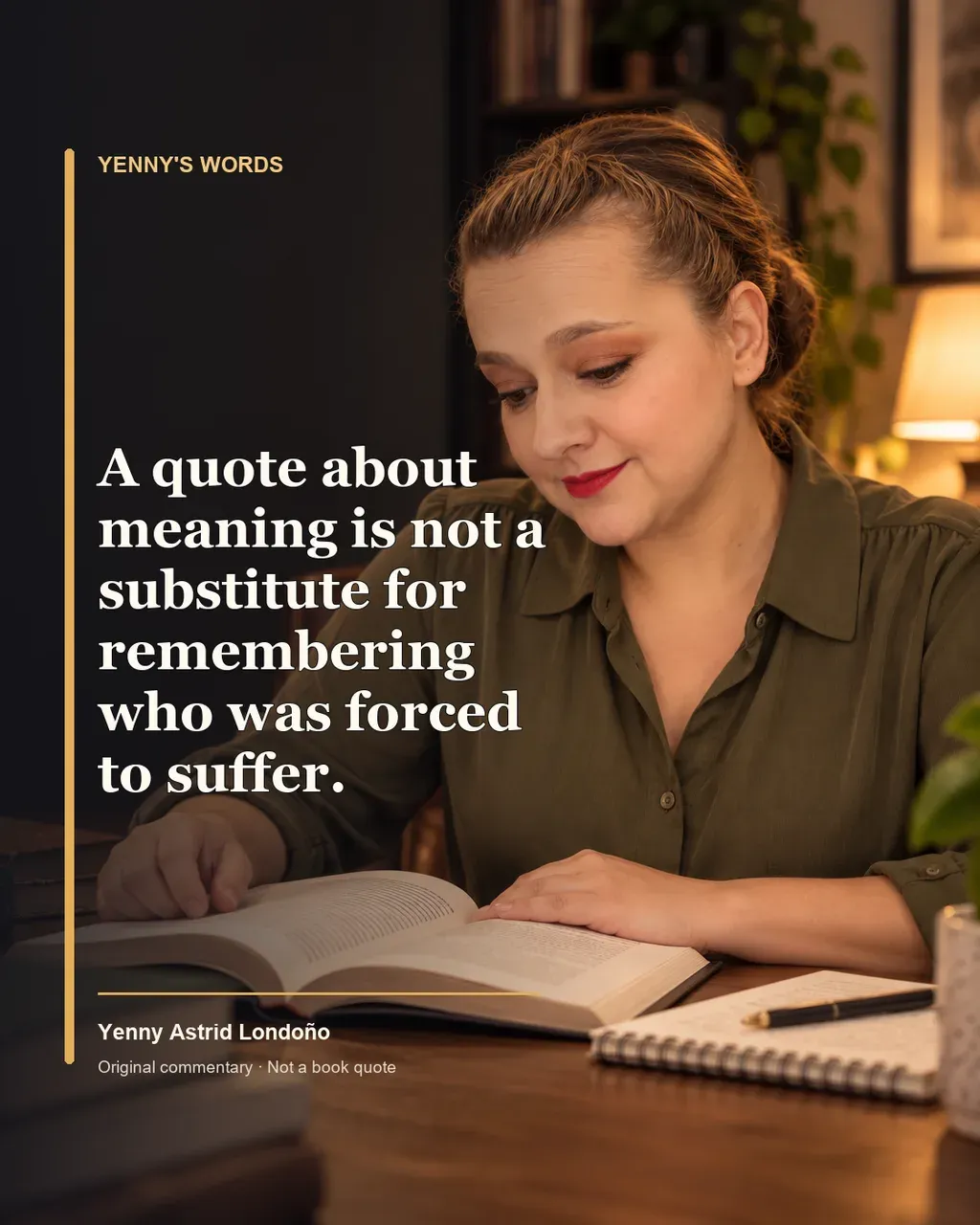
Meaning is not a prize the person in pain has to earn
Logotherapy gives a central place to the human search for meaning. Frankl writes that people may find direction through work, relationships, or the attitude they take toward circumstances they cannot change. That last idea is often repeated as if a person can simply choose not to be hurt. No. Choosing a response inside a terrible situation is not the same as choosing the situation, approving it, or having enough power to escape it.
If someone is grieving, ill, or living through injustice, asking what lesson they have learned can be a spectacularly selfish way to avoid sitting with them. Sometimes the useful response is practical help, company, treatment, or making the conditions less cruel. Meaning is not an invoice we hand to the person suffering so we can feel better about what happened. I like that Frankl’s idea can be read more modestly: meaning may be specific to a person and a moment. Today it might be caring for someone; tomorrow it may be asking for help and getting through the night. That is more humane than the grand order to discover your purpose by Friday.
The bestseller version leaves out the part we need to remember
The book’s popularity helps bring Frankl’s testimony and psychological ideas to readers who might not otherwise find them. It also creates a shortcut: take one hopeful sentence, remove the pages about hunger and murder, place the sentence over a mountain, and announce that attitude is everything. It is not. No one’s private attitude stopped the trains or liberated the camps. People and institutions committed the harm, and memory requires us to keep responsibility attached to the people who caused it.
That is why I get uneasy when the book is recommended as a universal cure for grief or treated as a manual for turning trauma into gratitude. A person can be moved by Frankl and still need medical care, community, justice, or time. The theory does not replace any of those things. I also would not trust every inspirational line circulating under his name without checking its source and context. The book deserves more than having its hardest parts cropped away so a sentence will fit neatly on a phone screen.

What I did not like
The movement from the account of the camps into the explanation of logotherapy can feel abrupt. If I enter expecting a sustained memoir, the more schematic discussion in the later portion may feel like a different book has walked into the room and taken over the chair. I am interested in the theory, but I do not always agree with how quickly a singular experience can seem to become a principle for everyone. The idea of inner freedom needs careful handling, because people do not all have the same room to choose. Illness, violence, social support, class, and the decisions of other people change that room dramatically.
My biggest objection, though, is to the way readers and sellers sometimes use the book as a prescription for the newly bereaved: read this, find meaning, feel better. No. Nobody needs a deadline for making sense of a loss. I give Man’s Search for Meaning 4.5 out of 5 stars for the power of Frankl’s testimony and for the questions it leaves open. I hold back half a star for the uneven transition between memoir and theory and for the risk that some ideas become too universal when removed from context. The book is worth reading slowly, with other voices nearby and no pressure to turn pain into a life lesson.
My verdict: read the book, then resist the shortcut
I recommend it as a personal testimony and an invitation to think about responsibility, meaning, and the limits of what can be changed. I would not use it as a replacement for a history of the Holocaust, a clinical guide, or a way to tell someone they should feel grateful. The most useful reading is not the one that makes us feel wise after underlining a sentence. It is the one that helps us notice the difference between hope and blame, between a person’s response and the crime imposed on them.
If one of Frankl’s ideas gives you a little footing, I am glad. Just keep the people in the history visible while you hold on to the idea. Otherwise we have taken a testimony about human beings and made it serve a caption. That is a poor way to honor the book and an even poorer way to remember the people whose lives it describes.

Frequently asked questions
Viktor E. Frankl combines testimony about his imprisonment in Nazi concentration camps with an explanation of logotherapy and the search for meaning. It is both personal account and psychological reflection.
It includes Frankl’s personal testimony and his psychological ideas. Calling it only a self-help book misses the historical experience at its center.
Logotherapy is the approach developed by Frankl that places the search for meaning among the central motivations in human life. The book presents his perspective; it is not a universal clinical prescription.
No careful reading should turn the book into that claim. Finding a response within circumstances someone cannot change does not make the harm good or excuse the people who caused it.
I give it 4.5 out of 5 stars for the force of the testimony and the questions it raises. I hold back half a star for the abrupt shift into theory and the way some ideas can sound too universal out of context.
It depends on the person and the moment. The book can be meaningful, but it should never be offered as a demand to find a lesson or recover on someone else’s schedule.
Frequently asked questions
What is Man's Search for Meaning about?
It brings together Viktor E. Frankl's testimony as a prisoner in Nazi concentration camps and an explanation of the core ideas of logotherapy, focused on the search for meaning.
Is it a novel?
No. It is a testimonial and essayistic work. Its camp scenes should not be read as fiction, and its perspective should not be taken as the whole history of the Holocaust.
What is logotherapy?
A psychotherapeutic approach developed by Frankl that gives a central role to the search for meaning in human life. His ideas can be debated and complemented with other clinical perspectives.
Does Frankl say we should be grateful for suffering?
That would not be a careful reading. He explores the possibility of finding direction even in circumstances we cannot change; that does not make the harm good or excuse those who cause it.
Is it a self-help book?
It is often sold that way, but the label falls short. It contains a historical testimony and a psychological proposal that deserve critical context, not just motivational lines.
Can I read it while grieving?
It may help some people and feel too harsh or untimely for others. There is no universal answer, and it should not be used to pressure someone to find meaning quickly.
The Book
Man's Search for Meaning
by Viktor E. Frankl
Get the bookIf you buy through this link, Yenny earns a small commission and you pay the same price.
Keep reading
If you liked it, keep going

James Clear
Atomic Habits
Atomic Habits: a tiny change still has to survive Tuesday
James Clear's Atomic Habits: useful tools for building routines, with a warning about tidy systems and unequal lives. My honest review, 4 out of 5.
October 21, 2026

Leigh Bardugo
Shadow and Bone
Shadow and Bone by Leigh Bardugo: a soldier discovers that darkness has an owner
Alina Starkov has spent years being ordinary beside Mal, her closest friend, until a crossing through the Shadow Fold reveals that Ravka may have been wrong about her. Her new power makes her valuable to the court, but valuable and free are not the same thing. This is my review of Leigh Bardugo’s Shadow and Bone, a fantasy about power, belonging and the uncomfortable moment when everyone suddenly has a plan for your life.
October 30, 2026

Leigh Bardugo
Six of Crows
Six of Crows by Leigh Bardugo: an impossible heist and six people who cannot work together without threats
Six thieves, one impossible job and a plan whose first rule is apparently “do not kill your teammates before we get inside.” This is my spoiler-light review of Leigh Bardugo’s Six of Crows, a fantasy about criminal skill, complicated loyalties and people who learned to survive by trusting nobody—including the people they need beside them.
October 29, 2026
Want more like this? Join the Readers Club and get one of my books for free.
Share
My books
Books by Yenny Astrid Londoño



About the author
Yenny Astrid Londoño
Yenny Astrid Londoño is a Colombian author and entrepreneur, founder of Anchetas Medellín. She writes about real life with sarcasm, irony and smart humor, turning everyday situations, mistakes and imperfect relationships into stories that readers can laugh at and recognize themselves in.

A free book from me
Get a free book from me
Subscribe and get Sobreviviendo a mis muertos in full as a PDF.
After that, I'll only write when I have something worth telling you.
Also available: Read this review in Spanish →