
Book review
Powerless by Lauren Roberts:
A deadly competition, a kingdom that treats difference like a crime and a protagonist who has to pretend in order to stay alive. Paedyn Gray is an Ordinary in a world that worships powers, and the crown would prefer her off the map. This is my spoiler-light review of Lauren Roberts’s first Powerless novel: a fast romantic fantasy that knows its audience and makes the tension part of the plot.
By Yenny Astrid Londoño · October 27, 2026 · 6 min read
Share
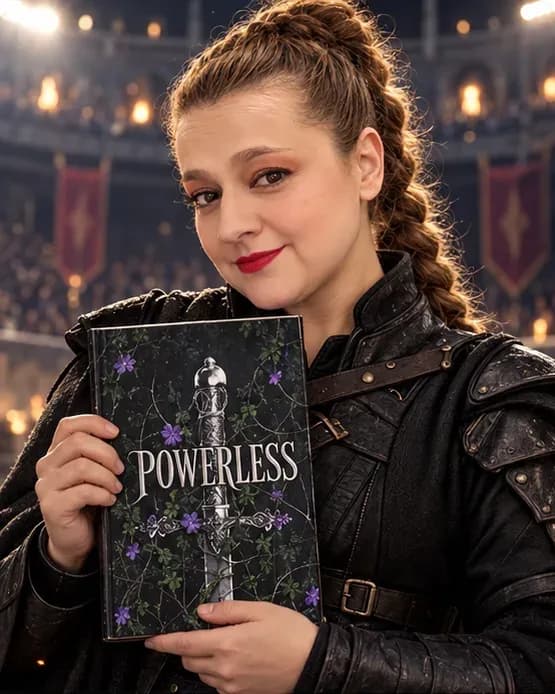
The Book
Powerless
by Lauren Roberts
More reviews by Lauren Roberts →
4 out of 5 stars
Paedyn, the Trials and the conflict between desire and duty kept me reading.
Paedyn learned to read people because nobody was coming to protect her
Paedyn has no powers in a society that sorts people by what they can do. She survives by watching, reading people and pretending to be something she is not. That makes her a compelling protagonist for this setup: she has a skill, but the kingdom does not recognize it as power because it cannot be shown off in an arena.
Her intelligence is practical. She notices what people want and what they are hiding because missing a signal could be dangerous. I like that she is not waiting for the world to discover her worth. She is already making decisions, even when every choice has a cost.
Ilya turns difference into law
The kingdom of Ilya divides people according to whether they have abilities. The system makes this difference into status and law, and an Ordinary person like Paedyn is at risk just for existing where she is not supposed to. The injustice is clear, though I wanted more about how the society sustains itself and what a real political change might look like.
The novel has a strong central conflict: who gets to live safely when the crown decides that one group is a threat? Paedyn’s survival story shows what the rules do to an individual. The wider social structure is still waiting for more development, which leaves space for later books and leaves me with questions this first installment does not yet answer.
The Purging Trials put Paedyn on an impossible stage
The competition turns Paedyn into a public spectacle. She has to perform under pressure in a world where the other contestants have abilities she lacks and the people watching may see through her disguise. The trials keep the plot moving and offer a steady source of danger.
The structure will feel familiar to readers of young adult fantasy: a dangerous competition, a protagonist concealing something and powerful people deciding who deserves to win. Roberts combines those pieces smoothly, but not every part feels new. I could often anticipate when an interaction would become provocation, tension and a long look. The book does not always resist the expected route.
Kai is the prince who represents the system and starts to doubt
Kai Azer is tied to the crown and the rules that put Paedyn in danger. His position makes the romantic tension political: he is not just a handsome person from the wrong side of the room; he represents a system that Paedyn has reason to fear. Their attraction develops alongside that conflict, so desire and duty do not fit into a neat little package.
They have chemistry, though some flirtation takes up room in situations where danger should be the priority. A charged exchange can be fun. When the building is metaphorically on fire, I sometimes want the characters to deal with the fire before looking at each other for another three paragraphs.
The romance works because there is a real conflict beneath it
Paedyn and Kai do not have the same relationship to power, safety or the crown. That gives the romance a problem beyond “will they, won’t they.” They can be drawn to each other and still stand on opposite sides of a social structure with consequences.
The romantic tension is one of the book’s strongest hooks. At the same time, the plot sometimes lets the relationship take priority over questions about Ilya and the opposition to the king. I wanted more about what change would require, who is organizing it and which people would pay the cost. The romance has room to grow; the politics do too.
The pace favors emotion over explaining the kingdom
The novel moves quickly and prioritizes the feelings and choices of its central characters. That makes it easy to read and keeps the stakes close. The world’s details arrive in smaller pieces, so readers looking for a fully explained society and political movement may want more.
That approach is a clear choice. The book knows whether it is writing toward romantic fantasy readers and delivers tournament danger, emotional tension and a quick pace. I enjoyed those elements. I also wanted a little more grounding beneath them, because the injustice Paedyn faces is big enough to support a more detailed account of how the kingdom works.
What I did not like
The competition and the relationship between an Ordinary heroine and a prince use familiar young adult tropes. The book combines them well, but not every part feels fresh. Some scenes move through predictable provocation, romantic tension and a long look; the novel does not always choose a less expected path.
I wanted more development of Ilya and the movement against the king. Paedyn’s injustice is clear, but questions about how the system stays in place and how it could change remain for later books. Kai and Paedyn have chemistry, though flirtation sometimes interrupts danger. The ending leaves threads open because the series is just beginning. A sequel hook is not automatically depth, no matter how dramatically the last page is placed.
My verdict: no powers, plenty of trouble
Powerless entertained me with a clear premise and a protagonist who has to rely on observation and deception in a world that respects only powers. Paedyn has character, the trials maintain tension, and the difference between her and Kai gives their romance a conflict with real stakes. The book moves quickly and knows what its readers came for: a competition, danger and a slow-burning attraction.
It is not the novel that reinvents every trope, nor the one that spends the most time explaining the kingdom. Its strongest element is Paedyn and the risk of being discovered; its limit is how many political ideas remain only sketched. I would continue the trilogy because I want to know what happens when the competition ends and the choices no longer fit inside an arena.
Who should read it
Read it if you like young adult fantasy with competitions, romantic tension and protagonists who survive by thinking quickly. If you want a fully developed political rebellion, this first book may leave you wanting more. Paedyn does not need powers to get into trouble; a crown, a tournament and a prince already fill her schedule.
My rating
4 out of 5 stars. Paedyn, the Trials and the conflict between desire and duty kept me reading. I take off a point for predictable tropes, a political world that needs more detail and romantic tension that occasionally displaces the urgent problem. The story has momentum; I want the next book to give its kingdom the same attention it gives its couple.
Frequently asked questions
Is Powerless the first book in a trilogy?
Yes. It opens Lauren Roberts’s Powerless trilogy, followed by Reckless and Fearless.
Who is Paedyn Gray?
She is an Ordinary in Ilya who survives by reading people and hiding the fact that she has no powers.
What are the Purging Trials?
They are a dangerous competition that puts Paedyn in public view and tests her against people with abilities.
Who is Kai Azer?
He is a prince of Ilya whose position ties him to the system Paedyn is trying to survive.
Does Powerless have romance?
Yes. The romantic tension between Paedyn and Kai is a major part of the novel, alongside the competition and political conflict.
What does it mean to be Ordinary in Powerless?
An Ordinary person has no supernatural ability in a kingdom that classifies and judges people according to their powers.
Who would enjoy Powerless?
Readers who like young adult romantic fantasy, dangerous tournaments and a heroine hiding her identity in a powerful court.
The Book
Powerless
by Lauren Roberts
Get the bookIf you buy through this link, Yenny earns a small commission and you pay the same price.
Keep reading
If you liked it, keep going

Lauren Roberts
Reckless
Reckless by Lauren Roberts: a romantic chase where both people know trust is a bad idea
The competition is over, but Paedyn and Kai are nowhere near safe. She is on the run, he is hunting her, and they both have reasons not to trust the person they want. This is my spoiler-light review of Lauren Roberts’s Reckless, the second book in the Powerless trilogy, where romantic tension travels through a world outside the palace and the political questions are still waiting for a fuller answer.
October 28, 2026

Rebecca Ross
Ruthless Vows
Ruthless Vows by Rebecca Ross: a war, a reporter without his memories and letters that still find their way
The war has consequences, Roman has lost the memories that explain his life, and the letters still find a way through. This is my spoiler-light review of Rebecca Ross’s Ruthless Vows, the second and final book in Letters of Enchantment. It continues Iris and Roman’s story by asking whether loving someone means recovering an older version of them or meeting the person they decide to become now.
October 27, 2026

Leigh Bardugo
Shadow and Bone
Shadow and Bone by Leigh Bardugo: a soldier discovers that darkness has an owner
Alina Starkov has spent years being ordinary beside Mal, her closest friend, until a crossing through the Shadow Fold reveals that Ravka may have been wrong about her. Her new power makes her valuable to the court, but valuable and free are not the same thing. This is my review of Leigh Bardugo’s Shadow and Bone, a fantasy about power, belonging and the uncomfortable moment when everyone suddenly has a plan for your life.
October 30, 2026
Want more like this? Join the Readers Club and get one of my books for free.
Share
My books
Books by Yenny Astrid Londoño



About the author
Yenny Astrid Londoño
Yenny Astrid Londoño is a Colombian author and entrepreneur, founder of Anchetas Medellín. She writes about real life with sarcasm, irony and smart humor, turning everyday situations, mistakes and imperfect relationships into stories that readers can laugh at and recognize themselves in.

A free book from me
Get a free book from me
Subscribe and get Sobreviviendo a mis muertos in full as a PDF.
After that, I'll only write when I have something worth telling you.
Also available: Read this review in Spanish →