
Book review
The Club Dumas:
Arturo Pérez-Reverte's The Club Dumas: Lucas Corso hunts rare books, forgeries and the Book of the Nine Doors. My honest review, 4 out of 5 stars.
By Yenny Astrid Londoño · October 21, 2026 · 7 min read
Share
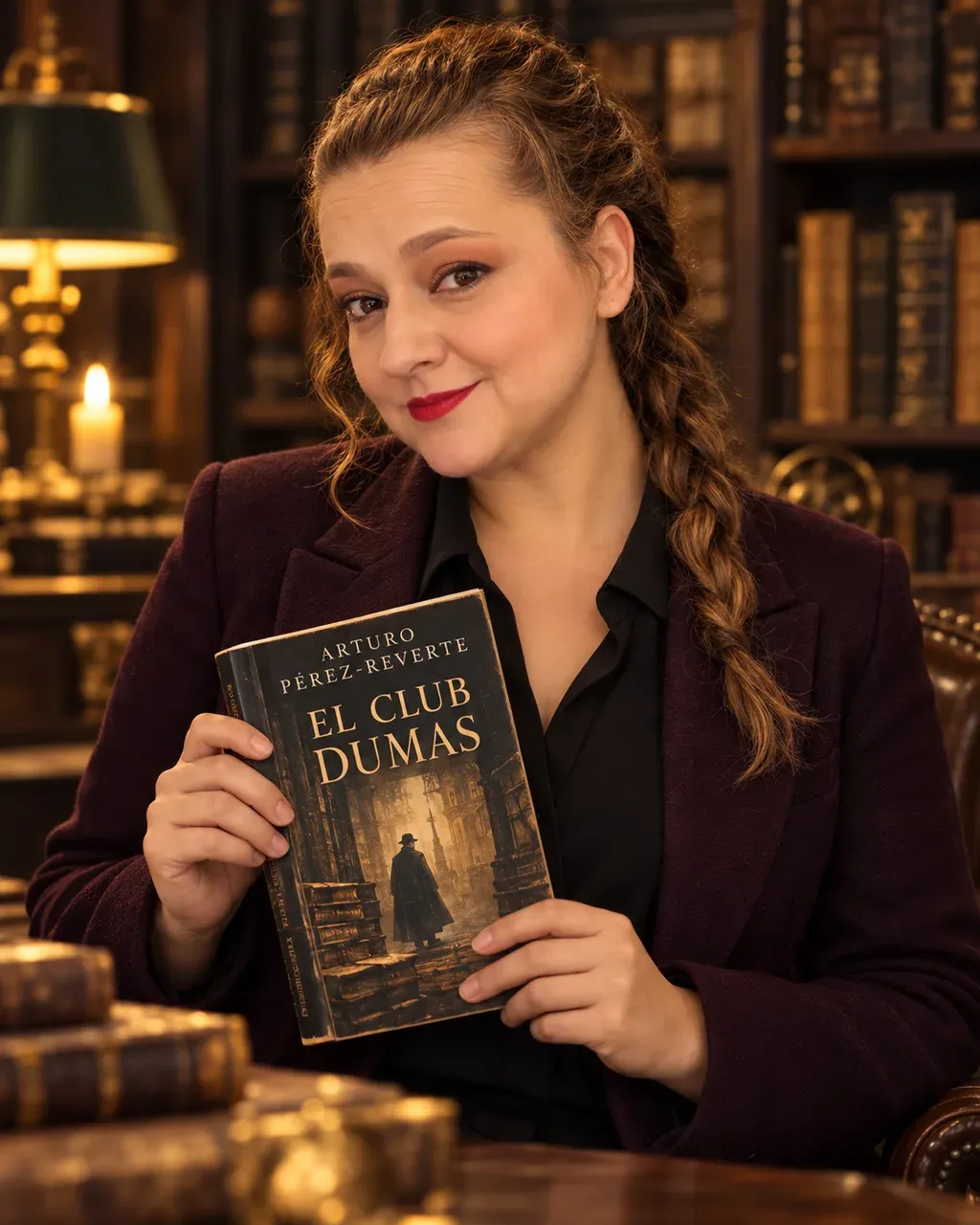
The Book
The Club Dumas
Mystery
by Arturo Pérez-Reverte
More reviews by Arturo Pérez-Reverte →
4 out of 5 stars
I liked Corso's trade, the collectors' world and the blend of literature with mystery.
Lucas Corso makes a living hunting down books
Lucas Corso is a mercenary of the book world: he finds, authenticates, and negotiates rare volumes for collectors. He does not do it only because paper makes his heart sing. It is his profession, and he understands that an unusual edition can stir up more greed than a jewel.
Two assignments pull him in different directions. One concerns a manuscript connected to Alexandre Dumas; the other involves the strange Book of the Nine Doors, surrounded by rumors of a text that can summon the Devil. The jobs look separate, then start brushing against each other. Corso visits libraries and consults experts while discovering that money alone may not explain why people want these books.
A book detective whose best weapon is suspicion
Corso is sharp, practical, and distrustful. He knows how to check provenance, spot a forgery, and read the person paying him. His best tool is not bravery but the ability to notice when one detail does not fit. That makes him an entertaining lead: he is not a detective with a badge; he is a professional reader learning that a case can get under his skin.
He can also feel cold. Corso calculates, bargains, and looks at people as if he is estimating their market value. That distance works for the plot, though it does not always make me care about him. I do not need a protagonist to be charming, but I do need some choice of his to matter to me. The novel earns that investment in places; elsewhere Corso seems so devoted to his own skepticism that I want to tell him, yes, we know, you trust nobody.
Books inside books, and the people who want to own them
One of the richest parts of the novel is its attention to reading. Books are not just strange objects someone locks away; they carry copyists, editors, readers, rumors, and centuries of interpretation. A volume may be valuable because of its text, its physical history, or the desire a collector projects onto it. Collecting can be passion and a market at the same time.
Pérez-Reverte fills the story with literary references. Readers who know Dumas will recognize extra layers; those who have not read him can still follow the central puzzle. At times, though, the novel feels like a conversation among insiders. It is possible to enter without a rare-book dictionary, but occasionally the narration puts references on the table and waits to see whether I brought mine.
Occult clues and the question of what we choose to believe
The mystery keeps two questions open: who can verify a text’s authenticity, and why do we believe the story attached to it? Corso’s investigation moves between the material and the supernatural. There could be a rational explanation, deliberate manipulation, or something that does not fit the usual rules. The book enjoys keeping several doors open while he looks for the key.
I like that the occult is not just a dark decoration with someone in a cape whispering in a library. The novel takes seriously the desire to find hidden power in signs and pages, while leaving room to wonder whether people are manufacturing a persuasive story. That ambiguity sustains curiosity. It may frustrate readers who want every mystery to come with a single, itemized receipt.

The structure follows clues, trips, and detours
The novel moves through investigations, journeys, and meetings with people who know different pieces of the puzzle. Each new clue can alter what came before. There is pleasure in checking one copy against another and suspecting that someone who looked like an intermediary has a larger role.
The pace is uneven. The Dumas thread and the occult thread do not always move with equal force, and some passages pause to develop literary references. If you came for a compact thriller, you will notice those detours. If you like a novel that luxuriates in its world and lets ideas accumulate, they may be part of the fun. I had both reactions: fascinated by certain clues, and checking the clock during a few explanations.
What the novel says about collecting
The book notices how wanting to own a rare book can turn into wanting to control its story. A collector wants a unique object, but also wants to be the person who possesses it. The volume gains value through rarity and the narrative around it, and that narrative can be exaggerated, manipulated, or forged.
That strikes me as amusing and sharp. Characters can talk about culture and beauty while bargaining over an object that also works as a status symbol. Love of books exists. So does some collectors’ love of themselves, and that second romance can take up quite a lot of shelf space. A huge library does not guarantee good intentions; it mostly guarantees more dusting.
What I did not like
Corso is chasing two objects and two storylines, and their connection can feel scattered before the pattern becomes clear. The mix of bibliographic research and occult mystery also leaves some areas intentionally ambiguous. I enjoy the game, but readers who want a single, definitive answer may feel the book kept the change.
I rate The Club Dumas 4 out of 5 stars. Corso’s profession, the collectors’ world, and the blend of literature and mystery work for me. I take off a point for uneven stretches, secondary characters who could have more depth, and an ambiguity that sometimes becomes frustrating rather than intriguing. The book’s most effective trick is also its risk: making me wonder whether the story is evidence or the story someone wants me to believe.
Who should read The Club Dumas?
I recommend it to readers who enjoy literary mysteries, libraries, rare editions, and stories that keep one foot in rational inquiry and the other in the occult. It is also a treat for Dumas readers who enjoy recognizing references and for anyone curious about a novel that makes reading part of the plot.
If you prefer a fast, straightforward mystery where every question gets closed, this may not be your book. Corso keeps looking, and the novel invites us to look at the reader as well: how much of what we believe comes from proof, and how much from wanting the story to be true? The pages do not only hide clues. Sometimes they recruit us.
Corso chases books no one should open without asking
The story blends bibliographic investigation, literary references, and occult ambiguity into a mystery about desire and belief. I recommend it for the atmosphere and the hunt, with the warning that it will not neatly label every boundary between explanation and invention. Some books want a reader. These two assignments want a partner in crime.

Frequently asked questions
Lucas Corso, a rare-book dealer and researcher, investigates a manuscript linked to Alexandre Dumas and a mysterious occult volume called the Book of the Nine Doors.
Corso is a pragmatic book hunter who authenticates rare editions for collectors. His professional knowledge becomes the main tool in an investigation that grows increasingly strange.
It plays with occultism and the possibility of supernatural forces while also leaving room for rational explanations and manipulation.
No. Recognizing Dumas adds literary layers, but the central mystery can be followed without having read his novels.
It includes suspense and a continuing investigation, but it also pauses for book history, literary references, and detours. Its pace is more leisurely than a compact modern thriller.
I give it 4 out of 5 stars for Lucas Corso, the rare-book world, and the literary mystery, while taking a point off for uneven pacing and unresolved ambiguity.
Frequently asked questions
What is The Club Dumas about?
Lucas Corso, a rare book investigator, takes on jobs related to a manuscript by Alexandre Dumas and a mysterious book linked to the occult. The two investigations begin to cross.
Who is Lucas Corso?
A specialist who searches for and authenticates old books for his clients. His work requires investigating where copies come from and distrusting easy answers.
Do I need to have read Alexandre Dumas?
No. Knowing Dumas helps you appreciate more references, but the plot can be followed without having read all the works mentioned.
Is it a horror novel?
It includes occult elements and an unsettling atmosphere, but it is also a literary mystery and an investigation novel. It does not rely on horror alone.
Does the novel explain all its mysteries?
Some answers remain open to interpretation. The ambiguity is part of the experience and may please or frustrate depending on how much closure each reader wants.
Do I need to know about old books?
No. The novel gives enough context to understand Corso's work, although its bibliographic references enrich the reading.
Which books does Lucas Corso investigate?
Corso takes on jobs related to a manuscript attributed to Alexandre Dumas and a copy of Las nueve puertas del reino de las sombras. The two inquiries cross throughout the novel.
The Book
The Club Dumas
by Arturo Pérez-Reverte
Get the bookIf you buy through this link, Yenny earns a small commission and you pay the same price.
Keep reading
If you liked it, keep going

Adalyn Grace
Belladonna
Belladonna by Adalyn Grace: an heiress, a ghost and Death with more presence than several living people
A gothic mansion, poison and a young woman looking for answers among people hiding far too much. This is my spoiler-light review of Adalyn Grace’s Belladonna, a mystery about an heiress who can see Death and a family that could use fewer secrets and more honest conversation.
October 27, 2026

Joël Dicker
The Truth About the Harry Quebert Affair
The Truth About the Harry Quebert Affair by Joël Dicker: the writer looking for a book finds a body
Marcus Goldman has a book deadline, a serious case of writer’s block and a mentor with a body buried in his garden. The universe has a dark sense of humor, and apparently very little respect for an author’s calendar.
October 24, 2026
Carlos Ruiz Zafón
The Shadow of the Wind
The Shadow of the Wind by Carlos Ruiz Zafón: you find a book, and the whole city tells you to forget it
Daniel Sempere enters the Cemetery of Forgotten Books and chooses a novel. I have made bad purchases, but none came with a stranger determined to destroy every copy.
October 23, 2026
Want more like this? Join the Readers Club and get one of my books for free.
Share
My books
Books by Yenny Astrid Londoño



About the author
Yenny Astrid Londoño
Yenny Astrid Londoño is a Colombian author and entrepreneur, founder of Anchetas Medellín. She writes about real life with sarcasm, irony and smart humor, turning everyday situations, mistakes and imperfect relationships into stories that readers can laugh at and recognize themselves in.

A free book from me
Get a free book from me
Subscribe and get Sobreviviendo a mis muertos in full as a PDF.
After that, I'll only write when I have something worth telling you.
Also available: Read this review in Spanish →