
Book review
A Nearly Normal Family:
My review of Mattias Edvardsson's A Nearly Normal Family: Stella is accused of murder, and her pastor father and lawyer mother discover what loyalty costs.
By Yenny Astrid Londoño · October 9, 2026 · 9 min read
Share
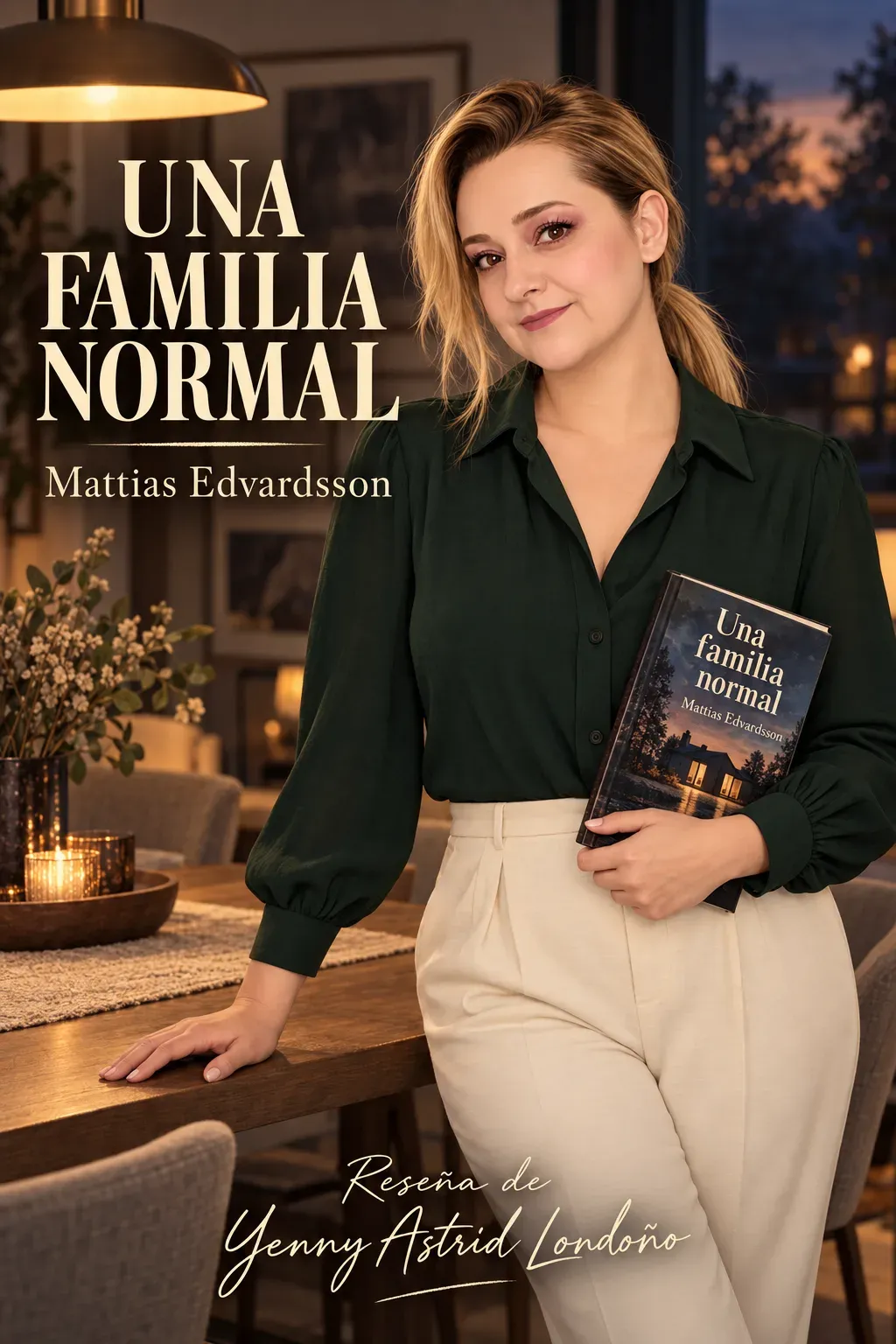
The Book
A Nearly Normal Family
Psychological thriller and family drama
by Mattias Edvardsson
4 out of 5 stars
I give A Nearly Normal Family 4 out of 5.
Stella is accused, and her parents discover a new scale of values
An accusation does not only threaten Stella's future. It changes the meaning of every earlier argument the family thought it had settled. A parent who once demanded honesty may begin asking whether honesty is useful right now. The shift can be moving and alarming at the same time. I do not doubt that Adam and Ulrika love their daughter. I doubt that love makes their choices automatically sound.
Stella should remain more than the problem her parents are trying to solve. She is young, but not an empty space where adults may project their fear. As the case gathers weight, I want to know what she wants and how she sees the family that claims to know her so well. Being eighteen means other people can still call you a child when it suits them and hold you fully responsible when that is more convenient. The novel works best when it notices that imbalance.
Stella is not an exercise in how quickly a reader can decide whether a young woman looks capable of murder. The charge reaches her parents as a threat to the person they love and to the story they have told themselves about their family. I can understand wanting to protect a daughter without automatically treating every protective act as noble. The difficult question is what Adam and Ulrika will permit themselves to believe once a comforting explanation becomes useful.
Adam can preach the right thing more easily than he can live it
Adam's profession gives him a vocabulary for morality. He knows how to speak about honesty, responsibility and the duty to other people. Those words carry different weight when the person under suspicion is his daughter. I like that the novel does not need to expose him as a secret hypocrite to make the conflict sharp. Most people are perfectly sincere about a principle until the bill arrives addressed to their own family.
His point of view is also limited. He remembers Stella as a father does, which means concern can sound a lot like knowledge. A parent may be right about a child's habits and still miss the part of her life that happens beyond the house. Adam's conviction can invite sympathy while narrowing the room Stella has to speak. I found myself asking whether he was protecting his daughter or protecting the version of fatherhood in which he always knows what protection requires.
Adam's position as a pastor makes the distance between public conviction and private panic impossible to ignore. It is easy to speak about truth and forgiveness when the person in the dock belongs to somebody else's congregation. At home, moral language begins to sound different. I do not read his struggle as proof that faith is a fraud; I read it as a test of whether his principles were meant to apply when they cost him something.
Ulrika knows the law; motherhood does not follow procedure
Ulrika understands cases, arguments and the difference between suspicion and proof. That professional experience should help her see the situation clearly. It also gives her tools for managing a story before anybody else can tell it. A lawyer's clarity and a mother's fear are not mutually exclusive; together they can be powerful and difficult to question.
I resist the easy claim that she ought to switch off her legal mind at home. Her knowledge matters. What I question is how it may shape which facts she emphasizes and which decisions she calls necessary. A person can use a good argument to protect someone, and also to avoid a truth that would make protection less comfortable. Ulrika is most interesting when her competence does not settle the moral question for us. Knowing the rules is not the same as being able to bear the result.
Ulrika has a lawyer's habits and a mother's investment, and those two forms of knowledge do not add up to a neutral witness. She understands how facts are presented, what an omission can do and how an innocent detail may look under examination. That expertise can help Stella, but it can also give Ulrika more sophisticated ways of avoiding a fact she does not want. Knowing the law does not mean you get to cross-examine your fear into silence.
Three voices move the judge's chair
The novel changes narrators, asking us to reconsider the same family from different positions. That is more useful than a final twist pasted onto a single voice. Adam's fear, Ulrika's control and Stella's account each reveal what another person could not or would not notice. We are not merely collecting clues; we are testing how a person turns incomplete knowledge into a story they can live with.
I enjoy that friction. It is tempting to choose the first speaker whose pain feels familiar and then treat later chapters as footnotes. Edvardsson keeps making that loyalty uncomfortable. A plausible explanation is not always a complete one, and the person who sounds calmest may simply have had more practice arranging facts. If you want to read this well, keep a little space between sympathy and a verdict.
The three perspectives do more than repeat the same scene with fresh pronouns. Each speaker decides where a story begins and which motive deserves the benefit of the doubt. I found myself correcting my own certainty as the family members took turns at the microphone. It is an effective reminder that intimacy gives people more evidence about one another and more reasons to misread it. A parent can know a daughter for eighteen years and still never have heard the version she tells herself.
The family's reputation has unpaid lawyers
Respectability can be a kind of defence before a lawyer ever enters the room. Adam's position, Ulrika's profession and the family's ordinary routines encourage others to imagine what people like them would or would not do. That social confidence can protect, but it can also stop a community from asking a necessary question.
I do not think the novel says every pleasant family has a monstrous secret. It shows how a good image becomes a resource once danger arrives. Who gets the benefit of doubt? Whose behaviour is read as a phase, and whose as evidence? The Sandells have spent years living inside a recognizable role. When the accusation lands, they can try to use that role to tell the world what kind of story this must be. The problem is that a family photo cannot testify under oath.
What did not work for me
The adult explanations occasionally circle their own point. Adam and Ulrika have complex reasons for what they do, but I did not need every justification repeated to understand the strain. A few passages made me want the book to trust its reader and leave one argument unfinished rather than having a parent rehearse it again.
More importantly, the parents' moral drama can crowd Stella. She is the person accused of murder, not merely the occasion for two adults to discover that their principles are flexible. The final shape of the story gains when her experience has weight beyond what it teaches them. I also wanted some judgments to be pushed by concrete consequences rather than by how persuasively a character explains an intention. Love is a motive. It is not a receipt proving that no one was harmed.
Some of the delayed disclosures are a little too convenient for a novel so interested in honesty. I can accept that people hide things out of fear; I become less patient when everybody seems to wait for the exact chapter in which their secret will improve the suspense. The book is strongest when the gap between accounts grows from character, not from a timetable. I wanted the moral mess to stay messy even after the plot began arranging its answers.
What this adds to the crowded family-thriller shelf
Many thrillers promise that a seemingly normal family hides a secret. This one is stronger when it asks what normal means to the people performing it. The Sandells do not have to be exceptionally bizarre for the question to sting. A child is in danger, and the parents discover that words they used confidently in ordinary life now come with exceptions.
The three perspectives also turn the familiar twist mechanism into an ethical one. New information changes not just who we suspect but what we think a parent owes a daughter and what a daughter owes her parents. I would discuss the book around a table without reducing the conversation to “Were they right?” A more revealing question is when each person stopped asking what Stella wanted and started deciding what her story should mean.
Who should read it, and what pace to expect
I recommend it to readers who like moral uncertainty, family loyalties and a suspense novel where a courtroom question rearranges domestic life. It is a standalone, so you do not need to arrive with a series diagram. The three-part structure is the point; give each voice time before deciding whom you believe.
If you want a police procedural built from forensic details or an action scene every chapter, this may feel slower and more reflective. The alleged murder matters, but so do the long habits that make the Sandells react as they do. I would also avoid descriptions that reveal how the narratives fit together. The reading pleasure lies in changing your mind for reasons the book actually gives you.
My rating: 4 out of 5 for a family with too many good explanations
I give A Nearly Normal Family 4 out of 5. Its shifting voices make the question of guilt inseparable from the question of loyalty, and the pastor-lawyer pairing provides a concrete pressure on ideas of right and wrong. I held back points for repeated adult justification and for moments when Stella feels crowded by her parents' need to interpret her.
The family may love one another. That is the beginning of the discussion, not its end. When an accusation arrives, each person starts discovering how much truth they can bear and how much they are willing to edit in the name of care. They can call the result protection. I am allowed to ask whom it protects first.
The 4.3 is for a family whose individual defenses keep changing the case against them. It loses points when a withheld fact feels placed by the author rather than concealed by the person living with it. What remains is a nasty, useful question: when you say you would do anything for your child, does that include asking her a question whose answer might hurt you? Love does not become smaller when it lets the truth into the room.
Frequently asked questions
Is A Nearly Normal Family the English title of Una familia normal?
Yes. Mattias Edvardsson's novel is published in English as A Nearly Normal Family and in Spanish as Una familia normal.
Who narrates the story?
Adam, Ulrika and Stella each provide a perspective. Their different accounts change how the reader understands the accusation and family history.
Is Stella eighteen?
Yes. Her age matters because the adults around her alternate between treating her as someone to protect and someone whose choices they must judge.
Is the book mainly a courtroom thriller?
The murder accusation drives it, but family dynamics and moral choices receive as much attention as the legal question.
Do you reveal whether Stella is guilty?
No. This review discusses the narrative structure and themes without giving away the resolution.
What was my biggest reservation?
Adam's and Ulrika's explanations can run long, and their moral crisis sometimes takes space Stella needs as a character.
Why do I rate it 4 out of 5?
The three voices and the clash between love, law and reputation are compelling. Repeated parental justification prevents a higher rating.
The Book
A Nearly Normal Family
by Mattias Edvardsson
Get the bookIf you buy through this link, Yenny earns a small commission and you pay the same price.
Keep reading
If you liked it, keep going

Javier Castillo
The Snow Girl
The Snow Girl: Kiera disappears and everyone moves on except her parents
Javier Castillo's The Snow Girl: Kiera vanishes at a New York parade and a tape reopens the case five years later. My honest review, 4 out of 5.
October 22, 2026
John Katzenbach
The Analyst
The Analyst: a birthday threat, fifteen days and a therapist who has lost control
John Katzenbach's The Analyst: a psychoanalyst gets fifteen days to find out who is threatening him. My honest review of this thriller.
October 22, 2026
Juan Gómez-Jurado
The Patient
The Patient: the President on the operating table and a daughter nobody can trade
Juan Gómez-Jurado's The Patient: a neurosurgeon, a President on the table and a kidnapped daughter in sixty-three hours. My honest review.
October 22, 2026
Want more like this? Join the Readers Club and get one of my books for free.
Share
My books
Books by Yenny Astrid Londoño



About the author
Yenny Astrid Londoño
Yenny Astrid Londoño is a Colombian author and entrepreneur, founder of Anchetas Medellín. She writes about real life with sarcasm, irony and smart humor, turning everyday situations, mistakes and imperfect relationships into stories that readers can laugh at and recognize themselves in.

A free book from me
Get a free book from me
Subscribe and get Sobreviviendo a mis muertos in full as a PDF.
After that, I'll only write when I have something worth telling you.
Also available: Read this review in Spanish →