
Book review
The Fifth Season by N. K. Jemisin:
In the Stillness, the end of the world has a calendar. Essun is looking for her daughter while the ground starts breaking again, and the society that survives these disasters is much better prepared for earthquakes than for treating people humanely. This is my spoiler-light review of N. K. Jemisin’s The Fifth Season, a book that makes catastrophe political before anyone has time to call it weather.
By Yenny Astrid Londoño · October 27, 2026 · 6 min read
Share
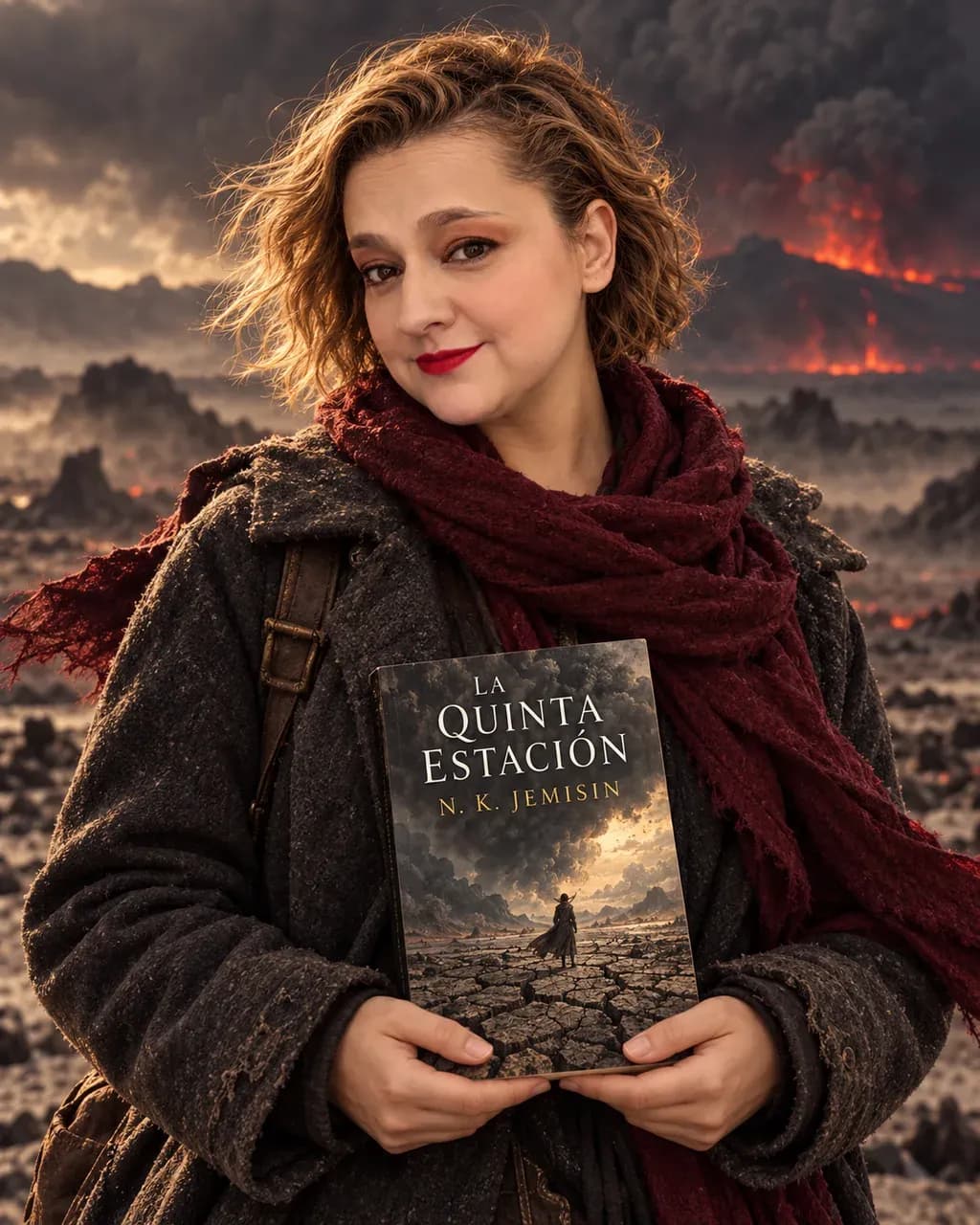
The Book
The Fifth Season
by N. K. Jemisin
4.5 out of 5 stars
The structure, the world and the protagonist strike me as memorable.
The apocalypse has a season in the Stillness
The Stillness is a continent built around the expectation that a catastrophe will eventually arrive. Communities prepare for long periods of ash, darkness and scarcity, and people learn practical rules for surviving them. But survival does not make the society fair. Orogenes—people who can sense and control seismic energy—may help prevent destruction, yet they are treated as dangerous tools to control.
That contradiction gives the world its bite. The society has organized itself around disaster and still finds ways to reproduce inequality inside every emergency plan. I like that the apocalypse does not erase the social structure; it makes the structure more visible and more dangerous. Someone has already decided who gets protected, who gets blamed and who is expected to be useful while everybody else panics.
Essun searches for her daughter while the world comes apart
Essun learns that her daughter has disappeared after a family tragedy, just as a catastrophic event begins a new period of darkness and scarcity. Her search is personal, urgent and shaped by a world that has already taught her what people do to those they fear. She is not looking for a chosen destiny; she wants her child back.
Essun’s pain gives the opening its force, though it also makes the tone heavy from the start. I understood the book was not planning to offer a cheerful tour of the end times. The more she learns about the people around her, the more the search becomes a question of what kind of survival is possible when the world has trained everyone to betray someone else first.
Being an orogene can save you and condemn you
Orogenes can sense and control the earth’s energy. Their ability may prevent a quake or an eruption, but the people with power do not treat them as neighbors with a skill. They are feared, trained, contained and used. The same ability that might save a community can make its owner a target.
Jemisin ties the magic system to the book’s politics. Power does not arrive as a neutral gift; institutions decide who is allowed to use it, who controls the training and what happens when a person refuses. The world’s cruelty is not an accident that the supernatural can fix. It is built into the way people organize safety and authority.
Three voices, three moments and one uncomfortable question
The novel shifts among three narrative threads and uses second person in one of them. At first, the changes ask for work. The voices are not simply three camera angles; they create a puzzle about identity, time and how much a narrator is willing to tell us. I appreciated that the structure has a reason and is not there just to make the book look clever on a shelf.
The second-person narration can create distance. Being told “you” may feel intimate to some readers and unsettling to others, as if the book has decided to assign you a life without asking. I got more out of it as the threads began to connect, but I was not instantly carried along. The form asks you to participate before it rewards you with the full picture.
The earth’s power comes with consequences
The geology is not just a source of dramatic scenery. It shapes where people live, how they prepare, which institutions hold authority and what counts as a safe future. A society that expects the ground to break has rituals and rules for surviving. It also has myths about who caused the disaster and who should be controlled next.
That gives the fantasy a climate-fiction edge without reducing the story to a lesson. The ground is a physical force, but the book is equally interested in the human systems that decide who pays for it. When you live through repeated catastrophe, every structure that claims to protect you deserves a few questions. Especially the ones that ask you to be grateful while locking the door.
A difficult book that does not carry you in its arms
Jemisin builds a world through unfamiliar terms, institutions and relationships. The writing does not stop to explain every concept as soon as it appears. That can make the setting feel mysterious and large; it can also leave readers trying to remember which group controls whom while the story moves on.
The prose is controlled and the structure is deliberate, but this is not a light read to clear your head. The book asks for attention to form, history and social power, and the subject matter stays heavy. I found that demanding quality rewarding when the pieces clicked. When the world’s rules were still unsettled in my mind, I wanted a clearer handhold that would not turn the novel into a manual.
What I did not like
The second-person voice may push some readers away, and the fragmented structure asks for effort before its connections become clear. I respect the purpose of the form, but a purposeful choice can still be difficult. In some stretches I wanted one of the voices to stay with me longer instead of switching threads just as I had begun to understand that character.
Essun’s grief is so strong that it leaves little room for other emotional shades early on. The tone remains heavy for long sections. Some world concepts could also be explained more clearly without turning the book into a handbook. Ambiguity works best when it makes me curious; less so when I am trying to remember which institution controls whom.
My verdict: survival does not make a society fair
The Fifth Season understands that the end of the world does not erase inequality. It makes it more visible and more dangerous. Essun searches for her daughter in a society prepared for cataclysm but much less prepared to treat the people who might help it survive with humanity.
The risky narrative form, the power system and the geology running through daily life all stayed with me. It takes attention, and its tone offers little rest. I would not recommend it as light entertainment for switching off your brain. I would recommend it as fantasy and speculative fiction that refuses to separate magic from politics or survival from human choices.
Who should read it
Read it if you enjoy speculative fiction that changes the rules of narration and asks who controls resources when everything is at risk. If you want instant explanations, immediately likable characters and an apocalypse solved by one neat mission, this is not that line. The Stillness has other priorities and could frankly use a customer service desk.
My rating
4.5 out of 5 stars. The structure, the world and Essun are memorable. I take off half a star because the form can create distance, the tone gives little rest and several concepts need close attention to settle. The book asks a lot; it gives a lot back, though not always in the form of a comfortable chair.
Frequently asked questions
What is The Fifth Season about?
Essun searches for her missing daughter after a family tragedy as a geological catastrophe begins a new season of darkness and scarcity in the Stillness.
Is The Fifth Season the first book in a trilogy?
Yes. It opens N. K. Jemisin’s Broken Earth trilogy, followed by The Obelisk Gate and The Stone Sky.
What is an orogene?
An orogene is a person who can sense and manipulate seismic energy, an ability the society both needs and fears.
Why is part of the novel narrated in second person?
The second-person voice is part of the novel’s structure and connects to its questions about identity and perspective. It may feel unusual at first.
Is The Fifth Season fantasy or science fiction?
It combines speculative science fiction and fantasy, with an imagined world, unusual powers and geological catastrophe.
Is The Fifth Season easy to read?
It requires attention because the world, terminology and narrative structure unfold gradually. Its tone and subject matter are also intense.
Who would enjoy The Fifth Season?
Readers who like ambitious speculative fiction, political world-building and stories that experiment with point of view.
The Book
The Fifth Season
by N. K. Jemisin
Get the bookIf you buy through this link, Yenny earns a small commission and you pay the same price.
Keep reading
If you liked it, keep going
Tomi Adeyemi
Children of Blood and Bone
Children of Blood and Bone by Tomi Adeyemi: when magic returns, power refuses to hand it back quietly
This is an epic fantasy about magic taken away, political violence and a young woman deciding what to do with a power she barely understands. Zélie’s world has a strong identity, and the magic does not sit quietly in the corner while the palace makes decisions. Here is my spoiler-light review of Tomi Adeyemi’s first Legacy of Orïsha novel.
October 27, 2026

Scott Lynch
The Lies of Locke Lamora
The Lies of Locke Lamora by Scott Lynch: robbing the rich works until someone worse shows up
Crime fantasy, cons and a city where talent attracts trouble. Locke Lamora and the Gentlemen Bastards make their living by taking money from the rich—until a more dangerous player changes the rules. This is my spoiler-light review of Scott Lynch’s first Gentleman Bastards novel: a clever caper whose humor does not make its violence pretend.
October 27, 2026

R. F. Kuang
The Poppy War
The Poppy War by R. F. Kuang: passing the exam was the least of Rin’s problems
Military fantasy, an academy and a war that refuses to become decorative. Before my spoiler-light review of R. F. Kuang’s The Poppy War, here is the warning more useful than any synopsis: the novel includes extreme violence and scenes inspired by wartime atrocities. This is not a light adventure with pretty uniforms and battles for choosing a team from the couch. Kuang draws on twentieth-century Chinese history, and some scenes hurt because she does not turn horror into a heroic postcard.
October 27, 2026
Want more like this? Join the Readers Club and get one of my books for free.
Share
My books
Books by Yenny Astrid Londoño



About the author
Yenny Astrid Londoño
Yenny Astrid Londoño is a Colombian author and entrepreneur, founder of Anchetas Medellín. She writes about real life with sarcasm, irony and smart humor, turning everyday situations, mistakes and imperfect relationships into stories that readers can laugh at and recognize themselves in.

A free book from me
Get a free book from me
Subscribe and get Sobreviviendo a mis muertos in full as a PDF.
After that, I'll only write when I have something worth telling you.
Also available: Read this review in Spanish →