
Book review
The Name of the Wind by Patrick Rothfuss:
A red-haired innkeeper is hiding a life so enormous it has become a legend. He tells it with music, magic and enough confidence to make me want to ask for evidence instead of another song. This is a spoiler-light review of The Name of the Wind, the first book in Patrick Rothfuss’s Kingkiller Chronicle.
By Yenny Astrid Londoño · October 26, 2026 · 7 min read
Share
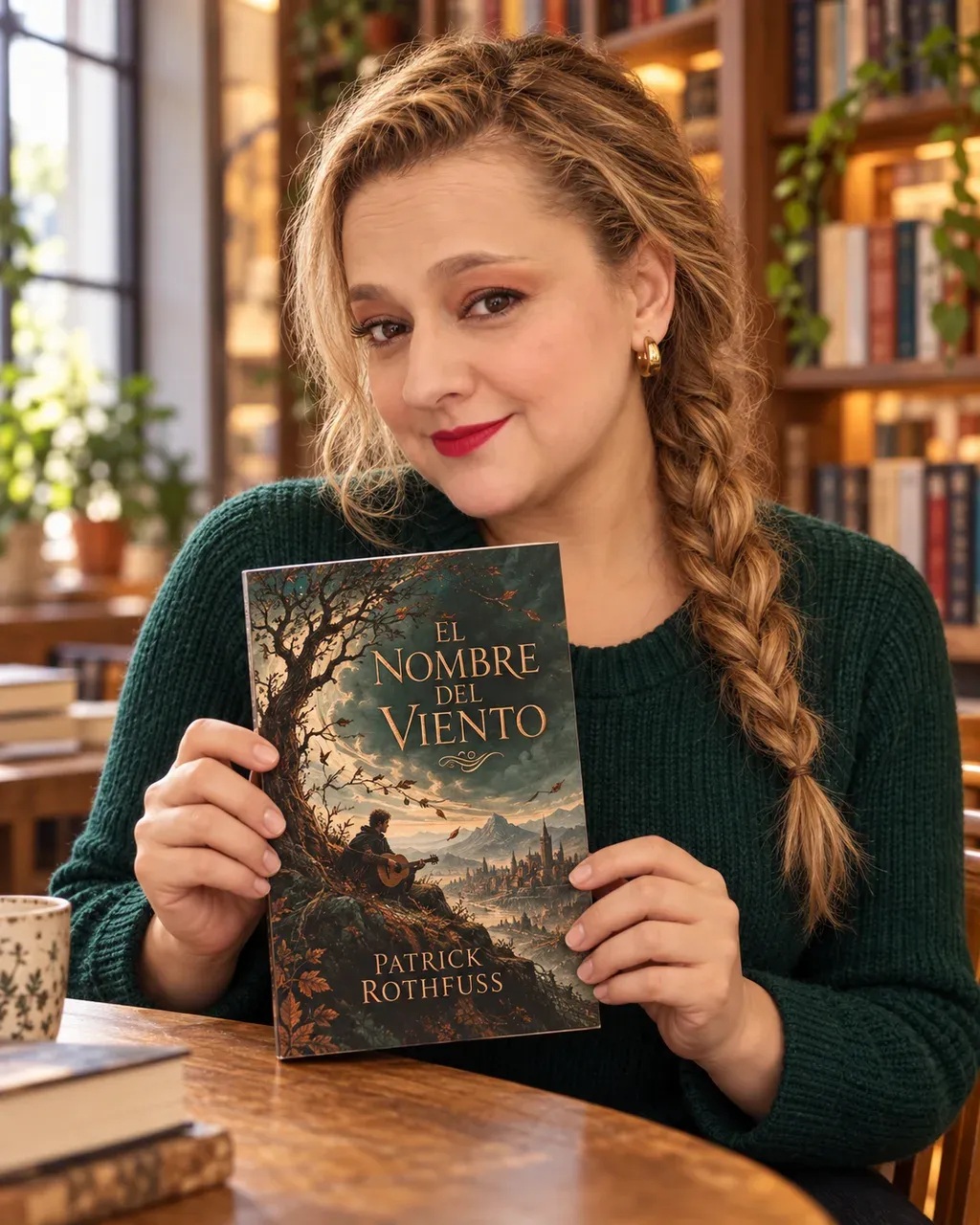
The Book
The Name of the Wind
by Patrick Rothfuss
4 out of 5 stars
The prose and the structure keep me going; the delay and the focus on Kvothe, which is too narrow, cost it a star.
The innkeeper who used to be far too many things
Kvothe now lives under another name in a quiet inn, looking like a man who has put his life away. Then Chronicler arrives, a scribe who wants to record the story of the person people call a magician, musician, thief, killer and hero. Kvothe agrees to tell it over three days. This first novel covers only the first day, which means he has barely started his story and already has me waiting for the next installment. I admire the confidence. I also notice the calendar.
That frame gives the book its most interesting question: how much of Kvothe’s reputation is true, and how much is a talented young man polishing his own legend? He has a remarkable memory, a sharp tongue and plenty of reasons to choose what he tells. He is not simply recalling his life; he is editing it in front of us. I felt like Chronicler: listening, taking notes and occasionally wanting to say, “All right, son, less epic buildup. We have not even reached lunch.”
Before the University, there was a family
Kvothe grows up with a traveling troupe of performers. His parents and fellow travelers are his home, school and first stage. Music is not a decorative talent added to his character sheet; it is how he earns a living, connects with people and understands the world. That matters when violence tears that life away. The story does not turn him immediately into a polished hero. He faces abandonment, hunger and the ordinary cruelty of surviving without protection.
Rothfuss lets grief breathe instead of putting up a neon sign that says TRAUMA HERE. Kvothe is bright, but intelligence does not make every decision wise. Fear, pride and hunger can still lead him into trouble. He keeps believing that his mind will get him out of every mess, a habit many of us share right up until the bill arrives.
The University is not a scholarship for the broke
The University promises knowledge, studied magic and answers to questions Kvothe has carried for years. It also brings competition, money problems and a hierarchy that talent does not erase. Sometimes talent only lets you get into trouble with better vocabulary.
I like that magic requires study, practice, mistakes and consequences. Kvothe cannot wave a hand and order the universe to send him a convenient solution. The sympathy system has rules, and learning them gives the academic chapters their own appeal. My issue is that Kvothe is so exceptional that some people around him can feel arranged to confirm it. A few arrive to compete with him, admire him, distrust him or become a romantic possibility; some feel alive, while others seem to be helping the legend along. I came to hear a story and sometimes wanted somebody to take the microphone away from him for a minute.

Music, names and the need for everything to mean something
The novel understands that a song can hold a truth a report cannot explain. It also treats names as powerful: knowing a thing deeply can change your relationship to it. Music, magic and storytelling all return to the same question—how do we name what happened to us, and how large can a story grow after the person who lived it begins telling it?
Rothfuss’s attention to language is one of the book’s pleasures. A song has rhythm, an inn has a smell, and a conversation can leave something unsaid. At other times, I had already understood that music mattered and the book kept tuning the violin as if it had to convince the whole building. Kvothe knows he can tell a story. That confidence can be charming, but it also gives me reason to wonder what he has chosen to leave out.
A beautiful voice with a very real price tag: time
Rothfuss writes with a musicality that works in scenes, not just in pretty sentences. The book has atmosphere, humor and a memorable point of view. It also takes its time. The story follows Kvothe through stretches of learning, work, money trouble and longing; it is interested in the texture of his life as much as in the plot’s forward motion.
That slow pace is not automatically a flaw. Some readers want to live in the world; others want the story to pick up the pace before they forget why they walked into the room. I enjoyed the detail when it deepened a character or idea. When it repeated what the book had already made clear, I started checking how many pages were left. A lyrical sentence can be lovely and still take the scenic route without asking.

Kvothe is fascinating, and I still do not trust his version completely
The frame makes us listen to an older Kvothe describe the gifted child he was. That distance gives the story humor and sadness, but it also means the narrator knows exactly where to make himself look brilliant. We see moments of fear, bad judgment and loneliness, yet the whole account arrives through the person whose reputation is under examination.
I like that tension. It asks us to enjoy the performance and keep our eyebrows raised. Kvothe can be genuinely talented and still be telling the story in the way that makes him sound most impressive. Those things are not mutually exclusive; anyone who has ever retold an argument to a friend knows this.
A coming-of-age story that refuses to sprint
The book follows Kvothe from a lively childhood through loss and into a world of institutions, rules and people who can help or hurt him. It is a story about becoming skilled, but also about the stories we make to explain who we have become. The fantasy does not hurry through that transformation. It wants us to notice what he learns, what he loses and the habits he carries forward.
The novel’s scale is intimate in some chapters and legendary in others. That contrast works best when the everyday details keep the myth from floating away. The result is less a sequence of quests than a long conversation with a character who knows the power of a good pause. Sometimes he uses that power beautifully. Sometimes I would like him to get to the point before the next song.
What I did not like
The main drawback is the pace. The book can linger on details long after I have understood their purpose, and the first installment does not give much closure to the larger story it opens. That is especially frustrating because the frame promises a three-day account and then stops after day one. I know series are allowed to continue; I still reserve the right to notice when a book ends by pointing toward another book.
I also wanted more people around Kvothe to feel like they had stories of their own, rather than orbiting his brilliance. Some relationships are compelling, but others seem to exist mainly to admire, challenge or desire him. The book is aware of his legend, which helps, but awareness does not always make the imbalance disappear.
Who should read it
Read The Name of the Wind if you enjoy lyrical fantasy, a protagonist with a theatrical streak, detailed magic and a world that rewards attention. It works for readers who like to spend time with a character rather than race from one battle to the next. If you need fast plot movement and a satisfying standalone ending, this may test your patience.
You should also be comfortable beginning a larger story whose full shape remains unresolved. I enjoyed the music, the University and the question of how much Kvothe’s legend owes to Kvothe himself. I did not enjoy every pause, but I kept listening.
My rating
4 out of 5 stars. The prose and structure keep me invested; the slow pace and the story’s intense focus on Kvothe take away the fifth star. The book promises a legend, and I want to see whether the man telling it can handle us checking the details. I enjoyed the voice, but sometimes I wanted the story to stop admiring Kvothe long enough to let the rest of the cast breathe.
Frequently asked questions
What is The Name of the Wind about?
It follows Kvothe, a legendary figure who tells a scribe the story of his early life, from his childhood with traveling performers to his years at the University.
Is The Name of the Wind the first book in a series?
Yes. It is the first novel in Patrick Rothfuss’s Kingkiller Chronicle.
Is the book more about action or storytelling?
It focuses heavily on Kvothe’s voice, learning and personal history. There is danger and adventure, but the pacing is reflective rather than nonstop action.
What kind of magic appears in the novel?
The book includes sympathy, a form of magic with rules that characters study and practice, as well as other mysteries tied to names and knowledge.
Is The Name of the Wind a slow read?
It is deliberately detailed and spends time on music, study and everyday life. Readers who prefer a fast-moving plot may find it slow in places.
Does this review reveal the ending?
No. It discusses the premise, Kvothe’s narration and the themes without revealing the ending.
Who would enjoy this book?
Readers who like lyrical prose, character-focused fantasy, carefully developed magic and a narrator whose version of events invites scrutiny.
The Book
The Name of the Wind
by Patrick Rothfuss
Get the bookIf you buy through this link, Yenny earns a small commission and you pay the same price.
Keep reading
If you liked it, keep going

Tomi Adeyemi
Children of Blood and Bone
Children of Blood and Bone by Tomi Adeyemi: when magic returns, power refuses to hand it back quietly
This is an epic fantasy about magic taken away, political violence and a young woman deciding what to do with a power she barely understands. Zélie’s world has a strong identity, and the magic does not sit quietly in the corner while the palace makes decisions. Here is my spoiler-light review of Tomi Adeyemi’s first Legacy of Orïsha novel.
October 27, 2026

Scott Lynch
The Lies of Locke Lamora
The Lies of Locke Lamora by Scott Lynch: robbing the rich works until someone worse shows up
Crime fantasy, cons and a city where talent attracts trouble. Locke Lamora and the Gentlemen Bastards make their living by taking money from the rich—until a more dangerous player changes the rules. This is my spoiler-light review of Scott Lynch’s first Gentleman Bastards novel: a clever caper whose humor does not make its violence pretend.
October 27, 2026

N. K. Jemisin
The Fifth Season
The Fifth Season by N. K. Jemisin: the world breaks again, and Essun has to find her daughter
In the Stillness, the end of the world has a calendar. Essun is looking for her daughter while the ground starts breaking again, and the society that survives these disasters is much better prepared for earthquakes than for treating people humanely. This is my spoiler-light review of N. K. Jemisin’s The Fifth Season, a book that makes catastrophe political before anyone has time to call it weather.
October 27, 2026
Want more like this? Join the Readers Club and get one of my books for free.
Share
My books
Books by Yenny Astrid Londoño



About the author
Yenny Astrid Londoño
Yenny Astrid Londoño is a Colombian author and entrepreneur, founder of Anchetas Medellín. She writes about real life with sarcasm, irony and smart humor, turning everyday situations, mistakes and imperfect relationships into stories that readers can laugh at and recognize themselves in.

A free book from me
Get a free book from me
Subscribe and get Sobreviviendo a mis muertos in full as a PDF.
After that, I'll only write when I have something worth telling you.
Also available: Read this review in Spanish →