
Book review
The Priory of the Orange Tree by Samantha Shannon:
Court intrigue, dragons, different histories and women who have better things to do than decorate a throne room. Here is my spoiler-light review of Samantha Shannon’s The Priory of the Orange Tree, a standalone novel in the Roots of Chaos world. If the thousand-plus pages intimidate you, I will not lie: this is not exactly a pocket read for the bus. But it does build a world where women make the political decisions instead of waiting for men to finish making them.
By Yenny Astrid Londoño · October 26, 2026 · 7 min read
Share
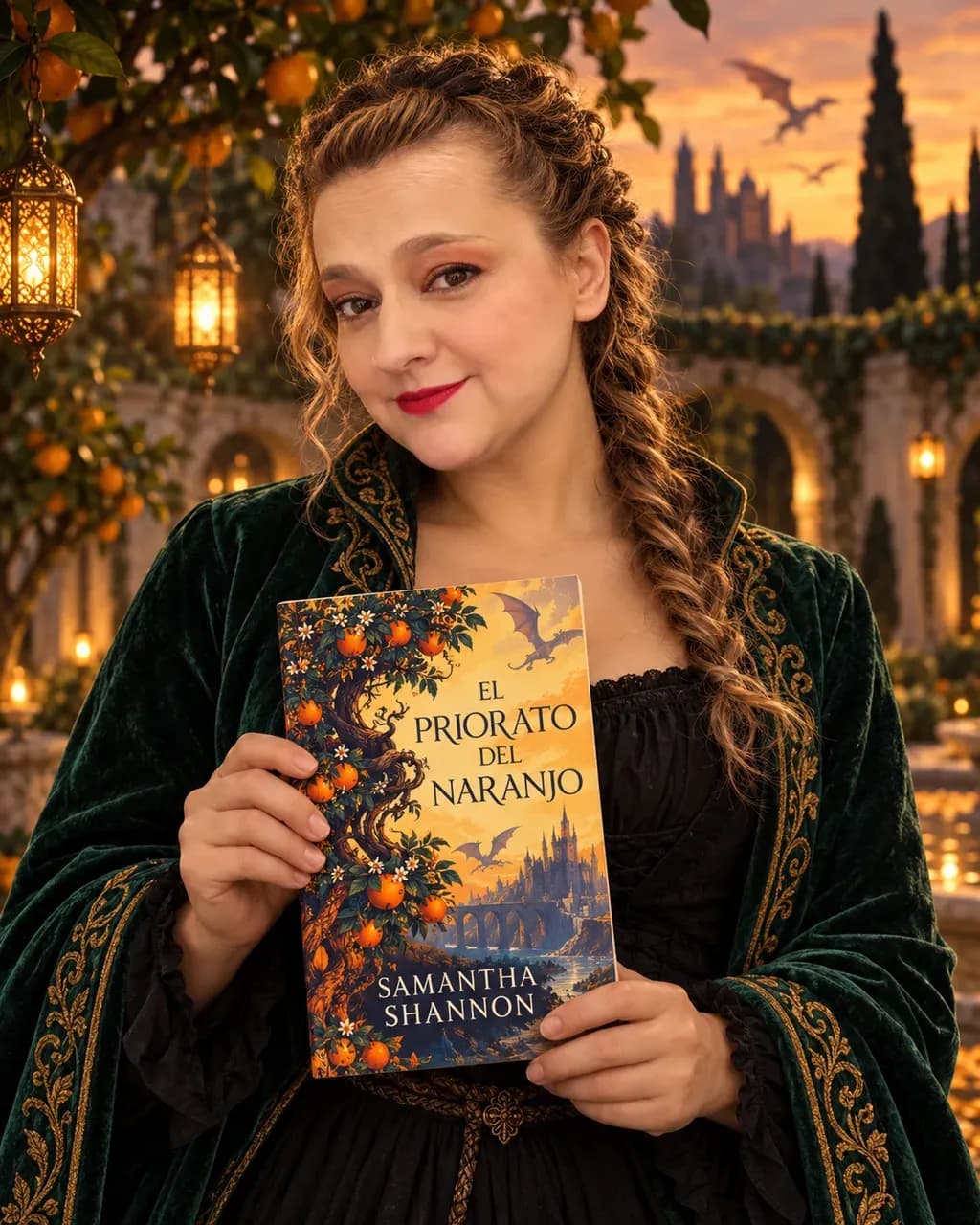
The Book
The Priory of the Orange Tree
by Samantha Shannon
4 out of 5 stars
The world, the intrigue and its protagonists convince me; the excess of names and some long stretches lower my enthusiasm.
A world divided by a history nobody tells the same way
The novel introduces a land divided by religion, politics and memories of an ancient threat. In the west, House Berethnet rules Inys, and Queen Sabran IX needs to secure an heir. In the east, other cultures keep different traditions and a closer relationship with dragons. Each side believes it has the correct version of history, and people defend their certainty with the confidence I wish they would use to check their own accounts.
The conflict is not resolved with a pretty map and one explanatory speech. Shannon distributes the information and lets characters reveal their prejudices, loyalties and fears as the stories approach one another. Sometimes I learned more from what someone refused to say than from the official version. The divide matters in daily life: whom people can trust, what they are taught and what counts as a threat.

Sabran rules with a crown and a clock ticking over her head
Sabran lives among protocol, advisers and an intimate political problem: the survival of her dynasty is tied to a prophecy about the return of the Nameless One. Everyone has an opinion about what she should do with her body, marriage and future. What a surprise: you get a crown, and suddenly strangers are ready to manage your breathing too.
I liked that Sabran is neither a cold queen who needs to learn to smile nor a perfect woman who solves politics with one clever sentence. She is trapped by a system that expects her to produce an heir while warning that every choice could weaken the kingdom. Her power is real, but it comes with conditions. Sometimes she makes decisions that frustrate me; at other times she understands better than the people around her what it costs to pretend everything is under control.

Ead is at court, but court does not own her
Ead Duryan arrives as a lady-in-waiting, though her true loyalty belongs to a secret society of mages. Her assignment is to protect Sabran without revealing where she comes from or how much she knows. Every conversation becomes careful work: listen, measure the danger and keep your face from giving away the plan. Ead can handle a dagger and an intrigue, but that does not mean she is allowed to make mistakes.
The relationship between Ead and Sabran is one of the book’s most compelling centers because it begins with distrust and develops through attention. They do not hand over instant faith just because the plot wants to speed things up. There are reasons to keep their distance and reasons to move closer. Ead is not defined only by her usefulness to the queen; she brings her own history, training and idea of what it means to serve someone.
Tané dreams of flying; nobody gives her the shortcut
In the east, we follow Tané, who has spent years preparing to become a dragonrider. Her future depends on discipline, choices and a society with its own rules. She does not have Sabran’s privilege, but she also lives with other people trying to decide what she can become. The book understands that ambition is not always a speech. Sometimes it is getting up early, training and continuing while everyone measures you.
Tané’s story opens the map and introduces another culture without turning it into an exotic postcard. There are hierarchies, traditions, dangers and internal conflicts. When her decisions lead her away from the path she planned, the novel does not label them a simple mistake destiny will correct in two chapters. They have consequences and make her look directly at herself. Decisions matter. How inconvenient, especially when we later have to analyze them from the couch.
Water dragons, fire dragons and historical accounts to settle
The dragons are not all the same scaled creature designed for the cover. Eastern and western traditions understand them differently, and that difference feeds the central conflict. Some are linked to the sea; others are associated with the danger the west fears. The past shapes how communities interpret every new sign. The mythology is connected to politics, not pasted on like a sticker to make the book look more epic.
The novel plays with a good question: what happens when two peoples build their identities around opposing stories of the same danger? You cannot just say, “You misunderstood,” and expect everyone to hug. Distrust has already settled into institutions and family memory. Shannon lets the legends have consequences, which gives the fantasy real weight. There are so many names, places and versions, though, that I would have welcomed an emotional map alongside the geographical one.
Several points of view, and quite a lot of luggage
The book moves among characters and regions. That lets a decision at court echo through a distant journey and shows the world from very different positions. It also demands attention. This is not a novel to read two pages with your phone in one hand and a grocery list in the other, unless you enjoy returning and wondering whether you are in Inys or looking for someone on another continent.
The prose likes atmosphere, ceremony and detail. In court scenes, that richness helps: a conversation can weigh as much as a duel, and an invitation can sound like a threat wrapped in silk. On the road, the pace stretches. Some scenes could reach their point sooner and let the reader discover the world without greeting every stone. Not every detail needs its own welcome ceremony.
What I did not like
The size and number of names can pull a reader out of the story. The novel introduces several regions, orders, beliefs and characters with the confidence of someone assuming I already have the family tree open in another tab. I like complex worlds; I also like knowing who is negotiating with whom without having to recite a list before bed.
The pacing is uneven. Some court chapters have delicious tension; other stretches take their time as if the dragon asked to stop and stretch its wings. The storylines take a while to meet, and some supporting characters deserve more development. The two mythologies can be contrasted so insistently that I wanted certain people to exist outside their function in the grand conflict.
My verdict: women make the moves
I like The Priory of the Orange Tree for its women with power, desire, doubts and decisions of their own. Sabran, Ead and Tané are not waiting in line for a hero to explain their world. Each lives inside a different structure, and the book understands that ruling, protecting someone and pursuing a dream all come with different costs.
I would not ask this novel to be short; its ambition needs room. I would ask it to trim a few detours and trust that readers can connect some of the pieces without having them all laid out at once. There are dragons, diplomacy, magic and an ancient threat. What holds the whole thing together is human decision-making, which tends to be more complicated than a creature with teeth.
Who should read it
Pick it up if you enjoy ensemble fantasy, secret-filled courts and worlds where mythology helps explain who holds power. If you want a story that explains everything in three pages and walks you gently through the rest, this book will be checking the clock while you study the map. Come prepared with patience, coffee and a desire to watch the women in the kingdom make their own moves.
My rating
4 out of 5 stars. The world, intrigue and women at its center won me over; the excess of names and long stretches lowered my enthusiasm. This is expansive fantasy with more politics than dragon racing, which works for me as long as the journey does not keep circling the same landscape.
Frequently asked questions
What is The Priory of the Orange Tree about?
It follows several characters in a divided world as an ancient threat approaches. Queen Sabran must protect her dynasty, Ead watches over her from court, and Tané pursues the chance to become a dragonrider.
Who are the main characters?
The story follows Sabran IX, Ead Duryan and Tané, alongside other characters such as Niclays Roos. Their stories begin in different regions and connect over time.
Is The Priory of the Orange Tree part of a series?
It belongs to Samantha Shannon’s Roots of Chaos world and can be read as a standalone novel, though other books explore the same world.
Is there romance in The Priory of the Orange Tree?
Yes, but the novel also devotes substantial space to politics, magic, friendship and tensions between kingdoms. Romance does not replace the epic conflict.
Is it a fantasy book with dragons?
Yes. Dragons are central to different cultures in the world, though not every character understands them in the same way.
Is The Priory of the Orange Tree a fast read?
Not necessarily. It is a long, multi-point-of-view novel with extensive world-building. Its pace varies between court intrigue, travel and political developments.
Who would enjoy it?
Readers who like epic fantasy with several women protagonists, court intrigue, competing mythologies and room for a story to unfold slowly.
The Book
The Priory of the Orange Tree
by Samantha Shannon
Get the bookIf you buy through this link, Yenny earns a small commission and you pay the same price.
Keep reading
If you liked it, keep going

Tomi Adeyemi
Children of Blood and Bone
Children of Blood and Bone by Tomi Adeyemi: when magic returns, power refuses to hand it back quietly
This is an epic fantasy about magic taken away, political violence and a young woman deciding what to do with a power she barely understands. Zélie’s world has a strong identity, and the magic does not sit quietly in the corner while the palace makes decisions. Here is my spoiler-light review of Tomi Adeyemi’s first Legacy of Orïsha novel.
October 27, 2026

Scott Lynch
The Lies of Locke Lamora
The Lies of Locke Lamora by Scott Lynch: robbing the rich works until someone worse shows up
Crime fantasy, cons and a city where talent attracts trouble. Locke Lamora and the Gentlemen Bastards make their living by taking money from the rich—until a more dangerous player changes the rules. This is my spoiler-light review of Scott Lynch’s first Gentleman Bastards novel: a clever caper whose humor does not make its violence pretend.
October 27, 2026

N. K. Jemisin
The Fifth Season
The Fifth Season by N. K. Jemisin: the world breaks again, and Essun has to find her daughter
In the Stillness, the end of the world has a calendar. Essun is looking for her daughter while the ground starts breaking again, and the society that survives these disasters is much better prepared for earthquakes than for treating people humanely. This is my spoiler-light review of N. K. Jemisin’s The Fifth Season, a book that makes catastrophe political before anyone has time to call it weather.
October 27, 2026
Want more like this? Join the Readers Club and get one of my books for free.
Share
My books
Books by Yenny Astrid Londoño



About the author
Yenny Astrid Londoño
Yenny Astrid Londoño is a Colombian author and entrepreneur, founder of Anchetas Medellín. She writes about real life with sarcasm, irony and smart humor, turning everyday situations, mistakes and imperfect relationships into stories that readers can laugh at and recognize themselves in.

A free book from me
Get a free book from me
Subscribe and get Sobreviviendo a mis muertos in full as a PDF.
After that, I'll only write when I have something worth telling you.
Also available: Read this review in Spanish →