
Book review
The Way of Kings by Brandon Sanderson:
Roshar is not wallpaper behind the characters. Its storms, politics and rules decide what people can do, and that is only the start of the commitment. Brandon Sanderson opens The Stormlight Archive with a world, a war and enough pages to make your shoulder ask whether this fantasy book comes with a physiotherapist.
By Yenny Astrid Londoño · October 26, 2026 · 7 min read
Share

The Book
The Way of Kings
by Brandon Sanderson
More reviews by Brandon Sanderson →
4.5 out of 5 stars
The worldbuilding, Kaladin and the questions about honor convince me; the length, the slow start and the uneven pace stop me from giving it five without charging overtime.
A warning before you start
This is a long first volume in a very large series. It asks for patience while it establishes the world and shifts among several characters. If you expect a quick fantasy adventure that explains everything in the first chapter, this book has not received that memo. I recommend checking a sample and choosing a reading pace you can actually sustain.

Roshar is not a backdrop; it makes the rules
Roshar is shaped by highstorms, a harsh environment and societies built around surviving them. That changes architecture, habits, status and the way people think about danger. The worldbuilding works because the setting is not just a collection of exotic names. The storms affect daily life, and the culture grows from that pressure.
The cost is that the book asks us to learn many terms and systems. Some readers will enjoy building a mental map; others may feel that the glossary arrived before the plot offered them a place to sit.
The opening moves among timelines and characters who seem to be living in separate books. Kaladin is marked by war and loss; Shallan arrives with a private purpose; Dalinar, a military leader, clings to visions the people around him cannot interpret. The strands begin to speak to one another gradually, but the reader has to carry those differences for a while before seeing the shape they make.
Kaladin and the weight of staying alive
Kaladin has lived through loss and has to keep going in circumstances designed to break him. His sections bring the book’s emotional pressure closest to the surface. He is not inspiring because he never struggles; he is compelling because the struggle keeps returning and he has to decide what he can still protect.
The story handles despair as more than a dramatic pose. That gives his chapters real weight, though the intensity can make for a heavy read. There is no shame in taking breaks. The book will still be enormous tomorrow.
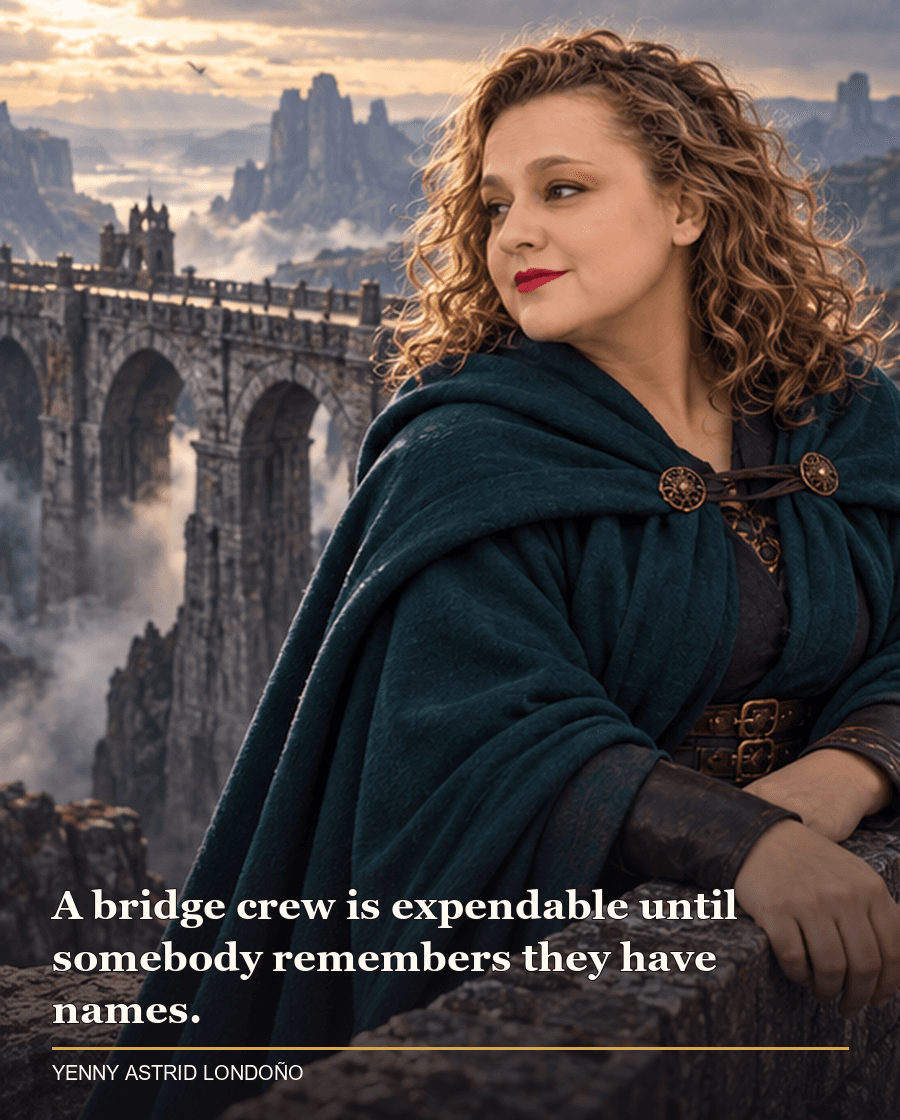
Kaladin’s role with the bridge crews makes responsibility concrete. He sees what it means when soldiers are treated as disposable pieces in somebody else’s strategy. The novel does not need a speech about the value of a life; it shows who gets to decide that some lives count for less. And when power turns people into a military calculation, the person doing the calculating is rarely running under the arrows.
Shallan has a plan and does not intend to tell you everything
Shallan enters with curiosity, a hidden agenda and a talent for sketching what she sees. Her chapters bring a different rhythm and a different kind of tension from Kaladin’s. She is trying to accomplish something while concealing what she needs, and the gap between the public explanation and private purpose keeps her interesting.
She travels to Kharbranth to study with Jasnah Kholin, but education is not her only reason for being there. Her drawings give her a way to think and preserve details she cannot yet explain. That creates a useful contrast with the military storyline: some characters want knowledge in order to understand; others want it because knowledge can be used to control people. In this book even a good question can become a weapon.
Her line moves more slowly than Kaladin’s. That did not bother me by itself, but the tonal shifts can make her story feel like a second novel placed inside the first. Once her choices connect to the larger world, the wait makes sense. Before that, I had to trust the author knew where all those locked drawers were going.
Dalinar and visions nobody wants in a strategy meeting
Dalinar is a powerful leader trying to decide whether the visions he experiences should change how he governs. His storyline brings questions of honor, authority and political trust into the fantasy. A leader can call something a vision, a duty or a prophecy; the people affected still have to live with the decision.
Dalinar carries a reputation built before the current crisis, and his allies do not always welcome it when the army’s most respected leader starts talking about signs and codes. I like that the conflict is not simply “is he good or bad?” It is what he does with the power he already has and whether it is possible to change how he uses it. A past does not disappear because someone has read a moral text and decided to improve. People are not apps that update while they sleep.

The magic arrives as a mystery, not an emergency button
Sanderson reveals the rules gradually. The magic system has structure and consequences, which makes discovery satisfying when details begin to connect. It also means explanations sometimes slow the action. I like a system that obeys rules; I like it slightly less when the book pauses to introduce the rulebook while everyone is waiting for the next scene.
The mysterious swords, armor and bonds are tied to a deeper history, and the book does not hand over the whole manual at once. Sometimes we discover a rule with a character; sometimes we wait several chapters while the book gives us a look that says “later.” That mystery works because magic is part of the moral and political problem: who gets to use power, what it costs and how it relates to a society that has turned certain weapons into symbols while forgetting what they meant.
A war story asking who pays for victory
The book gives battles political and personal consequences. Honor is not an abstract word when soldiers, workers and families pay for the decisions of leaders. The story is strongest when its scale does not erase individual lives.
The conflict in the Shattered Plains has continued so long that people keep fighting even when they no longer remember why it began. Leaders chase rewards and prestige; soldiers put their bodies in the path of danger. Every faction can call its own strategy honorable and the other side’s disgraceful. The work of the bridge crews and the distance between the person giving an order and the person running under fire show how violence can hide inside hierarchy, not only inside a sword.
Sanderson asks what honor means without turning it into a magic word that fixes everything. Being honorable can mean disobeying an order, telling a truth that harms your position or protecting somebody who cannot repay you. I like those questions. When they pile up back-to-back, though, I start to feel as if each protagonist is preparing a conference talk before going back to battle.
What I did not like
The length, the slow opening and the uneven pacing kept me from giving it five stars. Some explanations interrupt momentum, and the many names and points of view ask for a lot of attention before the larger design comes into focus. The world is ambitious; a reader still has only one back and one daily schedule.
There are characters, titles, maps, new words and a past that appears without explaining itself all at once. I enjoy detailed worlds, but not every proper name earns the amount of space it takes. The length is not automatically a virtue, even when a book behaves as if being heavy is itself a positive review. The prose is clear, but its solemnity can repeat the same note: honor, duty, pain, hope. Those themes matter; they do not need trailer music every time they enter the room.
The map is not the destination
I recommend it to readers who want to settle into a large fantasy world and do not mind learning its rules on the way. Come for Roshar, stay for the characters—and maybe stretch before picking the book up again.
My rating
4.5 out of 5 stars. The worldbuilding, Kaladin and the questions about honor convince me. The length, opening and uneven pace stop me from handing out five stars without charging the book overtime.
Frequently asked questions
Is The Way of Kings the first Stormlight Archive book?
Yes. It is the opening novel of The Stormlight Archive.
Who are the main characters?
The story follows Kaladin, Shallan and Dalinar, among other characters whose paths connect to the larger conflict.
What is The Way of Kings about?
It begins a sweeping fantasy story set on Roshar, where war, political power, survival and mysterious abilities shape several characters’ lives.
Can I read it without knowing other Sanderson books?
Yes. It starts a new series and does not require reading another Cosmere book first.
Is it a fast read?
No. It is long, detailed and paced as the first volume of an epic series.
Does magic play a major role?
Yes, though its rules and significance unfold gradually.
Who would I recommend it to?
Readers who enjoy detailed worldbuilding, multiple viewpoints, long arcs and fantasy that rewards patience.
The Book
The Way of Kings
by Brandon Sanderson
Get the bookIf you buy through this link, Yenny earns a small commission and you pay the same price.
Keep reading
If you liked it, keep going

Tomi Adeyemi
Children of Blood and Bone
Children of Blood and Bone by Tomi Adeyemi: when magic returns, power refuses to hand it back quietly
This is an epic fantasy about magic taken away, political violence and a young woman deciding what to do with a power she barely understands. Zélie’s world has a strong identity, and the magic does not sit quietly in the corner while the palace makes decisions. Here is my spoiler-light review of Tomi Adeyemi’s first Legacy of Orïsha novel.
October 27, 2026

Scott Lynch
The Lies of Locke Lamora
The Lies of Locke Lamora by Scott Lynch: robbing the rich works until someone worse shows up
Crime fantasy, cons and a city where talent attracts trouble. Locke Lamora and the Gentlemen Bastards make their living by taking money from the rich—until a more dangerous player changes the rules. This is my spoiler-light review of Scott Lynch’s first Gentleman Bastards novel: a clever caper whose humor does not make its violence pretend.
October 27, 2026

N. K. Jemisin
The Fifth Season
The Fifth Season by N. K. Jemisin: the world breaks again, and Essun has to find her daughter
In the Stillness, the end of the world has a calendar. Essun is looking for her daughter while the ground starts breaking again, and the society that survives these disasters is much better prepared for earthquakes than for treating people humanely. This is my spoiler-light review of N. K. Jemisin’s The Fifth Season, a book that makes catastrophe political before anyone has time to call it weather.
October 27, 2026
Want more like this? Join the Readers Club and get one of my books for free.
Share
My books
Books by Yenny Astrid Londoño



About the author
Yenny Astrid Londoño
Yenny Astrid Londoño is a Colombian author and entrepreneur, founder of Anchetas Medellín. She writes about real life with sarcasm, irony and smart humor, turning everyday situations, mistakes and imperfect relationships into stories that readers can laugh at and recognize themselves in.

A free book from me
Get a free book from me
Subscribe and get Sobreviviendo a mis muertos in full as a PDF.
After that, I'll only write when I have something worth telling you.
Also available: Read this review in Spanish →