
Book review
The Widow:
Fiona Barton's The Widow: Jean Taylor, a journalist and the truth about a husband's crime. My honest review, 3.5 out of 5.
By Yenny Astrid Londoño · October 9, 2026 · 11 min read
Share
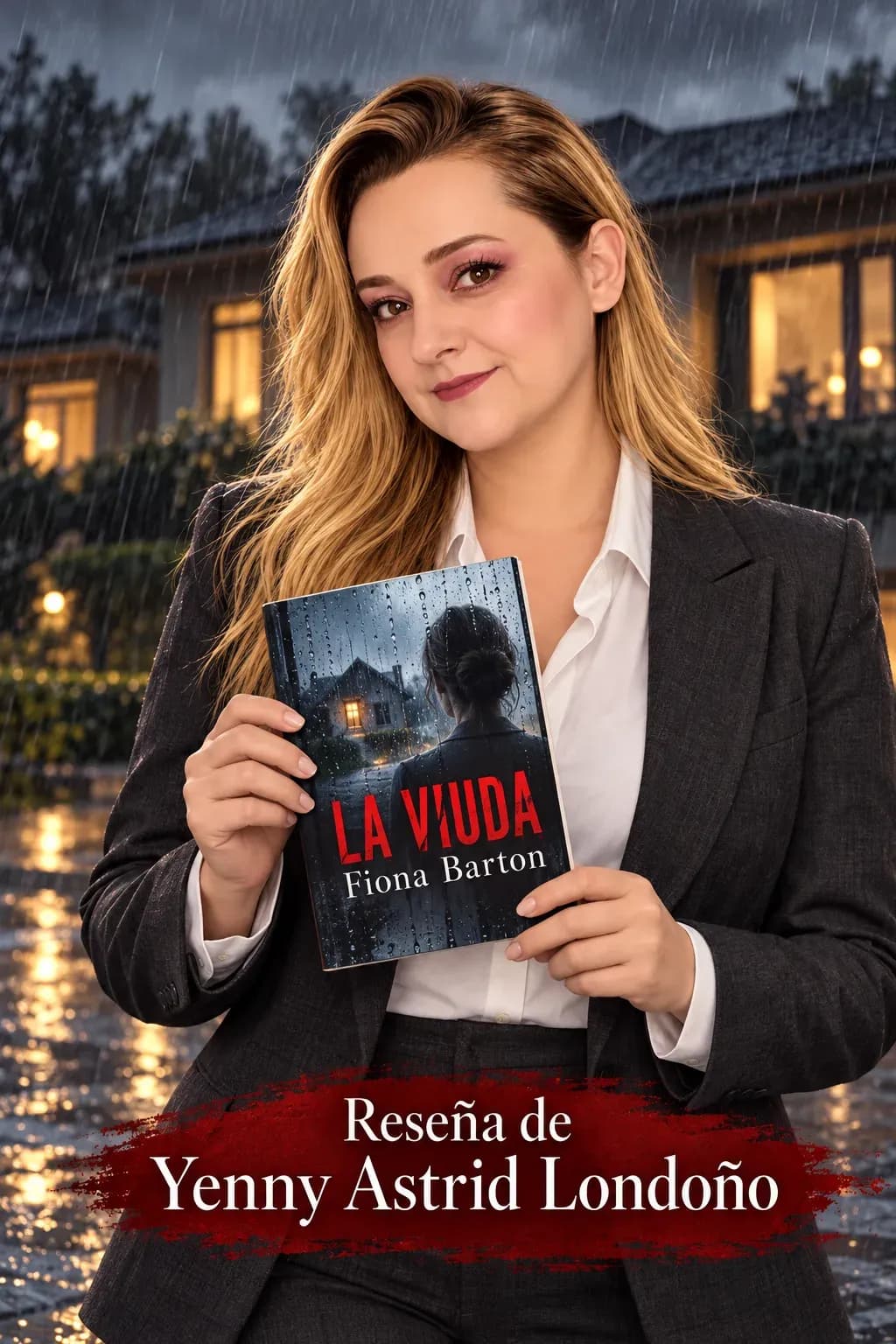
The Book
The Widow
Psychological thriller
by Fiona Barton
3.5 out of 5 stars
Jean's voice and the crossing between intimacy, investigation and journalism sustain the interest.
After Glen dies, Jean is left with questions about what she knew, what she said, and who gets to turn her grief into a public story.
La viuda
Fiona Barton · Crime fiction and psychological thriller
Yenny’s rating: 3.5 out of 5 stars
Amazon affiliate link. As an Amazon Associate, I may earn from qualifying purchases.
What this review covers
A widow inherits the questions, not the whole explanation
“I didn’t know” can mean several things. It can describe real ignorance, protect someone from a truth they could not face, or try to stop other people from asking. Fiona Barton builds The Widow around that distance. Jean Taylor’s husband, Glen, dies after becoming the focus of a criminal investigation into a child’s disappearance. Now the police and the press want to know what Jean knew and when.
The premise is not that a wife must automatically be guilty because she lived in the same house. It is also not that grief turns every memory into an acquittal. Jean shared a life with Glen; that gives her access to parts of his world, not a ready-made verdict about what she did with that access.
I like that the book makes us stay with the uncomfortable middle. We cannot infer complicity from proximity, but we cannot call every silence harmless because the person speaking is a widow. The details matter more than the label on the relationship.
The change in Jean's position is essential. While Glen is alive, the public sees the couple through the crime attached to him; after his death, Jean becomes the person everyone can question without worrying that he will answer back. That does not make her words false. It does make the imbalance uncomfortable, and the book keeps us aware of it.
The marriage keeps organizing what Jean can look at
A shared home does not guarantee shared knowledge. There can be doors nobody opens, questions nobody repeats, and explanations people accept because arguing would make daily life harder. That is not proof every marriage is a conspiracy. It is a reminder that relationships can train people where to look and when to stop.
In Jean’s case, the stakes are criminal. A troubling detail may be minimized; a story repeated often enough can become familiar enough to pass as memory. Fear, affection, habit, and self-protection can all shape how someone interprets what is in front of them. They do not all mean the same thing, and they do not erase the choices a person makes.
I resist two easy answers: the wife must have known everything, or the wife was powerless and therefore responsible for nothing. Both let us finish judging before we have read the evidence. A marriage can contain harm and still leave a person accountable for decisions inside it.
A person can be affected by a partner's control and still make choices within the relationship. Those facts do not cancel each other out. The novel is at its most useful when it lets us examine that difficult middle instead of handing us a ready-made moral category called 'the wife.' Jean's marriage matters, but it cannot answer every question about Jean for us.
Jean can present her grief and keep part of herself back
Jean’s sections are unsettling because she does not simply deliver information. She controls how it arrives. The reader has to consider not only what she says but why that detail, in that moment, is the one she is willing to offer.
That makes her more interesting than a narrator whose only job is to reveal a clue. Grief can be real while the person grieving still has a reason to protect a part of the story. If we decide emotion proves honesty, we are letting performance do the work of evidence. If we decide emotion proves deceit, we are doing the same thing with a different prejudice.
The book asks us to examine how someone can be affected by a relationship and difficult to read. Jean is not a solved case just because the marriage has ended. Some habits outlive the person who first taught them.
Her grief may be genuine and her account may still be selective; those ideas can occupy the same room. We often treat emotion as if it were a lie detector, trusting a performance that moves us or rejecting one that makes us uncomfortable. I would rather keep asking what the account gives us, what it leaves aside, and what would count as evidence beyond the way it feels.
Kate Waters wants a story; that does not make her neutral
Kate Waters needs access and a story the public will keep reading. Her attention can expose things people would rather leave buried, but journalism also turns a private life into material with a deadline and an audience. Listening closely and building a narrative about someone are related jobs, not identical ones.
That tension matters because Jean is not only a source or a headline. Kate's questions shape what gets said and what becomes visible to readers. The novel is sharper when it lets us notice the pressure behind the interview instead of treating the reporter as a transparent window onto the truth. A window can still have somebody choosing what gets framed.
The press can make a hidden case visible, but it also has to keep its audience interested. Kate's access to Jean gives the story an intimate angle, which may help readers see the person behind the headline. It can also leave Jean performing a version of grief for a public that has already decided what kind of widow it wants to meet.
Bob Sparkes looks for evidence while everyone else wants certainty
Detective Bob Sparkes has to build a case from evidence, not from the public's appetite for a quick answer. That difference may sound obvious, but a missing child and a notorious suspect make patience feel almost impolite. People want a name, a motive, and an ending they can repeat over dinner.
Police work cannot responsibly replace proof with the most satisfying theory. The book uses that gap to keep pressure on the investigation and on our own assumptions. We can suspect Jean, sympathize with her, or distrust her presentation; none of those reactions is evidence. I appreciate that distinction, even when I wanted the plot to stop circling the same question and hand us a new piece to examine.
Bob has to resist treating suspicion as a result. His case depends on what can be supported, not on whether the public finds Jean convincing or the marriage strange. I wanted the police work to move faster at points, but I respect the distinction between an answer that feels right and one the evidence can carry.
What I did not like about The Widow
The multiple perspectives and the aftermath of Glen’s death are central to the book, but the pace can feel measured for a thriller. Some stretches circle around what Jean may know before giving the reader enough new information to change the picture. I wanted a few of those returns to arrive with a sharper purpose.
The structure also makes the reader do a lot of interpretation. That can be the point, but it risks turning every pause or withheld detail into a clue. Not every silence needs a magnifying glass; sometimes a person is simply not ready to speak. The novel is strongest when it lets ambiguity breathe instead of asking it to carry every mystery at once.
I stayed interested in Jean and in the difference between public certainty and evidence. Still, a tighter middle would have made the tension more consistent and given the final movement more force.
Silence from fear and silence from refusal are not the same thing
The novel's central question is not simply whether Jean knew everything. It is what she noticed, what she could safely name, what she chose to avoid, and how those things changed over time. Fear can constrain a person; affection can confuse them; habit can teach them not to ask. Those forces deserve attention without becoming automatic acquittals.
I do not want the easy verdict that a wife must know every secret in her house. I also do not want the opposite shortcut, where marriage and grief erase every decision she made. The difference between being manipulated and cooperating cannot be solved by a label. It has to be considered through the details the story gives us.
Fear can explain why someone avoids a question, but an explanation is not automatically a complete answer. The distinction depends on detail: what a person knew, what choices were available, and what they did when the risk changed. The novel invites judgment, then makes me notice how quickly I want a simple verdict because ambiguity is more work than suspicion.
Who I would recommend it to—and what I would flag first
I would recommend The Widow to readers who prefer psychological tension, competing accounts, and the uncomfortable work of interpreting what a person says after their circumstances have changed. It is a better fit for people who enjoy a measured investigation than for anyone expecting a chase every twenty pages.
I would flag the missing child, harm to a child, media pressure, and manipulation within a relationship. This is not a light domestic mystery just because the title puts a wife at the center. The story's questions are worth discussing, but the person harmed should not become a decorative reason for the marriage to feel interesting.
Choose this one if you like a measured psychological mystery built around interviews, memory, and a marriage that cannot be reduced to one headline. I would not pick it for a fast police procedural or an uncomplicated domestic thriller. Its most interesting question is uncomfortable precisely because the book will not let me answer it just by deciding whether I like Jean.
My verdict: a widow is not a verdict
The Widow is a domestic crime novel about the space between knowing, suspecting, and choosing not to ask. Jean has to live with the story left behind by Glen, while Kate and Bob approach it from the very different demands of a newsroom and an investigation.
I give it 3.5 out of 5 stars. It is a good fit for readers who like unreliable perspectives and morally uncomfortable questions more than a race from one action scene to another. The pace is quieter than some thrillers, but its central question keeps working after the chapter ends: what does a person owe the truth when it could break the life they have built?
Jean’s grief deserves to be taken seriously. So do the people affected by Glen’s crimes. One does not cancel the other. I would rather sit with that tension than hand somebody a free pass or a ready-made sentence just because the ending would feel tidier.
Four stars for Jean's voice and for keeping sympathy separate from proof. My reservation is the balance: the marriage occupies so much of the novel that the missing child can risk becoming the force that makes the adults interesting. I needed the story to keep returning to the person harmed, not only the couple left behind.
Frequently asked questions
Yes. Its case can be followed on its own. Kate Waters also appears in other Fiona Barton novels, but you do not need to know those books to understand Jean Taylor’s story.
Glen’s death is part of the starting point, and the book also reconstructs the past. That change in time lets us examine what Jean can say as her circumstances shift.
Yes. It focuses on what Jean knows, what she withholds, and how the police and press view the case. Much of the tension comes from interpreting competing versions.
No. I examine the question of omission without answering it in advance. The identities, decisive events, and ending stay unspoiled.
She seeks information and access to Jean. Her role lets us question the difference between listening to a person and building a public story about her.
The novel includes a child’s harm and disappearance, media pressure, and manipulation within a relationship. I would not describe it as a light marriage mystery without mentioning the case at its center.
For Jean’s voice and the three perspectives on the case. I held back points for repetition around the central question and for how much room the victim gets beyond the marriage.
For the Spanish edition, check the publisher’s book page. The editions and translations may differ by market.
La viuda
Fiona Barton
About the author
I’m Yenny Astrid Londoño, a Colombian author and the founder of Anchetas Medellín. I write with sarcasm, irony, and humor about everyday life, without dressing it up.
The story behind the stories
From behind the pages
Stories, reviews, uncomfortable truths, and the occasional direct hit of sarcasm in your inbox. No spam and no calendar quotes.
Keep reading
© Yenny Astrid Londoño
Frequently asked questions
Is The Widow a standalone novel?
Yes. Its case can be read on its own; you don't need to know other novels to enter Jean Taylor's story.
Does Jean narrate after her husband's death?
Glen's death is part of the starting point. The book also reconstructs the past; that time difference lets the story examine what Jean can say when her situation changes.
Is it more psychological than an action novel?
Yes. Interest centers on what Jean knows, her silences and the police and journalistic gazes. Tension depends a lot on interpreting versions.
Does the review reveal what Jean knew or how the case ends?
No. It analyzes the question of omissions without answering it in advance. It keeps the identities, the decisive facts and the ending.
What role does journalist Kate Waters play?
She seeks information and access to Jean. Her presence allows discussion of the difference between listening to a person and building a story about her for the public.
What sensitive topics does it include?
Harm to and disappearance of a child, media pressure and manipulative relationships. I would not present it as a light marital mystery without mentioning the case that holds it up.
Why do I give it 3.5 out of 5?
For Jean's voice and the three perspectives on the case. The reservations are in the repetition of the central question and in how much room the victim keeps compared with the marriage.
The Book
The Widow
by Fiona Barton
Get the bookIf you buy through this link, Yenny earns a small commission and you pay the same price.
Keep reading
If you liked it, keep going

Camilla Läckberg and Henrik Fexeus
The Mentalist
The Mentalist: the trick is not the only thing under suspicion
Camilla Läckberg and Henrik Fexeus's The Mentalist: Inspector Mina Dabiri and mentalist Vincent Walder against a staged murder. Review, 4/5.
October 9, 2026

Camilla Läckberg
The Cuckoo
The Cuckoo: Fjällbacka remembers what it prefers to forget
Camilla Läckberg's The Cuckoo: a present-day investigation in Fjällbacka and an old crime that keeps coming back. My honest review, 4 out of 5.
October 9, 2026

Carmen Mola
The Mothers
The Mothers: Elena Blanco investigates a horror in a white coat
Carmen Mola's The Mothers: Elena Blanco investigates a horror that also knows how to wear a white coat. My honest review, 4 out of 5.
October 9, 2026
Want more like this? Join the Readers Club and get one of my books for free.
Share
My books
Books by Yenny Astrid Londoño



About the author
Yenny Astrid Londoño
Yenny Astrid Londoño is a Colombian author and entrepreneur, founder of Anchetas Medellín. She writes about real life with sarcasm, irony and smart humor, turning everyday situations, mistakes and imperfect relationships into stories that readers can laugh at and recognize themselves in.

A free book from me
Get a free book from me
Subscribe and get Sobreviviendo a mis muertos in full as a PDF.
After that, I'll only write when I have something worth telling you.
Also available: Read this review in Spanish →