
Book review
The Mentalist:
Camilla Läckberg and Henrik Fexeus's The Mentalist: Inspector Mina Dabiri and mentalist Vincent Walder against a staged murder. Review, 4/5.
By Yenny Astrid Londoño · October 9, 2026 · 6 min read
Share

The Book
The Mentalist
Mystery
by Camilla Läckberg and Henrik Fexeus
4 out of 5 stars
The contrast within the team and the use of illusionism as a criminal language support a strong premise.
A body turns an illusion into a real crime
The Mentalist begins with a disturbing murder staged like a magic trick. Inspector Mina Dabiri is pulled into the investigation and works with Vincent Walder, a mentalist who understands misdirection as a profession. Camilla Läckberg and Henrik Fexeus build the case around traps, performance, and the question of what a person can see when somebody else is carefully directing their attention. It is an inviting premise for a crime novel: the stage itself becomes part of the evidence.
I enjoy a mystery that makes me inspect the act of looking. An illusion does not make an object disappear; it makes the audience attend to the wrong thing. That is a useful idea for a novel about a criminal who wants to control what investigators notice. But once a body is part of the performance, the story has to remember that the spectacle was built around someone’s actual suffering. The killer may be proud of the trick. That does not mean the book should be equally dazzled by it.
Mina needs order; Vincent knows how to move attention
Mina and Vincent approach the work from very different places. Mina’s need for structure shapes how she experiences the investigation and the people around her. Vincent is practiced at reading attention, using performance, and making an audience believe it has seen more—or less—than it has. Their contrast gives the partnership its energy, especially when the novel lets each person’s skill meet the other’s limits rather than turning one of them into a walking instruction manual.
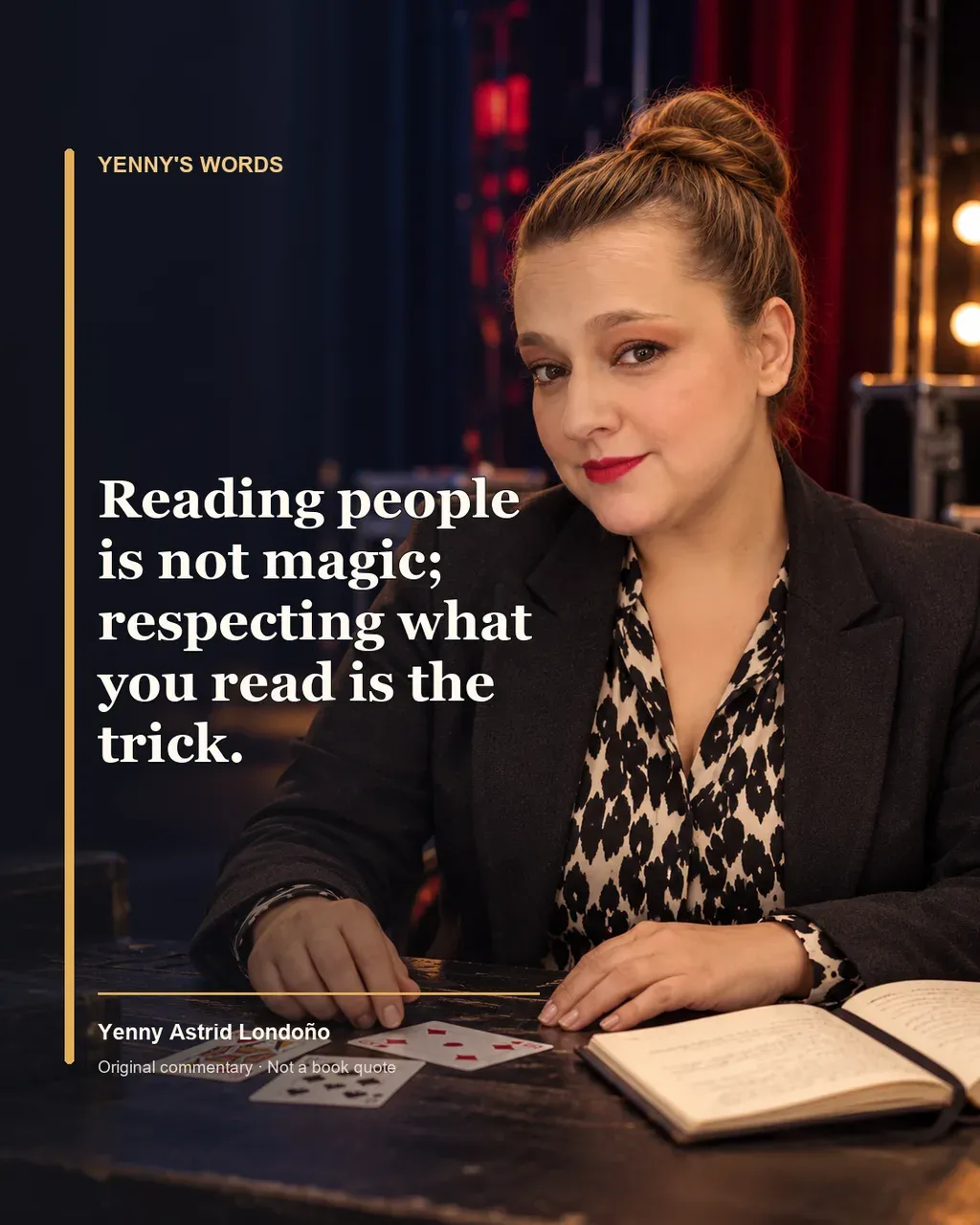
The word ‘mentalism’ can invite exaggerated claims about reading people. I appreciate that the book gives us an entertainer and investigator, not a magical authority who can diagnose a stranger’s whole soul from one eyebrow movement. In real life, reading a cue is not the same as knowing a person. In a thriller, that distinction can be deliciously useful: what a character infers, what they actually know, and what they want to be true are three different files. Someone should label the folders before the team starts making assumptions.
The investigation is strongest when the puzzle stays attached to people
The novel offers codes, staging, and a sequence of clues that ask the reader to think about the mechanics of a trick. That puzzle element gives the case momentum. I also like how illusion becomes more than a decorative profession: it is a way to talk about control, attention, and the gap between an event and the story someone tells about it afterward.
The risk is that each elaborate setup can make the perpetrator feel like the main attraction. The people harmed by the crimes should not become props in a demonstration of how clever the killer is. I kept wanting the investigation to return to what happened to them, who is telling their stories, and whether the puzzle’s elegance is making us forget the damage. A stage can be brilliantly designed and still be a place where someone paid for the performance with their life.
A long case needs character movement, not only more machinery
This is the opening of a series about Mina and Vincent, and the book lays out a lot: the central case, the investigative partnership, habits that affect the characters’ daily lives, and the possibilities for later installments. There is pleasure in watching a team learn how to work together, particularly when their differences make the job harder rather than conveniently complementary from page one.
The novel’s scale is part of its appeal, but length alone does not make a clue more satisfying. I want each new mechanism to change what Mina or Vincent understands, not simply add another impressive room to the criminal’s stage. The book works best when the personal detail affects the case and the case pressures the characters in a way that lasts after the next reveal. When those threads separate, the story can feel like it is asking me to admire the machine while the people wait in the hallway.

What I did not like about The Mentalist
My main reservation is the balance between spectacle and consequence. The elaborate traps and the criminal’s planning can receive so much attention that the victims risk becoming part of the set. I also found the book long, with details and character habits that sometimes repeat before the investigation has earned another loop. I do not mind a slow build if the extra pages deepen the people or sharpen the case. I do mind when a story seems to confuse one more mechanism with one more layer.
I give The Mentalist 4 out of 5 stars. The premise, the contrast between Mina and Vincent, and the use of illusion as a language of criminal control kept me reading. I hold back a star for the uneven pace and for moments when the performance threatens to take up more room than the lives caught inside it. The story has a good trick. I also want it to remember what the trick costs.
My verdict: a clever setup with a partnership worth following
I would recommend this to readers who like procedural mysteries with theatrical crimes, codes, and investigators whose skills do not neatly overlap. You do not need prior knowledge of Läckberg’s Fjällbacka books; this is a separate series written with Henrik Fexeus. The next books continue Mina and Vincent’s story, so the character relationship has somewhere to go beyond solving the first case.
The book left me thinking about who gets to control attention and what investigators risk when they start believing their own interpretations. That is more interesting to me than the idea that one clever person can read everybody else perfectly. The criminal wants to be remembered as a genius. Mina and Vincent have the harder task: make the case about the people harmed, not the performance that tried to erase them. I am curious about the next book, with one condition: keep the victims in the story, even when the killer has rented the brightest stage.
Frequently asked questions
Inspector Mina Dabiri works with mentalist Vincent Walder on a murder investigation involving staged crimes, illusions, and clues designed to control what people notice.
Mina is an inspector whose need for order shapes her work and daily life. Vincent is a professional mentalist who understands performance and misdirection. Their differences drive the investigative partnership.
No. It begins a separate series by Camilla Läckberg and Henrik Fexeus. Readers do not need to read the Fjällbacka books first.
Start with The Mentalist, then The Cult, followed by The Illusionist. The later books continue the characters and their relationship.
I give it 4 out of 5 stars for the theatrical premise, Mina and Vincent’s contrast, and its use of illusion in the investigation. I hold back a star for the length, repeated details, and the risk that the spectacle overshadows victims.
This review discusses the setup, investigative approach, and themes without spelling out the final solution or identities behind the case.
Frequently asked questions
Who are the protagonists of The Mentalist?
Inspector Mina Dabiri and the mentalist Vincent Walder. They work together on an investigation tied to illusion and staged crimes.
Is it part of the Erica Falck and Patrik Hedström series?
No. It is a different series, written by Camilla Läckberg with Henrik Fexeus. You can start without having read the Fjällbacka books.
In what order should the trilogy be read?
The Mentalist, La secta and El espejismo. Mina and Vincent's relationship continues, so I recommend following that order.
Do I need to know about mentalism to follow the case?
No. The novel provides the necessary context. Still, it is worth distinguishing a character's narrative inference from any supposed infallible ability to read real intentions.
Does the review explain the codes or reveal the killer?
No. It describes the type of investigation and its themes, but keeps the solutions to the traps, the identities and the ending.
Can it be long?
Yes, especially if you care more about the clues than about the setup of the characters. My criticism looks at the relation between length, repeated habits and the progress of the case.
Why do I give it 4 out of 5?
For the combination of illusionism and investigation and the contrast between Mina and Vincent. The reservations are about the length and the weight of the spectacle against the victims.
The Book
The Mentalist
by Camilla Läckberg and Henrik Fexeus
Get the bookIf you buy through this link, Yenny earns a small commission and you pay the same price.
Keep reading
If you liked it, keep going

Camilla Läckberg
The Cuckoo
The Cuckoo: Fjällbacka remembers what it prefers to forget
Camilla Läckberg's The Cuckoo: a present-day investigation in Fjällbacka and an old crime that keeps coming back. My honest review, 4 out of 5.
October 9, 2026

Fiona Barton
The Widow
The Widow: “I didn’t know” is not a complete answer
Fiona Barton's The Widow: Jean Taylor, a journalist and the truth about a husband's crime. My honest review, 3.5 out of 5.
October 9, 2026

Carmen Mola
The Mothers
The Mothers: Elena Blanco investigates a horror in a white coat
Carmen Mola's The Mothers: Elena Blanco investigates a horror that also knows how to wear a white coat. My honest review, 4 out of 5.
October 9, 2026
Want more like this? Join the Readers Club and get one of my books for free.
Share
My books
Books by Yenny Astrid Londoño



About the author
Yenny Astrid Londoño
Yenny Astrid Londoño is a Colombian author and entrepreneur, founder of Anchetas Medellín. She writes about real life with sarcasm, irony and smart humor, turning everyday situations, mistakes and imperfect relationships into stories that readers can laugh at and recognize themselves in.

A free book from me
Get a free book from me
Subscribe and get Sobreviviendo a mis muertos in full as a PDF.
After that, I'll only write when I have something worth telling you.
Also available: Read this review in Spanish →