
Book review
Knowing how to listen to others won't tell you where your husband is
Sara understands memory, fear and behavior. Her own home reminds her that knowing about something doesn't keep you outside it.
By Yenny Astrid Londoño · October 8, 2026 · 7 min read
Share

The Book
The Therapist
Nordic psychological thriller
by Helene Flood
3.5 out of 5 stars
Now she also needs someone to listen to her.
There is a very comfortable expectation about people who work listening to other people's problems: they should recognize their own immediately. The psychologist has to know when she's being lied to, the doctor should get sick discreetly, and whoever advises others should keep an orderly life so as not to discredit the craft.
What a generous standard to hold other people's humanity to.
Sara is a psychologist and lives with Sigurd in Oslo. He leaves her a message saying he's out with some friends. Later those friends call because he hasn't arrived. The contradiction seems small if you tell it quickly. Inside a marriage it has a different size.
It isn't only about finding out where someone is. It's that the voice you listened to left a version that no longer matches what the people around you are telling you. And that you still don't know whether you're facing a lie, an emergency or something much worse.
A voice message can stop being company
Listening to someone usually creates a sense of presence. They spoke, they warned you, they are where they said they'd be. You carry on with the day, leaning on that information without examining it.
When the friends' call contradicts the message, the sound keeps the words and loses the calm it brought. You can play back exactly the same voice and now hear something completely different.
That starting point strikes me as effective, because fear doesn't need to walk in making a scene. A discrepancy is enough. Everyday life stays available, but suddenly it requires interpretation.
If someone disappears after lying, the lie becomes a question with no one to answer it. You can be worried and furious at the same time. You need to know they're fine, and you also want to know what the hell they were doing.
I'm interested in there being room for that mix. Worry doesn't make the absent person a saint, and it doesn't oblige the person waiting to forget every earlier problem. A crisis can suspend an argument; it doesn't solve it by magic.

Sara knows how to listen and also has a life to interpret
Her profession adds a particular tension. We are used to the idea that whoever accompanies a conversation can watch what's happening with a certain distance. Here that distance begins to dissolve, because the matter is inside her own home.
Knowing the mechanisms of memory doesn't give you a flawless reproduction of your own memories. Knowing that fear changes attention doesn't let you switch it off when you need to sleep. The tool still exists; the person who has to use it is frightened.
I'm not interested in turning that into a spectacular paradox. It's a fairly human limitation. Nobody works with their own mind from outside it.
Also, listening to another person and looking at your own marriage demand different things. In a consulting room there's a space set up to attend to what a person tells you. At home there is shared history, tiredness, pending chores and many small ways of avoiding a conversation.
That Sara doesn't have extraordinary clarity about Sigurd doesn't invalidate her training. What it does is put her in a less comfortable place than the professional everyone turns to and who is supposed to understand everything already.
The house doesn't become unsettling only because of what may come in
Domestic life depends on an enormous number of small certainties. The door you closed, the object you left there, the noise you recognize without looking. We don't carry out an investigation every time we walk to the kitchen.
When uncertainty reaches those certainties, the house starts demanding attention in an exhausting way. It is no longer the place where you stop watching; it becomes the place you have to watch as well.
That idea unsettles me more than an obviously threatening scenario. You expect caution on an unfamiliar street. In your own bedroom you expect to be able to set that responsibility down for a while.
Flood works with an intimacy where routines matter. Domestic life offers a rhythm less strident than a chase, but it lets us understand what is at stake when a person stops recognizing her surroundings as safe.
There is no rest in continually checking whether you can rest. That sentence sounds tangled until someone takes away the calm of a house. Afterwards it becomes a fairly precise description of the day.
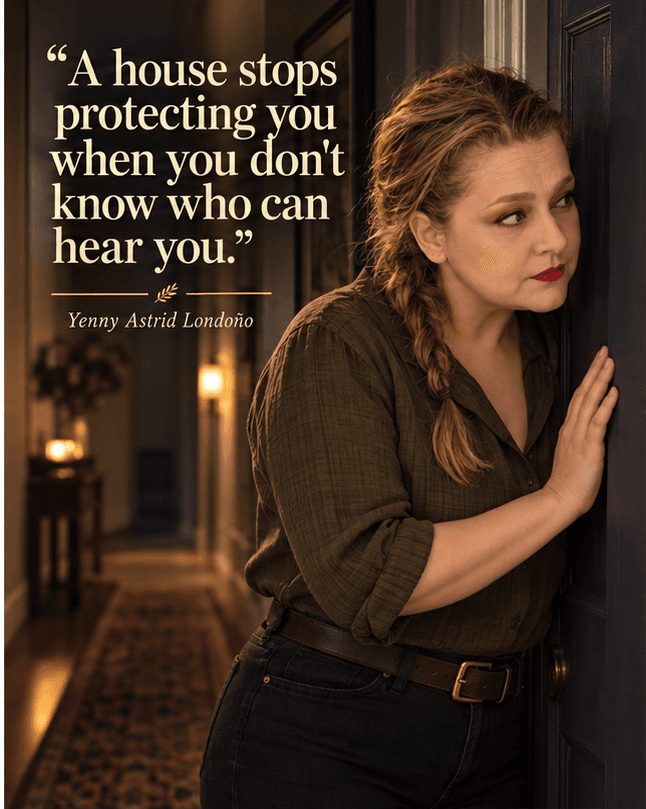
Cameras change the meaning of doubt
The discovery of hidden cameras and microphones establishes that Sara's life was being watched. We can no longer treat all of her uncertainty as if it were merely a failure of perception.
I'm interested in that shift, because there is an enormous ease in calming yourself by diagnosing the person who is afraid. She's nervous, she remembers badly, she interprets too much. Done. The rest we can carry on without looking.
Doubt about memory deserves attention. But it isn't proof that there is no danger. If a person can't reconstruct every detail perfectly, that doesn't automatically make someone who offers her a different version trustworthy.
Surveillance also violates something that goes beyond physical space. At home we can speak before we have an idea well organized, cry without an explanation, say something stupid that wasn't meant for an audience. When someone listens from outside, that private margin becomes information available to another person.
There doesn't need to be an intruder in the living room for them to have come in. A camera crosses a threshold too, even if it leaves all the furniture where it was.
Slowness can accumulate fear or turn into waiting
Psychological suspense depends a lot on how much we care about living a question alongside the protagonist. If we only want to know who did what, the domestic routines can feel long. If we understand why a routine has lost its safety, those same routines produce unease.
That's the criterion I use to look at The Psychologist. I don't demand that every scene end with a new threat, but I do want the attention given to Sara to make the problem sharper.
There's a difference between letting uncertainty accumulate and repeating it without transformation. I'm interested when the book lets us see how an interpretation changes, which detail gains value, and why the protagonist returns to something she thought was already settled.
So I wouldn't sell this proposal as a permanent rush of adrenaline. Its strength lies in the discomfort of accompanying a mind working with contradictory information, and in the gradual loss of the domestic refuge.
Whoever seeks speed above everything may grow impatient. Whoever enjoys reading how a person tries to understand her own life has a more concrete reason to step in.

What I didn't like about The Therapist
A slow thriller is one thing.
Spending fifty pages asking the same question is another.
Sara suspects.
I suspect.
She suspects again.
I keep suspecting.
Can we move on, please?
I don't need a corpse every ten pages.
But I do need to feel that the book moves.
If we're going around the same thought, that isn't psychological tension.
That's walking in circles.
Sara's knowledge shouldn't absolve her of being human
The Psychologist gives me plenty to talk about, because the protagonist's profession creates expectations that the story later has to revise. Sara doesn't need to show superhuman clarity for her fear to matter. Nor does she have to remember every minute flawlessly to deserve for someone to look into it.
Here I keep the identity of the culprit and the criminal resolution to myself. What I do point out is the surveillance, because it changes decisively how we read the uncertainty. The question can no longer be reduced comfortably to whether Sara is simply misunderstanding things.
The book invites us to look at the marriage, the house and memory as places where one version can impose itself before the proof arrives. My interest lies in what that imposition demands from the person who still has to live there.
Sara knows how to listen to a frightened person.
Frequently asked questions
Is it a fast-paced thriller?
No. It's slow, and the review says so. Some scenes repeat the same doubt without moving the story forward.
Does it reveal who is responsible?
No. It includes the disappearance and the surveillance, but keeps the resolution of the crime.
What kind of tension does it propose?
A domestic and psychological tension tied to memory, routines and uncertainty about the space Sara lives in.
What is The Psychologist about?
Sara understands memory, fear and behavior. Her own home reminds her that knowing about something doesn't keep you outside it.
What didn't I like about it?
That slowness doesn't always accumulate fear; sometimes it stays in waiting, repeating the uncertainty without transforming it. It isn't a permanent rush of adrenaline.
The Book
The Therapist
by Helene Flood
Get the bookIf you buy through this link, Yenny earns a small commission and you pay the same price.
Keep reading
If you liked it, keep going

Javier Castillo
The Snow Girl
The Snow Girl: Kiera disappears and everyone moves on except her parents
Javier Castillo's The Snow Girl: Kiera vanishes at a New York parade and a tape reopens the case five years later. My honest review, 4 out of 5.
October 22, 2026

John Katzenbach
The Analyst
The Analyst: a birthday threat, fifteen days and a therapist who has lost control
John Katzenbach's The Analyst: a psychoanalyst gets fifteen days to find out who is threatening him. My honest review of this thriller.
October 22, 2026

Juan Gómez-Jurado
The Patient
The Patient: the President on the operating table and a daughter nobody can trade
Juan Gómez-Jurado's The Patient: a neurosurgeon, a President on the table and a kidnapped daughter in sixty-three hours. My honest review.
October 22, 2026
Want more like this? Join the Readers Club and get one of my books for free.
Share
My books
Books by Yenny Astrid Londoño



About the author
Yenny Astrid Londoño
Yenny Astrid Londoño is a Colombian author and entrepreneur, founder of Anchetas Medellín. She writes about real life with sarcasm, irony and smart humor, turning everyday situations, mistakes and imperfect relationships into stories that readers can laugh at and recognize themselves in.

A free book from me
Get a free book from me
Subscribe and get Sobreviviendo a mis muertos in full as a PDF.
After that, I'll only write when I have something worth telling you.
Also available: Read this review in Spanish →